.png)
About Portugal
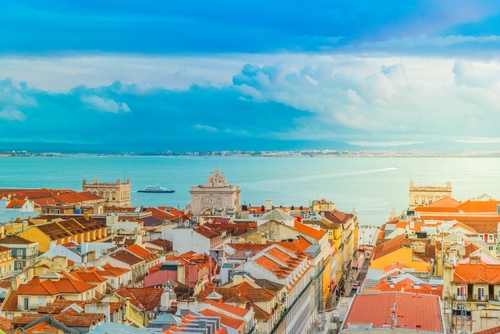
Portugal has the particular confidence of a country that was once much larger and has made peace with no longer being so. The Atlantic does most of the talking here. It sets the weather, it built the empire, and it still governs the pace of an afternoon in any town west of the Tagus. There is a word, saudade, that gets translated as longing and is really something more specific: an affection for something absent, held without bitterness. It is a useful thing to understand before you arrive, because it explains a great deal about how people here treat the past.
For remote workers the appeal was never a secret, and by now it is thoroughly not a secret. Lisbon and Porto have Europe's densest concentration of coworking desks outside Berlin, the fibre is excellent, English is widely spoken in the cities, and flights reach most of Europe in under three hours. What has changed is the arithmetic. A decade of arrivals has pushed Lisbon rents to levels that make the old cost-of-living argument harder to make with a straight face, and the political conversation about housing has sharpened accordingly.
That does not mean the case has collapsed, only that it has moved. Porto costs meaningfully less than Lisbon for a city with the same infrastructure. Braga and Coimbra cost less again. The Algarve empties out in October and becomes a genuinely cheap place to spend a winter. Portugal remains one of the few countries in Europe offering a clear, well-trodden, five-year path from remote-work visa to permanent residence, and the D8 has now processed enough applicants that the route is documented rather than theoretical. You are no longer an early arrival. You are joining something.
Widening the search? If you are looking to expand your job hunt across Southern Europe, take a look at Spain →, Italy →, and Greece →.
Cost of living
Portugal is no longer cheap by Western European standards, though it remains cheaper than France, Germany, or the Netherlands. The spread between cities is now the story, and it is wide enough that choosing Porto over Lisbon changes your monthly budget more than almost any other decision you will make.
Two things catch people out. Housing is the entire argument, and short-term listings aimed at foreigners run well above what locals pay for the same building, so a long lease negotiated in Portuguese is worth the effort. And winter heating is a genuine expense in older housing stock, which is frequently uninsulated and damp in a way the mild temperature readings never suggest.
- Furnished one-bedroom, central Lisbon: EUR 1,100 to EUR 1,600, with Porto roughly a quarter less and Braga or Coimbra closer to half.
- Coworking desk: EUR 120 to EUR 200 a month in Lisbon, less outside it.
- Lunch at a neighbourhood restaurant: EUR 9 to EUR 14 for the prato do dia, usually including soup and coffee.
- Espresso standing at the counter: around EUR 0.80, and it is called a bica in Lisbon.
Cost-of-living calculator
See how your budget stretches in Portugal.
Estimates use approximate exchange rates and typical monthly costs. Your actual costs will vary.
Visas & Entry
Portugal is a full Schengen member, so entry for most Western passports means 90 days within any 180-day period, and those days are shared across all 29 Schengen countries rather than counted separately. The EU Entry/Exit System is now operating, which means biometric registration at the border and slower crossings.
Anything longer than 90 days requires a national visa applied for from outside Portugal through a consulate or VFS centre. You cannot switch from tourist status once you are in the country.
- D8 income floor, 2026: EUR 3,680 per month, which is four times the EUR 920 minimum wage, plus EUR 11,040 in savings.
- Bringing family: add 50% for a spouse or partner (EUR 1,840) and 30% per dependent child (EUR 1,104).
- Timing: AIMA assesses against the minimum wage in force at your appointment, not your filing date, and the wage is expected to rise again in January.
| Visa or permit | What it covers |
|---|---|
| Schengen short stay | Ninety days within any 180-day period for US, UK, Canadian, Australian and most Western passports. Shared across all 29 Schengen states, not per country. |
| D8, Temporary Stay Visa | The lighter D8 route. Up to 12 months of remote work without converting to a residence permit. Suits a trial year; it does not build toward permanent residence. |
| D8, Residence Visa | The main route. Entry visa converts to a two-year residence permit, renewable for three-year periods, counting toward permanent residence. Income must come from outside Portugal. |
| D7, Passive Income Visa | For retirees and anyone living on pensions, dividends, royalties, or rent. Lower bar at one times the minimum wage, EUR 920 per month in 2026, but the income must be genuinely passive. |
| D2, Entrepreneur Visa | For founding or investing in a Portuguese business. Requires a viable business plan rather than a fixed investment figure. |
| Golden Visa | Residence by investment. Real estate was removed as a qualifying route in 2023, leaving funds, research, and cultural contributions. |
| Family reunification | Spouses, partners, dependent children and dependent parents can be included on the D8 residence route, each receiving a permit matching the main applicant's. |
| Permanent residence | Available after five years of continuous legal residence. Citizenship rules were amended in 2026, so confirm the current qualifying period rather than relying on the old five-year figure. |
Thresholds verified 20 August 2026 against the 2026 minimum wage of EUR 920. Figures move every January. Confirm before filing.
Work & Legal
Portuguese working culture is more formal than the cafe tables suggest. Meetings start with courtesy rather than agenda, titles matter in a way they do not in Amsterdam or Berlin, and August is functionally a write-off nationwide. Decisions travel up hierarchies and take longer than newcomers expect. The compensating advantage is that the country has absorbed a decade of remote workers and the paperwork around them is well understood.
- Foreign employers and foreign clients: lawful and precisely what the D8 was built for. No local entity required.
- Portuguese clients: restricted. The D8 requires income sourced outside Portugal, and taking local clients as a primary income source breaches its terms.
- Freelancing locally: means registering as trabalhador independente with Financas, obtaining a NIF, and invoicing through the official system.
- Before anything else: you will need a NIF (tax number), a NISS (social security number), and a Portuguese bank account. Start these early; they gate everything downstream.
Good to know: D8 visa processing typically runs 2-4 months; apply before arriving if planning an extended stay.
Taxes
The single most out-of-date belief about Portugal is that new arrivals get a flat 20% rate. That regime is closed, and what replaced it is far narrower than its nickname suggests.
| What applies | The rule in 2026 |
|---|---|
| Tax residency | Triggered by 183 days in a 12-month period, or by maintaining a habitual residence in Portugal. Residents are taxed on worldwide income. |
| NHR (the old regime) | Closed. No new applicants since 1 January 2024, and the transitional window shut on 31 March 2025. If you did not register before those dates you cannot obtain it, whatever older guides say. |
| IFICI, or NHR 2.0 | The replacement, and much tighter. A 20% flat rate aimed at scientific research, innovation, certified startups, and specified highly qualified roles at eligible Portuguese entities. A remote worker employed by a foreign company generally does not qualify. |
| Standard income tax (IRS) | What most D8 holders actually pay: progressive rates from 13.25% up to 48%, with an additional solidarity surcharge on high incomes. |
| Self-employed social security | 21.4%, charged on a coefficient of gross billings rather than the full amount. Newly registered freelancers are exempt for their first 12 months. |
| VAT (IVA) | 23% standard on the mainland, with reduced 6% and 13% bands. Madeira and the Azores apply lower rates. Services billed to clients outside Portugal are generally outside scope. |
| Treaty position | Portugal has an extensive treaty network including a double-taxation treaty with the United States, so Americans have relief routes that are unavailable in some other popular bases. |
| Annual filing | The IRS return is filed between April and June for the preceding calendar year. |
Verified 20 August 2026. IFICI eligibility is decided case by case and is the single most common point of confusion; take Portuguese tax advice before assuming you qualify. General information, not tax advice.
Healthcare
Portugal's public system, the Servico Nacional de Saude, is genuinely good and covers legal residents who register at a local health centre, which D8 residence permit holders can do. EU citizens are covered by the EHIC. The trade-off is waiting times for non-urgent specialist care, which is why most foreign residents carry private insurance alongside the SNS rather than instead of it.
Standards are high in Lisbon and Porto and thinner in the interior and on the smaller islands, where serious cases are transferred to the mainland.
- Private insurance: roughly EUR 20 to EUR 100 a month depending on age and coverage.
- Private specialist consultation: typically EUR 50 to EUR 90 without insurance.
- Visa requirement: private health cover is required for the initial D8 application, before SNS registration is possible.
- Emergency number: 112, the Europe-wide line.
| Hospital | What to know |
|---|---|
| Hospital CUF Descobertas, Lisbon | Flagship of the CUF private network and a common first stop for foreign residents in Lisbon. Broad specialist coverage and reliably English-speaking staff. |
| Hospital da Luz, Lisbon | One of the largest private hospitals in Portugal, with strong cardiology, oncology, and surgical departments. |
| Hospital CUF Porto | The CUF network's main northern facility, and the private equivalent of what CUF Descobertas offers in Lisbon. |
| Centro Hospitalar Universitario de Sao Joao, Porto | The major public teaching hospital for northern Portugal and the regional referral centre for complex cases. |
| Hospital de Santa Maria, Lisbon | Among Portugal's largest public hospitals and a national referral point for highly specialised procedures. |
| Hospital Lusiadas Lisboa | Private hospital with an established international patient service, commonly used by the expatriate community. |
Hospital list compiled 20 August 2026 and not yet confirmed against each facility directly. Treat as indicative and verify before relying on it.
Safety
Portugal is one of the safest countries in Europe and ranks near the top of the Global Peace Index most years. Violent crime against visitors is rare enough to be a non-issue for planning purposes. What you will meet is ordinary and mostly petty.
- Pickpocketing: the main risk, concentrated on Lisbon's tram 28, the Baixa and Alfama districts, Porto's Ribeira, and airport and station platforms.
- Street drug touts: persistent in central Lisbon and selling nothing real. Decline and keep walking.
- Atlantic surf: genuinely dangerous. Rip currents kill swimmers every year, so pay attention to beach flags rather than to how calm it looks.
- Wildfires: a real seasonal hazard inland and in the centre and north from June to September.
- Flooding: urban flooding in Lisbon and Porto during heavy winter rainfall, with notable events in 2025 and 2026.
Official travel advisories
| Government | Current position |
|---|---|
| United States | Level 1, Exercise Normal Precautions, the lowest tier. Issued 23 December 2025, flagging petty theft in crowded tourist areas and on public transport.travel.state.gov → |
| United Kingdom | No advisory against travel. Guidance focuses on Schengen 90-day limits and entry requirements for longer stays.gov.uk → |
| Australia | Exercise a high degree of caution, which is one tier above their lowest rating despite Portugal's strong safety record.smartraveller.gov.au → |
| Canada | Advises the same precautions Canadians would take at home, with petty crime the main flagged concern.travel.gc.ca → |
| US Embassy Lisbon | Register with STEP for alerts. Entering Portugal overland from another EU state without passing immigration requires declaring your entry to the PSP or GNR within three working days.pt.usembassy.gov → |
Advisory wording verified 20 August 2026. Australia's rating is higher than most people expect, and worth reading rather than assuming.
Good to know: Standard European pickpocket awareness in tourist areas is sufficient; the country has no significant violent crime problem.
Climate
Portugal is Atlantic rather than Mediterranean, and the difference matters. The ocean moderates everything on the coast, keeping summers cooler than Spain's interior and winters mild but wet. Lisbon averages more than 2,800 hours of sunshine a year. The north around Porto and Braga is greener and considerably rainier, the Alentejo interior bakes in summer, and the Algarve is the driest and warmest region. Winter is where expectations go wrong: temperatures are mild but housing is frequently uninsulated, so indoors can be colder and damper than the forecast implies.
| Season | What to expect |
|---|---|
| Spring, March to May | The best season. Highs climbing from 17C to 24C, rain easing through April, hillsides green before the summer burns them off. Prices sit below summer rates and the cities are workable. |
| Summer, June to August | Hot, dry, and busy. Lisbon and the Algarve reach 28C to 35C, the Alentejo interior considerably more. Coastal breezes keep it bearable. Peak prices, peak crowds, and wildfire season inland. |
| Autumn, September to November | The other good season. September holds summer warmth with the crowds gone, October settles around 22C, and the rain returns in November. The Atlantic stays swimmable well into October. |
| Winter, December to February | Mild at 8C to 16C on the coast, wettest in the north. Rarely freezing, but damp. The Algarve becomes a cheap and genuinely pleasant place to spend the season. |
Good to know: Porto is noticeably wetter and greyer than Lisbon year-round; factor this into city choice for longer stays.
Culture & Customs
Portuguese social life is warmer than its formality first suggests. Greetings matter, courtesy titles are used more than in most of Europe, and the shift from voce to first names is a small event rather than an automatic one. Meals are unhurried and the table is the point; lingering after the plates are cleared is expected rather than rude. Portuguese people are quieter than their Spanish neighbours and notice when visitors are not, and the comparison to Spain is itself worth avoiding, since a great deal of national identity rests on not being confused with anyone else.
The country is Catholic by heritage and relaxed in practice, with some of Europe's more progressive social legislation sitting comfortably alongside long-standing tradition.
- Learn a few words of Portuguese. English will carry you through the cities, but the effort registers, and European Portuguese sounds nothing like the Brazilian variety most learning apps teach.
- Understand that the couvert is not free. The bread and olives brought unasked to your table are charged for. Waving them away is normal and no one minds.
- Tip lightly. Rounding up or adding 5 to 10% is plenty; American-scale tipping is not expected.
- Do not order a coffee to go and expect enthusiasm. Coffee is drunk standing at the counter, quickly, and often several times a day.
- Be careful about the housing conversation. Foreign arrivals are widely seen as a driver of the rent crisis, and it is a live political issue rather than an abstract one.
- Note that Fado is not background music. In a proper Fado house you stay quiet while someone is singing.