.png)
About Lisbon
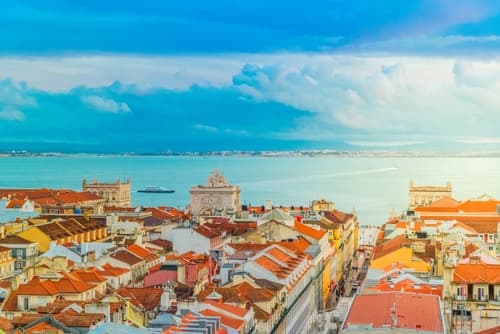
Lisbon sits on seven hills above the Tagus and has spent the past decade becoming one of the most discussed cities in Europe, which is both accurate and slightly unfortunate. The discussion attracted exactly the interest it was meant to attract, and costs have followed accordingly. The city that was a reliable budget base for remote workers in 2018 has shifted; Lisbon in 2026 is still cheaper than most Western European capitals, but it no longer undercharges for what it offers.
What it offers: one of the most architecturally compelling historic centers in Europe, tram lines that climb gradients other cities would tunnel beneath, the Tagus riverfront as a daily backdrop, and a food culture that runs from the absurdly cheap tosta mista at any neighborhood café to serious contemporary Portuguese restaurants. The Mouraria, Arroios, and Campo de Ourique neighborhoods outside the tourist core give the city its real texture.
For digital nomads and remote workers, a furnished one-bedroom apartment runs €1,100 to €1,700 a month depending on neighborhood and proximity to the river. Coworking is well-developed: Second Home in Mercado da Ribeira, Selina CoWork in Cais do Sodré, and a dense cluster of independent spaces in Príncipe Real and Santos serve the large international remote-worker community. Connectivity is generally excellent, though older building stock can still be inconsistent.
The Portuguese NHR tax regime changed in 2024, affecting the long-stay financial calculation for non-EU nationals significantly. Research the current rules before committing to a longer arrangement. Best months run March through May and October through November.
Cost of living
Cost-of-living calculator
See how your budget stretches in Lisbon.
Estimates use approximate exchange rates and typical monthly costs. Your actual costs will vary.
- Coffee
- $2
- Cheap meal
- $10
- Coworking (day)
- $20
- Mid-range meal for 2
- $45
- Rent (1BR, center)
- $1,500
- Transit (monthly)
- $42
- Internet (monthly)
- $28
- Rent (1BR, outside)
- $1,100
EnRoute Jobs AI tool
Real Value Calculator
See what a salary actually leaves you in the country you want to live in.
Neighborhoods
Mouraria / Intendente
Creatives, authentic Lisbon, lower costs
The oldest continuously inhabited neighborhood in Lisbon and the most genuinely multicultural: fado's actual neighborhood of origin, excellent cheaply priced lunch restaurants, and a community of international residents who have found it before the tourist infrastructure caught up. Changing rapidly.
Arroios
Remote workers, longer stays
The most functional neighborhood for the international professional community right now: the Almirante Reis corridor, the Intendente square area, good supermarket access at the Mercado de Arroios, and costs still below the riverfront districts. Well-connected by Metro and bus.
Campo de Ourique
Families, established residents, market culture
The bourgeois residential neighborhood west of the center: the Mercado de Campo de Ourique as its social center, excellent café infrastructure, and a settled community that makes it one of Lisbon's most genuinely livable neighborhoods. The tram and bus connections are good.
Alcântara / LX Factory
Creative industries, younger professionals
The western riverfront with the LX Factory market complex (Sunday market is best) and a growing concentration of studios, agencies, and creative companies in the renovated industrial buildings. Good cycle path along the Tagus connects it east to Santos and Cais do Sodré.
Culture
Lisbon is the city that reinvented itself from a sleepy Atlantic capital into one of Europe's most talked-about destinations: a place of extraordinary light, seven hills, fado music rising from the Alfama at night, and a golden Age of Discoveries heritage visible in every Manueline archway. Lisboetas are warm, melancholic (the famous 'saudade', a yearning nostalgia, is a genuine cultural mood), and increasingly ambivalent about the city's transformation by tourism and tech-driven gentrification that has pushed long-term residents to the periphery.
Climate & best time to visit
Mediterranean-Atlantic: warm, sunny summers (25–32°C) softened by Nortada winds from the Atlantic, and mild, damp winters (10–15°C). October–November brings autumn rain; March–May is fresh and pleasant. The best overall working weather is April–June and September–October.
Best months: April, May, June, September, October
Tips & safety
- •The Lisbon Viva Viagem card (loaded with monthly passes or credit) covers Metro, bus, tram, funiculars, and Carris; buy at any Metro station
- •Tram 28 is useful for understanding the geography of the historic center but runs at tourist density year-round; the 758 bus covers the same hills faster
- •The Lisbon library card (Rede de Bibliotecas de Lisboa) is free for residents and provides access to quiet study rooms throughout the city
- •The Mercado de Campo de Ourique (Tuesday-Sunday) is the best everyday food market in the city for actual grocery shopping
- •Monthly apartment costs in Arroios or Mouraria now run €1,100-1,600 furnished; the era of Lisbon as a budget European base is effectively over
- •The Lisbon Card provides 24/48/72-hour unlimited transport plus free museum entry; useful for an orientation week
- •The NHR tax regime change in 2024 significantly altered the financial calculation for non-EU nationals; the current framework requires specific research before committing to a longer stay
- •Emergency: 112; GNR (national guard) and PSP (metropolitan police) both operate English at command level
- •Lisbon has seen a gradual increase in petty theft in tourist areas; the Alfama, Baixa-Chiado, and tram 28 route are the primary areas
- •Pickpocketing in crowded trams (particularly tram 28) is well-documented; consider the bus alternatives for the same journey
- •Tap water is safe and drinkable throughout Lisbon
Areas to avoid: The Martim Moniz area at certain hours; not dangerous but the density of unlicensed hawkers and the chaotic infrastructure make it one of the less pleasant pedestrian environments in the center, The Bairro Alto after 2am if you want to avoid concentrated noise and street-level confrontation; the nightlife area runs late and loudly