.png)
Digital Nomad
How Digital Nomads Are Using AI and No-Code Tools to Build Micro-Businesses in 2025
AI and no-code tools have lowered the barrier to building a business to nearly zero. Here is how digital nomads in 2025 are using them to generate real income while traveling.
· October 2, 2025 · 13 min read
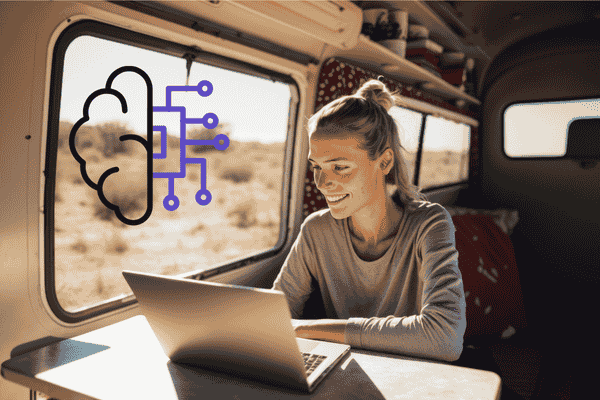
For years, the dream of working from a beachside café or a mountaintop cabin was reserved for the lucky few who managed to negotiate remote jobs. But in 2025, something new is stirring. Digital nomads are quietly breaking away from traditional jobs, turning instead to micro-businesses that travel with them.
It isn't just wanderlust that fuels this shift. It's a deeper restlessness. Return-to-office mandates have clipped the wings of countless remote workers, while artificial intelligence (AI) has reshaped industries with a force that feels both thrilling and unnerving.
However, nomads are finding freedom again. This time, it's not in jobs, but in businesses they build with their own hands, supported by AI and no-code platforms that make creation astonishingly simple.
Why are digital nomads leaving traditional jobs for micro-businesses?
The pandemic gave millions a taste of working from anywhere. But recently, many employers began calling workers back to the cubicle. For nomads, this return feels like a regression; a chain yanked taut just as they were learning to soar.
At the same time, AI is transforming employment itself. What once felt like stable career paths — marketing, data entry, even parts of programming — are being reshaped by automation. Job security has become a fragile thing. When stability falters, independence begins to look less like a gamble and more like a lifeline.
If traditional employers can't promise freedom or security, why not build something of your own? That's where micro-businesses come in.
The power of human skills in an AI era
AI may be powerful and convenient for building micro-businesses, but it lacks the human spark. Empathy, creativity, moral judgment — these are the qualities no machine can truly replicate. In fact, their value has only grown.
New roles are springing up in the shadow of AI. For example, prompt engineers can coax magic from a few well-chosen words, while ethicists ensure technology aligns with human values. These jobs are proof that people still have an edge.
Digital nomads are leaning into this. They're blending human artistry with machine efficiency to create businesses that feel personal and alive, even when much of the heavy lifting is automated.
The no-code and AI toolkit every solopreneur needs
What once required a team of developers, designers, and marketers can now be done by one determined nomad with a laptop and Wi-Fi. Here are the tools that help power micro-businesses.
No-code platforms
No-code platforms such as Carrd, Glide, and Zapier have changed the game for entrepreneurs who don't have traditional coding skills. Instead of hiring developers or waiting months for custom builds, you can now create polished landing pages, mobile apps, and automated workflows in a matter of hours.
Carrd is ideal for lightweight websites and portfolios, Glide helps turn spreadsheets into fully functioning apps, and Zapier connects hundreds of tools together so repetitive tasks run on autopilot. These platforms empower solopreneurs to move quickly, test ideas, and iterate without heavy upfront costs.
Payment tools
When it comes to selling across borders, Stripe and Gumroad remove many of the barriers that used to slow down small businesses. Stripe makes it seamless to accept credit cards and digital wallets in multiple currencies, while Gumroad lets creators sell digital products — from e-books to courses — without worrying about infrastructure. Both services handle taxes, security, and compliance in the background.
AI assistants
Modern AI assistants such as ChatGPT, Claude, and Midjourney bring an extra layer of power to solo ventures. They can draft blog posts, brainstorm marketing campaigns, generate images, summarize research, or even help refine product ideas in minutes.
ChatGPT is strong at content and ideation, Claude excels at reading and analyzing long documents, and Midjourney produces professional-grade visuals from simple text prompts. Together, they function like an always-available creative team that helps you move from concept to execution at a pace that would have been impossible only a few years ago.
EnRoute Jobs AI tool
Income Stacker
Design income-stream combinations to hit your target income.
What business models are thriving in 2025?
Nomads aren't just tinkering; they're building. Some are creating micro-SaaS tools that solve tiny but meaningful problems, such as budgeting apps for travelers or workflow automations for freelancers.
Others are building digital content empires, such as online courses, newsletters, and coaching programs powered by AI-driven research and design. Plus, many are blending freelance work with products and using AI to cut down on client hours while building scalable side ventures.
There are also the AI-assisted consultants, who use tools not to replace their expertise but to amplify it, delivering insights at speeds that astonish their clients. These businesses may be small, but they are nimble. For a nomad, nimble means freedom.
How to build your own micro-business
Starting a business that travels with you doesn't have to feel overwhelming. It can be broken down into a simple, repeatable process — one that focuses on momentum and ownership rather than chasing perfection.
Find a niche or pain point
The first step is to look closely at your surroundings and ask: What problems do people around me need solved? For nomads, this might mean noticing how hard it is to find reliable Wi-Fi in certain destinations, or how complicated it can be to manage travel visas. Wherever you are, there's a pain point waiting for a creative solution — and often it's something you've experienced yourself. Those are the best opportunities, because you understand the problem on a personal level.
Prototype fast with no-code
Once you have an idea, resist the urge to overbuild. A landing page, a lightweight app, or even a simple digital product can be enough to test the waters. No-code tools like Carrd, Glide, and Zapier make it possible to create something functional in a weekend rather than spending months in development. The goal isn't to launch the final version right away; it's to put your idea in front of real people and see how they respond.
Use AI for leverage
AI is the modern nomad's secret weapon. Instead of spending hours drafting copy or fumbling with design software, you can lean on AI to do the heavy lifting. Tools such as ChatGPT can generate marketing emails, Claude can summarize complex research, and Midjourney can create eye-catching visuals. Think of AI as your 24/7 creative partner — it frees up your time so you can focus on strategy and relationships, the things only you can do.
Set up payments and distribution
No matter how brilliant your idea, you'll need a way to get paid. Services such as Stripe, PayPal, and Gumroad take the headache out of selling across borders. They handle the technical side of global payments and leave you free to build, market, and grow. Having smooth systems in place for payment and delivery makes your business feel professional from day one.
Test, tweak, repeat
The beauty of this approach is that it's cyclical. You launch, you learn, you adjust. Instead of chasing perfection, you're chasing momentum. Each version gets a little better, a little closer to what your customers truly need. You may not strike gold overnight, but you will gain something even more valuable: ownership of your work, control over your time, and the ability to carry your business wherever the road takes you.
Challenges on the path
It would be dishonest to pretend the road is free of bumps. Overreliance on AI can strip your work of authenticity. Platforms can change policies overnight, leaving creators stranded. Balancing the demands of travel and business can wear down even the most resilient nomad.
You should also be aware of practical concerns such as tax laws, visas, and banking. These still require human patience and persistence. But these challenges are not barriers. They are part of the adventure.
Why freedom (not offices) will define the next chapter of work
The future of work isn't written in office memos or corporate handbooks. It's written in the quiet determination of people who refuse to give up their freedom. For digital nomads in 2025, AI and no-code tools aren't threats — they are wings. They make it possible to travel lighter, build faster, and earn on their own terms.
These micro-businesses may be small in size, but they carry a sense that work and life can finally move in rhythm, like the tide against a distant shore.
Start Shaping Your Own Path Today
Whether you're ready to build your first micro-business or still looking for remote employment that fits the life you want, EnRoute Jobs connects you with opportunities that let you work from anywhere you choose.