.png)
About Marshall Islands
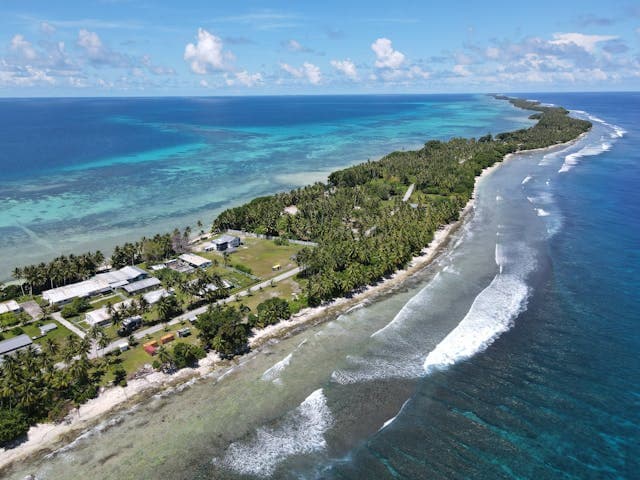
The Marshall Islands are 29 coral atolls and five islands scattered across two million square kilometers of the central Pacific, the largest ocean state with nearly the smallest land, a country whose total ground would fit inside Washington DC, whose highest natural point is about ten meters, and whose civilization solved deep-ocean navigation with wave-reading stick charts centuries before instruments caught up. Majuro, the capital atoll, is a ribbon of land often a few hundred meters wide wrapped around a lagoon; Kwajalein hosts a US Army garrison behind its own entry authorization; and the nation of roughly forty thousand runs on the US dollar, English alongside Marshallese, and a relationship with the United States unlike any other in this index.
That relationship is the paperwork story. Under the Compact of Free Association, renewed in its funding terms in 2023, citizens of the United States need no visa and may enter, reside, work and study in the Marshall Islands indefinitely, a right the islands extend in both directions, Marshallese citizens living and working in the US without visas under the same Compact, and one shared only with Palau and the Federated States of Micronesia; for an American remote worker the RMI is, on paper, one of the easiest long-stay addresses on the planet, and the page says so while immediately adding the practical half. Europeans and Britons enter visa-free for 90 days in any 180 under the 2016 Schengen-reciprocal waiver; a diplomatic-relations list including Australia, New Zealand, Canada, Japan, Korea, Taiwan and the Pacific Islands Forum receives visas on arrival, commonly stamped at 30 days with extensions available from the Immigration Division in Majuro, official sources disagreeing on durations and fees enough that the desk's practice governs; the entry file's quirk is a required measles vaccination certificate for most visitors, with police and health clearances requestable; and foreign-client remote work during any lawful stay sits in a tolerance so complete it has never needed a name, the domestic labor market being government, agencies, fisheries and the shipping registry that flies the world's third-largest merchant flag.
The practical half is the honest half. Healthcare is basic, Majuro Hospital handling the everyday and Honolulu handling everything serious across four hours of ocean, which makes evacuation insurance the actual health plan; connectivity runs on a single submarine cable whose famous outages taught the nation resilience and on the satellite options that have since changed the story, with the backup plan as standard kit; king tides flood parts of Majuro in the November-to-February season as the sea-level-rise frontline reality it is, the nation's climate fight being existential and eloquent; and the history deserves the gravity the islands give it, 67 US nuclear tests at Bikini and Enewetak between 1946 and 1958, Castle Bravo's fallout, the Runit Dome, and a Nuclear Victims Remembrance Day each March 1 that visitors should know before they come. The Marshall Islands are not a destination the nomad economy will ever list; they are a place a prepared professional can legally stay longer than almost anywhere, in a nation whose navigation tradition, matrilineal land tenure and oceanic patience make the stay something closer to a privilege.
Widening the search? If you are looking to expand your job hunt across Oceania, take a look at Philippines →, Japan →, and Australia →.
Cost of living
Majuro prices as a dollar-economy import island at the end of long supply lines: apartments and self-contained units run 800 to 1,500 US dollars monthly in the limited formal rental market, much of it moving by word of mouth and notice board rather than listings, guesthouses and the handful of hotels price nightly for the consultant-and-agency market, and the housing search itself is the first local skill. Utilities run island-expensive with power the dominant line, aircon a genuine budget decision, and water catchment-and-conservation conscious in the drought-prone north's shadow.
Daily life splits by supply chain: local staples, reef fish, tuna at the dock, breadfruit, pandanus and coconut, price generously, the plate-lunch tier feeds at 6 to 10 dollars, and everything imported, which is most things at Payless and the town stores, carries the freight it crossed the Pacific with, produce arriving by air pricing like the airfare. The practical lines: taxis run shared and cheap along Majuro's single road, the car is optional on an atoll thirty miles long, inter-atoll travel runs by irregular Air Marshall Islands flights and field-trip ships that are their own adventure, and the connectivity budget, primary data plus satellite backup, is the professional's real utility. The comfortable working month assembles at 2,000 to 2,600 dollars, the guesthouse-and-plate-lunch floor sits near 1,300, and the honest Marshallese additions are the Honolulu-priced flights in and out, the evacuation-insurance premium that is the health plan, and the church-and-community giving a respectful guest participates in genuinely.
- Housing moves by word of mouth: 800 to 1,500 dollars for the limited formal units, guesthouses pricing for the agency market, and the search itself as the first local skill.
- Eat by supply chain: dock tuna, reef fish, breadfruit and the 6-to-10-dollar plate lunch price generously; the imported aisle carries its Pacific freight, and air-freighted produce prices like the airfare.
- Budget the island utilities honestly: power dominates, aircon is a genuine decision, and the data-plus-satellite-backup connectivity line is the professional's real second rent.
- Carry the remoteness lines: Honolulu-priced flights, the evacuation premium that is the health plan, and the community giving that guest status genuinely includes.
Cost-of-living calculator
See how your budget stretches in Marshall Islands.
Estimates use approximate exchange rates and typical monthly costs. Your actual costs will vary.
Visas & Entry
The Marshall Islands runs the index's most unusual entry architecture, and the Compact of Free Association is its heart: citizens of the United States, Palau and the Federated States of Micronesia need no visa and may enter, live, work and study in the RMI for an unlimited period, the State Department confirming the no-visa position plainly, which makes the islands one of the only places on earth where an American passport carries indefinite live-and-work rights with no application at all; the Compact runs both ways, Marshallese citizens holding the mirror rights in the United States, and its funding terms were renewed for twenty years in 2023.
Everyone else meets a small system administered personally. European Union and United Kingdom citizens enter visa-free for 90 days in any 180 under the 2016 Schengen-reciprocal waiver. A diplomatic-relations list, Australia, New Zealand, Canada, Japan, South Korea, Taiwan, the Philippines and the Pacific Islands Forum among them, receives visas on arrival at Majuro, commonly stamped at 30 days with extensions of up to 60 more available from the Immigration Division for modest fees, though official sources disagree on durations and charges enough that the desk's current practice governs; other nationalities apply in advance through the embassy network with a 100-dollar visitor fee. The entry file carries quirks worth knowing: a measles (MMR) vaccination certificate is required of most visitors between six months and 62 years, police and health clearances can be requested, onward tickets and funds are checked, a 20-dollar departure fee applies at the airport, and travel to Kwajalein requires a separate Entry Authorization from the US Army garrison, with visits realistically meaning Ebeye. Work in the domestic market runs employer-sponsored permits for non-Compact nationals through a small ministry process; foreign-client remote work during any lawful stay sits in a complete, unnamed tolerance; and the long game barely exists for non-Compact nationals, while for Americans it requires nothing at all, which is the entire point.
- Americans, understand what you hold: no visa, no clock, indefinite live-and-work rights under the Compact; almost nowhere else on earth extends this to a US passport, and the only applications are the flight and the housing search.
- Everyone else, land with the physical file: passport validity, onward ticket, funds, the measles certificate most visitors never expect, and clearances producible on request; the desk is personal and order wins.
- Extend early and politely: the Immigration Division's process is discretionary and face-to-face, modest fees apply, and starting well before expiry is the entire strategy.
- Book the geometry first: the island-hopper through Honolulu or Guam is the lifeline, seats thin and price high near departure, and the flight budget belongs beside the housing line.
- Treat Kwajalein as the separate system it is: the garrison's Entry Authorization is a military process, Ebeye is the civilian reality, and the restriction has nothing to do with Marshallese hospitality.
- Keep the remote-work tolerance unremarkable: offshore-client laptop work during a lawful stay draws no interest, the domestic market is its own small permit world, and the distinction keeps everything simple.
| Visa or permit | What it covers |
|---|---|
| The Compact rights | US, Palauan and FSM citizens: no visa, unlimited stay, full live-work-study rights confirmed by the State Department's own guidance; the Compact runs both directions and its funding terms renewed in 2023 for twenty years. |
| EU and UK entry | Visa-free for 90 days in any 180 under the 2016 Schengen-reciprocal waiver, with the standard passport-validity, onward-ticket and funds checks at the desk. |
| Visa on arrival | The diplomatic-relations list, Australia, New Zealand, Canada, Japan, Korea, Taiwan, the Philippines and the Forum, receives arrival visas commonly stamped at 30 days; official sources disagree on durations and fees, and the Majuro desk's practice governs. |
| Extensions and advance visas | The Immigration Division in Majuro extends visitor stays for modest fees on a personal, discretionary process; unlisted nationalities apply in advance through the embassy network at a 100-dollar visitor fee. |
| The entry quirks | A measles vaccination certificate is required of most visitors, police and health clearances can be requested, the departure fee runs 20 dollars, and the paperwork file is physical in the old Pacific style. |
| Kwajalein and the garrison | The US Army garrison atoll requires its own Entry Authorization; civilian visits realistically mean Ebeye, and the restriction is military rather than Marshallese. |
| Work and the long game | Domestic employment runs employer-sponsored permits for non-Compact nationals through a small ministry process; for Americans the long game requires nothing at all, which is the architecture's entire point. |
Good to know: No DNV; THE COFA SUPERPOWER: US/Palau/FSM citizens = no visa, UNLIMITED stay, live-work-study indefinitely (State Dept confirms; mirror rights for Marshallese in US; funding renewed 2023, 20 yrs); visa_free_days set 365 as UI proxy for unlimited (report note); EU/UK = visa-free 90-in-180 (2016 Schengen-reciprocal waiver); VOA list (AU/NZ/CA/JP/KR/TW/PH/PIF) commonly 30 days + extensions (~+60, modest fees); OFFICIAL SOURCES CONFLICT on durations/fees, desk practice governs; others = advance visa $100; QUIRKS: MMR measles cert required (6mo-62yrs), police/health clearances requestable, $20 departure fee; Kwajalein = US Army Entry Authorization (Ebeye = civilian reality); domestic work = employer-sponsored permits; offshore-client tolerance complete and unnamed; USD official currency.
EnRoute Jobs AI tool
Route Planner
Map visa routes, timelines, and relocation costs for your next destination.
Work & Legal
Marshallese professional life runs at oceanic pace inside a small-capital ecosystem: government, the US embassy and agency world, regional organizations, the fisheries sector around the world's busiest tuna transshipment lagoon, the shipping registry's legal tier, and the churches and schools that anchor community life, with English carrying business and Marshallese carrying everything that matters. Relationships are the entire economy of trust, introductions open what applications cannot, respect for elders and the iroij traditional leadership runs through modern institutions, and the matrilineal land tenure underneath means land is never simply bought but negotiated through lineage in ways no outsider should assume.
The legal lines are simple: offshore-client work during a lawful stay is nobody's concern; domestic employment for non-Compact nationals runs employer-sponsored permits; Americans under the Compact work as freely as at home, with the tiny formal labor market being the actual constraint; and local business formation is a small-ministry, know-everyone process. The operational texture is the honest half: connectivity runs on the cable with satellite backup as standard professional kit since the famous outages, power argues for surge protection and patience, the working week honors church and family absolutely, Sundays quiet the atoll, and the time zone at UTC+12 is among the world's earliest, holding Asia-Pacific comfortably, catching US afternoons across the date line, and asking Europe for pure asynchrony. The professional who works the trade-wind mornings, keeps the Sunday quiet, learns yokwe and kommol tata, and lets the atoll's pace recalibrate the calendar has found the arrangement the islands actually offer.
- Run the connectivity stack as the real office: cable primary, satellite backup, offline discipline for the outage days, and the surge protector as standard kit; the famous 2017 lesson built the habit.
- Keep the work registers clean: offshore clients are nobody's concern, the domestic market runs permits for non-Compact nationals, and Americans work as freely as the Compact intends.
- Respect the tenure and the titles: matrilineal land moves through lineage, the iroij leadership threads modern institutions, and the introduction outranks the application everywhere.
- Work the earliest time zone deliberately: UTC+12 holds Asia-Pacific in-hours, catches the US across the date line, and gives Europe-facing work the pure-async structure it needs.
Good to know: Offshore-client work = complete unnamed tolerance; domestic = employer-sponsored permits (non-Compact); Americans work freely under COFA (tiny formal market = the real constraint); matrilineal land via lineage (never assume purchase); iroij leadership threads institutions; connectivity = cable + satellite backup standard (2017 outage lesson); Sundays quiet the atoll; UTC+12 earliest tier.
Taxes
Marshallese tax is among the lightest and simplest anywhere: a two-rate wages tax topping at 12 percent on local employment, a gross-revenue tax on local business, no tax at all on the visitor's foreign income, the US dollar as the currency, and no comprehensive treaty network to speak of.
| What applies | The rule in 2026 |
|---|---|
| The visitor's position | Foreign-source income is outside the Marshallese net entirely: the offshore-client professional owes nothing locally regardless of stay length, and the system has no instrument aimed at them at all. |
| The wages tax | Local employment income is taxed at 8 percent on roughly the first 10,400 dollars and 12 percent above, employer-withheld, the entire personal system fitting in a sentence. |
| Business and the gross-revenue tax | Local enterprise pays a gross-revenue tax at low single digits with small-business thresholds, plus local government license fees; the arithmetic is simple and the registrar personal. |
| The missing taxes | No general income tax on worldwide earnings, no capital gains tax, no VAT, no estate tax: the daily fiscal texture is import duties priced into the shelf and little else. |
| The shipping registry | The RMI flag flies one of the world's largest merchant fleets through the corporate registry, a specialist offshore file entirely separate from personal taxation and irrelevant to the visiting professional. |
| Dollar simplicity | The US dollar is the currency, there is no exchange arithmetic, no local banking requirement for the visitor, and the financial texture is American-rural with island patience. |
| Americans specifically | No comprehensive US tax treaty and no totalization agreement, and the Compact does not change US taxation: citizenship-based taxation continues in full, the foreign earned income exclusion applies for qualifying bona fide residents abroad, and the RMI's zero on foreign income means the US file is the only file. |
| The home-country half | A Marshallese stay changes nothing at home by itself: residence, filing and social obligations continue wherever they already live, and the islands' fiscal silence makes the home-country file the entire tax picture. |
Verified 21 August 2026: the foreign-income silence for visitors, the 8-and-12 wages tax on local employment, the gross-revenue business tax, the absent income-CGT-VAT-estate layers, the shipping-registry separation, the dollar economy, and the absence of any comprehensive US treaty or totalization agreement with the Compact leaving US taxation untouched. General information, not tax advice.
Good to know: Foreign income = outside the net entirely (no instrument aims at visitors); wages tax 8% (~first $10,400) / 12% above, employer-withheld; gross-revenue tax low single digits on local business; NO worldwide income tax/CGT/VAT/estate; import duties = the daily texture; shipping registry = separate specialist file (world #3 flag); USD official; no comprehensive US treaty/totalization; COFA does NOT change US taxation (FEIE for qualifying residents; the US file = the only file).
Healthcare
Marshallese healthcare is the thinnest file in this index and the page says so plainly: Majuro Hospital, the Leroj Atama Medical Center, anchors the system with emergency stabilization, general and maternity care at basic-but-real standard, Ebeye's hospital serves the Kwajalein lagoon population, dispensaries dot the outer atolls, and the ceiling arrives immediately, anything serious, surgical beyond the routine, cardiac, oncology, complex trauma, means medical evacuation to Honolulu across four-plus hours of ocean on limited-frequency flights, which is why evacuation insurance is not a recommendation here but the actual tertiary tier of any plan, booked before the flights.
The health syllabus is atoll-tropical: the sun at latitude-seven intensity, coral cuts that infect fast in lagoon conditions and deserve immediate cleaning, the bottled-or-catchment water rule, dengue and mosquito awareness in season, ciguatera awareness on certain reef fish answered by asking locals what they eat, the diabetes-era realities of the imported diet worth resisting personally, and the heat managed by trade winds and pacing. Pharmacy stock is basic and prescription supplies travel with you, dental is basic, and the practical kit, personal medications for the full stay, a serious first-aid capability, and the insurer's assistance line stored beside the local numbers, is the professional's real clinic. Emergencies answer through Majuro's local numbers with response at small-island scale, and the summary is the preparation-honest one: adequate for the minor, stabilizing for the serious, and evacuated for everything else.
- Book the evacuation cover before the flights: Honolulu is the tertiary tier across four hours of ocean, the uninsured evacuation is a five-figure event, and the policy is the plan.
- Carry the clinic with you: full-stay prescription supplies, a serious first-aid kit, and the specialized anything, because the pharmacy stocks the basics and the freight takes weeks.
- Clean every coral cut immediately: lagoon conditions infect fast, the small wound is the classic island escalation, and the antiseptic discipline is the cheapest medicine on the atoll.
- Eat and drink with local knowledge: bottled or catchment water, the ciguatera question answered by what locals eat, mosquito discipline in season, and the imported-diet trap resisted personally.
| Hospital | What to know |
|---|---|
| Majuro Hospital (Leroj Atama Medical Center) | The national anchor: emergency stabilization, general and maternity care at basic-but-real standard, and the evacuation decision as its designed ceiling. |
| Ebeye Hospital | The Kwajalein-lagoon facility serving one of the Pacific's densest communities, with Majuro and evacuation as the next steps. |
| The outer-atoll dispensaries | Health-assistant posts across the chains under the ministry, the primary tier that keeps basic care within canoe-and-flight reach. |
| The Honolulu bridge | Serious cases evacuate to Hawaii across four-plus hours on limited-frequency routes; the evacuation-inclusive policy is the plan's actual tertiary tier, arranged before travel. |
| The private-and-pharmacy tier | Modest clinic consultations in Majuro, basic pharmacy stock, and the personal medical kit as the professional's real supplement. |
| Emergency architecture | Majuro's local emergency numbers answer at small-island scale, the insurer's assistance line belongs beside them, and the stabilize-and-evacuate pattern is the system working as designed. |
Hospital list compiled 21 August 2026 and not yet confirmed against each facility directly. Treat as indicative and verify before relying on it.
Good to know: Thinnest file in index (said plainly); Majuro Hospital = anchor (stabilize + everyday); Ebeye = Kwaj lagoon; outer-atoll dispensaries; Honolulu evacuation = the ACTUAL tertiary tier (4+ hrs, limited flights, book cover BEFORE flights); coral-cut discipline, ciguatera = ask locals, bottled/catchment water, dengue season; carry the clinic (full-stay meds + serious first-aid); local numbers + insurer line.
Safety
The Marshall Islands' safety file is Pacific-calm with an environmental core, and the page carries its unique layers honestly. The official half: the US advisory holds Level 1, Exercise Normal Precautions, and the domestic register earns it, violent crime rare, Majuro's practical file running to petty theft, unlocked-door opportunism and the occasional weekend rowdiness around bars, with solo travelers reporting ease and the community's own social order functioning as the security system it has always been; village dogs are the walking reality answered by calm and a picked-up stone.
The genuine files are the ocean's and history's. The environmental tier leads: king tides in the November-to-February season flood parts of Majuro's ribbon as the sea-level-rise frontline reality it is, with the nation's adaptation fight being existential and its warnings followed; the islands border the typhoon belt with storms rarer than the western Pacific's but real; distant-source tsunamis put the entire low-lying country on notice when the Pacific moves, and the radio's word is law; droughts stress the northern atolls; and the marine environment, currents in the passes, reef cuts, the boat trips that are the only roads between islands, asks the respect every atoll nation teaches. The historical tier deserves its own entry: the nuclear legacy of 67 tests at Bikini and Enewetak is a living national grief and a live technical file, Runit Dome included, Nuclear Victims Remembrance Day each March 1 is a national observance, and visitors treat the subject with the gravity Marshallese carry it, while Kwajalein's garrison runs its own restricted world. Emergencies answer through Majuro's local numbers at small-island scale, and the honest summary is the score's: a Level 1 society of genuine warmth whose risks are the rising sea, the open ocean, and the preparation the remoteness demands.
- Read the Level 1 as earned: rare violent crime, community order as the older security system, and a practical file of locked doors, beach bags and weekend-bar awareness.
- Respect the king-tide calendar: the November-to-February season floods parts of Majuro's ribbon as the frontline reality it is, the warnings are followed, and the ground-floor housing question is a real one.
- Keep the tsunami-and-storm instincts: distant Pacific events put the entire low country on notice, the radio's word governs, and the typhoon-belt edge is real if rarer than the western Pacific's.
- Treat the ocean as the roads it is: pass currents, reef respect, boat-trip judgment and the tell-someone habit are the atoll syllabus, and local knowledge outranks every guidebook.
- Carry the nuclear history with gravity: Bikini, Enewetak, Runit and March 1's remembrance are living national grief, the subject is treated with the weight Marshallese give it, and the visitor who knows before arriving honors the difference.
- Know the local numbers and the insurer's line: Majuro's emergency response runs at small-island scale, the assistance line sits beside it, and STEP enrollment carries real weight this far out.
Official travel advisories
| Government | Current position |
|---|---|
| United States | Level 1, Exercise Normal Precautions: the floor tier, with the file's substance being limited medical facilities, irregular transport and environmental awareness rather than any human-threat register.travel.state.gov → |
| Australia | Normal safety precautions with the limited-healthcare, boat-travel and seasonal files carried as the practical substance.smartraveller.gov.au → |
| New Zealand | Normal precautions in the Pacific register: the evacuation-insurance advice and inter-atoll transport realities stated plainly.safetravel.govt.nz → |
| Canada | Normal security precautions with the remoteness, medical-limitation and weather files as the genuine content.travel.gc.ca → |
| US Embassy Majuro | Enroll in STEP; the small mission's notices run to weather and events, and for Compact-rights Americans it is the home-country post next door. Mejen Weto, Ocean Side, Majuro; +692 247 4011.mh.usembassy.gov → |
Advisory positions verified 21 August 2026: the US Level 1 with Australian, New Zealand and Canadian normal-precautions equivalents, the rare-violent-crime register, and the genuine files, king tides and sea-level frontline reality, tsunami and typhoon-edge awareness, marine risk, the nuclear legacy's living gravity and the Kwajalein restriction. Open the sources before travelling.
Good to know: US L1 + AU/NZ/CA normal-precautions; violent crime rare (community order = the security system; practical file = locks + beach bags + weekend bars + dogs); real files: KING TIDES Nov-Feb flood Majuro ribbon (sea-level frontline; existential adaptation fight), typhoon-belt edge, distant-tsunami notice (radio = law), northern droughts, ocean-as-roads syllabus; NUCLEAR LEGACY = living gravity (67 tests 1946-58, Bikini/Enewetak, Runit Dome, Mar 1 remembrance; know before arriving); Kwajalein restricted; 75→78.
Climate
The Marshall Islands run the equatorial Pacific's steadiest heat: 26 to 30 degrees essentially every day of every year, humidity high and trade-wind-moderated, a wetter season from roughly May through November when the showers build and the typhoon-belt edge stirs, and a drier, breezier December-through-April when the northeast trades blow steady and the atolls show their best light. There is no cold and no elevation, the highest ground stands about ten meters, so the climate's drama is the ocean's: king tides in the November-to-February window that can flood sections of Majuro's ribbon and put the sea-level-rise frontline on the front step, squalls that arrive and pass with lagoon speed, drought cycles that stress the northern atolls' catchments, and the distant-storm swell that reshapes a beach overnight. The working calendar is simple: December through April is the prize, the trades steady, the rain lighter, the lagoon at its clearest and the connectivity at its calmest; the wet months run heavier and stickier without ever becoming a different climate; and the light, dawn over the lagoon at the edge of the world's earliest time zone, sunset the color the postcards undersell, is the constant the entire arrangement banks on. The kit is the atoll minimum, light everything, serious sun protection, reef shoes, a rain layer and the water bottle, and the deepest climate fact is the sobering one: this is the weather file of a nation negotiating its own physical future, and the visitor who understands that reads every king tide correctly.
| Season | What to expect |
|---|---|
| The dry trades, December to April | The prize: steady northeast winds, lighter rain, the lagoon at its clearest and the best working weather of the year, with the king-tide window overlapping its start. |
| The wet season, May to November | Heavier showers, stickier heat and the typhoon-belt edge stirring: the same warm climate with more water in it, and squalls that pass at lagoon speed. |
| The king-tide window, November to February | The ocean's calendar entry: peak tides that can flood sections of Majuro's ribbon, followed seriously as the frontline reality they are. |
| The constants | 26-to-30 forever, no cold, no elevation, trade-wind mercy, drought cycles in the north, and dawns at the edge of the world's earliest hours. |
Good to know: One warm climate: dry trades Dec-Apr = the prize; wet May-Nov = same climate, more water, typhoon-belt edge; king tides Nov-Feb = the ocean's calendar entry (frontline reality); no cold, no elevation (~10m max); northern drought cycles; earliest-hours dawns.
Culture & Customs
Marshallese culture is oceanic civilization in its purest surviving form: a people who read the sea itself, the stick-chart wave navigation that steered canoes across thousands of empty miles stands among humanity's great intellectual achievements, and whose society still runs on the structures that made atoll life possible, the matrilineal clans through which land and identity descend, the iroij chiefly lineages whose authority threads modern government, and a communal ethic of sharing that atoll scarcity made law long before any constitution. Christianity arrived thoroughly in the nineteenth century and holds deeply, the churches anchor every community, Sunday quiets the atolls genuinely, and the gospel choirs are among the Pacific's finest.
The codes are respect worn quietly: modest dress everywhere beyond the resort beach, women's knees covered in the local style, calm voices and unhurried manners, elders honored first in every room, permission asked for photographs and village visits, gifts given rather than tips, and the yokwe greeting, love to you, offered and returned as the daily currency. The traditions live: the kemem first-birthday feast is the great family celebration a visitor may be honored to join, jaki-ed woven mats and amimono handicrafts carry the material culture, canoe traditions revive through the waan aelon programs, and Manit Day each September celebrates custom itself as a national holiday. The history is carried with gravity: the nuclear testing years displaced communities whose exile continues, March 1's Nuclear Victims Remembrance Day is a national observance, and the sea-level fight frames the future with an eloquence the nation's poets have made world-famous. The professional who learns yokwe and kommol tata, dresses modestly, keeps the Sunday quiet, accepts the plate at the kemem and treats both the navigation genius and the nuclear grief with the weight they deserve has been granted the real islands: the Pacific's deep culture, still intact, still reading the waves.
- Offer yokwe and mean it: the greeting translates as love to you, kommol tata is the thank-you, and the two words plus a calm manner open every atoll door.
- Dress and speak in the quiet register: modest everywhere beyond the beach, knees covered in the local style, voices low, elders first, and hurry read as the foreign accent it is.
- Honor the Sunday and the sharing ethic: church quiets the atolls genuinely, the communal economy runs on reciprocity, and gifts given rather than tips is the entire transaction culture.
- Accept the kemem invitation as the honor it is: the first-birthday feast is the great family celebration, the plate offered is belonging, and the second helping is the compliment.
- Treat the navigation heritage as the genius it is: the stick charts and wave-reading tradition stand among humanity's great achievements, the canoe revival is living pride, and informed admiration lands.
- Carry the nuclear history with the nation's gravity: Bikini and Enewetak's displacement continues, March 1 is remembrance, and the visitor who knows the story before arriving honors the difference between grief and curiosity.