.png)
About Majuro
Majuro is the capital of the Marshall Islands, a Pacific atoll nation whose entire land territory sits less than two meters above sea level. This is not a footnote; it is the central fact of the place, one that the residents manage with a matter-of-fact quality that understandably frustrates the international climate scientists who visit. The atoll is narrow, a road connecting a series of islands end-to-end, with the lagoon on one side and the open ocean on the other, and a population of roughly 28,000 occupying a geography that feels, to new arrivals, genuinely unlikely.
For digital nomads, Majuro is not a practical base in the conventional sense. Internet connectivity is improving but expensive and inconsistent by the standards of the rest of this database: satellite service and limited fiber infrastructure serve the government and business community, with residential connectivity ranging from acceptable to unreliable. A one-bedroom apartment runs $400 to $700 a month; costs for imported goods, which is most goods, run significantly higher than the rent suggests.
What Majuro offers that no other city in this database offers: an unmediated relationship with one of the most consequential climate stories of the 21st century, a Marshallese culture and language that has maintained itself across Spanish, German, Japanese, and American administration, and a remoteness that is not romanticized because it is too real to be.
For researchers, journalists, climate scientists, and those with a specific professional or personal connection to the Pacific Islands region, Majuro makes sense. For most geo-flex professionals seeking a functional base, its infrastructure gaps make it a destination rather than a headquarters. Best months run November through April; typhoon season peaks June through October.
Cost of living
Cost-of-living calculator
See how your budget stretches in Majuro.
Estimates use approximate exchange rates and typical monthly costs. Your actual costs will vary.
- Coffee
- $2
- Cheap meal
- $5
- Coworking (day)
- —
- Mid-range meal for 2
- $25
- Rent (1BR, center)
- $500
- Transit (monthly)
- —
- Internet (monthly)
- $40
- Rent (1BR, outside)
- $350
EnRoute Jobs AI tool
Real Value Calculator
See what a salary actually leaves you in the country you want to live in.
Neighborhoods
D-U-D (Delap-Uliga-Djarrit)
Government workers, expats, commercial activity
The main urban corridor with the government, market, restaurants, and the port. The commercial and administrative heart of the atoll.
Laura
Peace and quiet, beach life
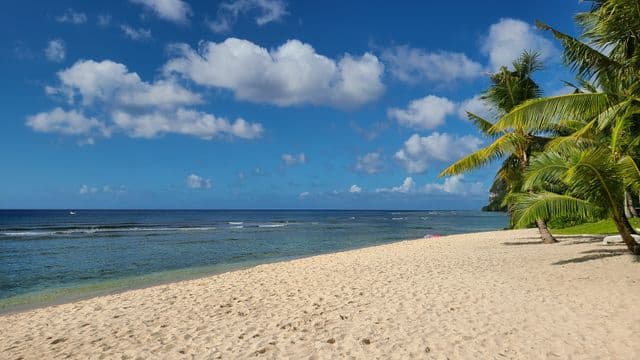
The widest and greenest part of Majuro Atoll, at the far western tip. Less developed with better beaches and a more rural feel.
Culture
Marshallese society is warm, communal, and deeply shaped by tradition. Family clans (jowi) and matrilineal land rights remain central to social organisation. The legacy of US nuclear testing on Bikini and Enewetak atolls during the Cold War carries enormous weight in the national psyche and shapes relations with the United States to this day. Life moves slowly; the sea, fishing, and community gatherings set the rhythm of daily existence.
Climate & best time to visit
Equatorial Pacific: consistently hot (27–30°C year-round) with high humidity. Trade winds provide natural cooling. Wettest months are November–January; driest and most pleasant are April–July. Inter-island connectivity varies by weather season.
Best months: April, May, June, July
Tips & safety
- •Majuro is a narrow atoll; the main road runs the entire length of the inhabited strip and most daily life happens within a few hundred meters of this road on either side
- •The Robert Reimers Hotel area and the main town are the practical centers for visitors; the rest of the atoll is quieter and more residential
- •The Marshall Islands use the US dollar and have strong connections to the United States through the Compact of Free Association; American goods and dollar pricing are standard
- •Internet connectivity is limited and expensive by Pacific standards; work requiring heavy data transfer should be planned around connectivity constraints
- •A compact rental car is the most practical transport; the road is in variable condition and distances are longer than they appear on a map due to the linear geography
- •Medical facilities are limited; for anything beyond basic treatment, evacuation to Honolulu or Guam is the pathway; travel insurance with medical evacuation coverage is essential
- •Sun intensity at the equatorial location is extreme; consistent SPF 50 application and protective clothing are non-negotiable for extended outdoor time
- •Fresh water is collected via rainwater in some areas; stick to bottled or verified clean water sources
- •Western Pacific typhoon season runs June through November; check conditions if travel is time-sensitive
Areas to avoid: Majuro has no dangerous neighborhoods by any international standard; the community is very small and strangers are noticed, Ocean swimming off the ocean side of the atoll involves strong currents and larger waves; the lagoon side is the safe swimming option