.png)
About Bhutan
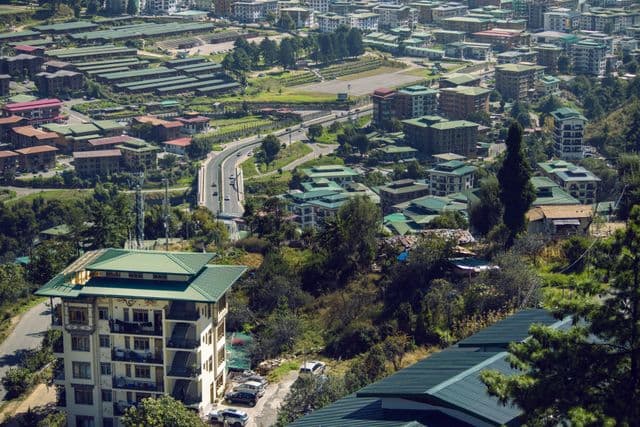
Bhutan occupies a geography and a philosophy almost nothing else has preserved: the last Himalayan Buddhist kingdom, carbon-negative by constitutional forest mandate, measuring progress in Gross National Happiness since before sustainability had a hashtag, television arriving only in 1999, no traffic light in the capital because the one they installed was removed by popular demand, and the dzong fortress-monasteries standing in the river valleys like red-and-white arguments against impermanence. It is the index's most deliberate inversion of everything the nomad economy assumes, and this page respects the design instead of arguing with it.
The entry model is the philosophy priced: all nationalities except Indians, Bangladeshis and Maldivians need a visa, 40 dollars, applied directly through the official immigration portal since the 2023 liberalization or through the licensed operators most visitors still sensibly use, issued in about five working days as a clearance letter airlines check at boarding; and every night in the kingdom carries the Sustainable Development Fee, 100 dollars per person, halved from 200 in September 2023 and locked at that rate through August 31, 2027, after which it is scheduled to revert absent new policy, with children under six exempt, six-to-eleven at half, Indians at 1,200 rupees, and a 24-hour waiver for the border towns. New for 2026: a 5 percent GST rides tourism services, hotels, guides, vehicles, meals, while the SDF and visa fee stay exempt. The guide rules relaxed but did not vanish, independent movement now possible in the Paro-Thimphu-Punakha corridor while licensed guides remain mandatory for dzong visits, all trekking and travel beyond the west; Paro's spectacular approach is the main door, Phuentsholing the working land border, and stays run to roughly 90 days with online extension, every night metered. Long-term foreign residence essentially does not exist, work permits are rare employer-sponsored exceptions, and the honest sentence is the shortest in this index: you cannot move to Bhutan. The forward hook is real, though: Gelephu Mindfulness City, the 2,500-square-kilometer special administrative region on the southern border chartered by the King in February 2024, is being master-planned as a mindfulness-economy hub with its own legal architecture, and early residency concepts for remote professionals are in pilot through the GMC authority's partner programs, thin and early but the first crack of a door the kingdom has never had.
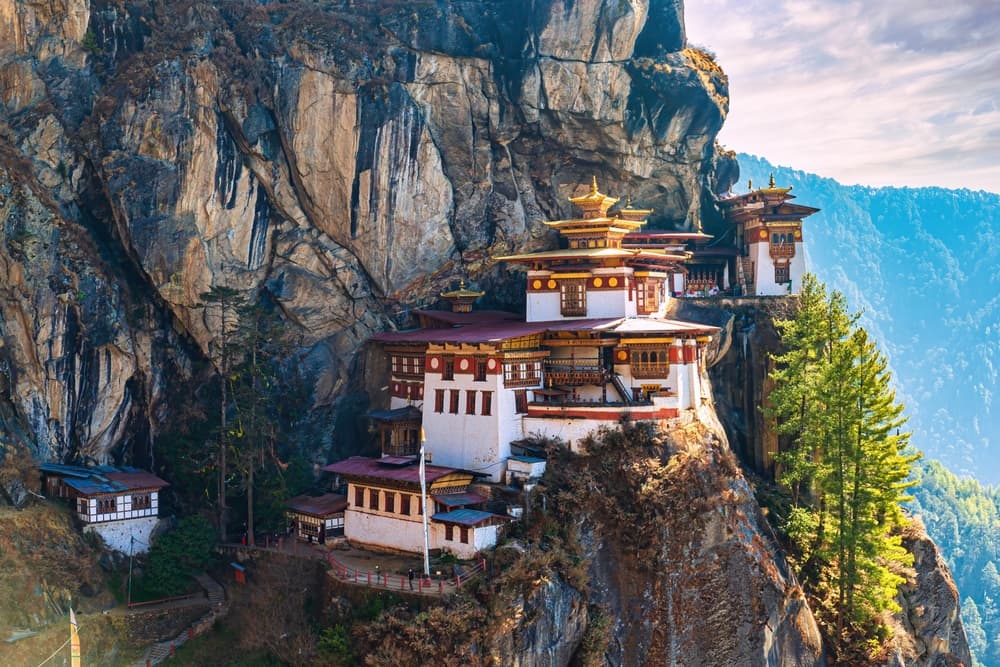
What the meter buys is the argument: free healthcare and education for every citizen funded partly by your fee, forests covering seventy percent of a country whose constitution demands sixty, Tiger's Nest hanging above the Paro valley, festival dances the community performs for itself with visitors incidental, and a near-zero-crime calm under a US Level 1 advisory whose genuine cautions are altitude, mountain roads and monsoon landslides. Bhutan prices the visit as a pilgrimage, and for once the brochure language is simply accurate.
Widening the search? If you are looking to expand your job hunt across South Asia, take a look at India →, Thailand →, and Malaysia →.
Cost of living
Bhutan's budget arithmetic is unlike anywhere else in this index because the government fee dominates it: the SDF's 100 dollars per person per night runs 3,000 dollars a month before a single hotel night, meal or guide fee, which is precisely the design, and the underlying country is otherwise inexpensive, three-star hotels at 40 to 80 dollars, the mandatory-when-required guides at 30 to 50 daily, hearty Bhutanese meals at 5 to 10, and the new 5 percent GST riding the services while the SDF stays exempt.
The practical texture: packages remain the sensible format for most visits, bundling hotels, guide, driver and meals at 250 to 350 dollars daily all-in including the SDF; the independent option in the western corridor trims costs modestly at logistics' expense; cash still matters outside the main hotels with cards spreading; and the ngultrum pegs to the Indian rupee both circulate. A comfortable week runs 2,200 to 2,800 dollars per person with the government share around 740, the monthly-budget framing this index uses elsewhere translates here to roughly 4,800 to 6,000 dollars for a month mostly measuring the fee, and the honest Bhutanese addition is philosophical: the price is the policy, the crowds it prevents are the product, and the arithmetic only makes sense scored against what the country is not.
- The SDF dominates every budget: 100 dollars per person per night, 3,000 monthly before any other cost, locked through August 2027 and scheduled to revert to 200 after; the fee is the policy and the policy is the point.
- The country underneath is inexpensive: three-star hotels at 40 to 80 dollars, meals at 5 to 10, guides at 30 to 50 daily, and the 5 percent GST new for 2026 riding services while the SDF stays exempt.
- Packages remain the sensible format: 250 to 350 dollars daily all-in including the fee, with the western-corridor independent option trimming modestly at logistics' expense.
- Score the arithmetic honestly: a week runs 2,200 to 2,800 per person, the crowds the fee prevents are the product, and Bhutan prices as the pilgrimage it is rather than the base it is not.
Cost-of-living calculator
See how your budget stretches in Bhutan.
Estimates use approximate exchange rates and typical monthly costs. Your actual costs will vary.
Visas & Entry
Bhutan requires a visa of all nationalities except Indians, Bangladeshis and Maldivians, who use a permit system, and the process modernized in 2023 without abandoning the doctrine: applications run directly through the official immigration portal or via licensed operators, a 40-dollar non-refundable fee, passport validity of six months as the absolute gate, a photo and insurance to spec, processing in roughly five working days, and a clearance letter airlines check at boarding, with visa stamps issued at Paro's arrival hall or the Phuentsholing land border; no walk-up visa exists anywhere, and OCI cardholders follow their passport, not their Indian origin.
The Sustainable Development Fee is the system's engine: 100 dollars per person per night for international visitors, halved from 200 in September 2023 and locked through August 31, 2027, scheduled to revert absent new policy, paid at application, with children under six exempt, six-to-eleven at half rate, Indians at 1,200 rupees nightly, Bangladeshis at 15 dollars for an annual quota, a full waiver for stays under 24 hours in the border towns of Phuentsholing, Samtse, Gelephu and Samdrup Jongkhar, and MICE-group waivers for qualifying conferences; from January 1, 2026 a 5 percent GST applies to tourism services while the SDF and visa fee remain exempt. The liberalized movement rules: independent travel now works in the Paro-Thimphu-Punakha corridor, licensed guides remain mandatory for dzong and sacred-site visits, all trekking, and travel beyond the west, with route permits extending the map; stays run to roughly 90 days with online extensions, every night metered. Long-term status essentially does not exist: work permits are rare employer-sponsored exceptions inside a system built to protect Bhutanese employment, there is no investment or retirement route, and citizenship is among the world's most restricted. The forward file is Gelephu Mindfulness City: the special administrative region chartered in February 2024 with its own developing legal architecture, where early residency concepts for remote professionals are in pilot through GMC authority partner programs, unproven and worth watching directly rather than through intermediaries.
- Apply three weeks out through official channels: the portal and the licensed operators both work, the six-month passport rule rejects instantly, and the clearance letter is what the airline wants at check-in.
- Budget the SDF as the trip's spine: 740 dollars of government fees on a standard week, locked pricing through August 2027, and the scheduled reversion to 200 as the reason the current window is the value era.
- Use the corridor freedom, book the guide beyond it: Paro, Thimphu and Punakha now move independently, while dzongs, treks and the east require the licensed guide the doctrine always intended.
- Add the GST to 2026 arithmetic: five percent on services since January, the SDF exempt, and operator quotes worth confirming as inclusive or not.
- Read Gelephu as a watch, not a plan: the SAR's residency pilots are early and thin, the direct GMC channels outrank intermediaries, and the standard kingdom remains a metered visit by design.
- Respect the design instead of gaming it: there is no border-run culture, no gray-zone economy and no long-stay hack; Bhutan built the system to prevent exactly that, and the visit priced as a pilgrimage is the product.
| Visa or permit | What it covers |
|---|---|
| The e-visa | Forty dollars, applied through the official portal or a licensed operator, six-month passport validity as the absolute gate, roughly five working days, and a clearance letter checked at boarding; stamps at Paro or Phuentsholing, no walk-up visa anywhere, and OCI holders follow their passport. |
| The SDF | One hundred dollars per person per night, locked through August 31, 2027 and scheduled to revert to 200 after: under-sixes exempt, six-to-elevens at half, Indians at 1,200 rupees, Bangladeshis at 15 dollars on quota, and the 24-hour border-town waiver since April 2023. |
| The 2026 GST layer | Five percent on tourism services, hotels, guides, vehicles and meals, from January 1, 2026, with the SDF and the 40-dollar visa fee explicitly exempt; budgets built on 2025 quotes need the adjustment. |
| Movement rules, liberalized but real | Independent travel works in the Paro-Thimphu-Punakha corridor; licensed guides remain mandatory for dzongs and sacred sites, all treks, and everything beyond the west, with route permits extending the map. |
| Entry geometry | Paro's spectacular mountain approach as the main door via Bangkok, Delhi, Kathmandu and Singapore, Phuentsholing as the working land border, and the eastern land crossings subject to periodic suspension; confirm the crossing at application. |
| Stays and the missing long game | Roughly 90 days maximum with online extensions, every night metered; work permits are rare employer-sponsored exceptions, no investment or retirement route exists, and long-term foreign residence essentially does not. |
| Gelephu Mindfulness City | The 2,500-square-kilometer special administrative region chartered February 2024 with its own developing legal architecture: early remote-professional residency concepts in pilot through GMC authority partners, thin, unproven, and the kingdom's first such door ever. |
Good to know: No DNV; the anti-volume design respected: e-visa $40 via immi.gov.bt (direct since 2023) or operators, 6-month passport gate, ~5 days, clearance letter at boarding; SDF $100/night LOCKED through Aug 31 2027 (then scheduled → $200): <6 free, 6-11 half, India ₹1,200, Bangladesh $15 quota, 24-hr border-town waiver; NEW Jan 1 2026: 5% GST on services (SDF + visa fee EXEMPT); guides mandatory for dzongs/treks/beyond western corridor (independent OK Paro-Thimphu-Punakha); ~90-day max, online extensions, every night metered; no long-term residence exists; GELEPHU MINDFULNESS CITY (SAR, Royal Charter Feb 2024, 2,500 km²) = early remote-worker residency pilots; watch directly, don't flip flag.
EnRoute Jobs AI tool
Route Planner
Map visa routes, timelines, and relocation costs for your next destination.
Work & Legal
Bhutanese professional culture runs on Buddhist courtesy and monarchical respect: Dzongkha is the national language while English carries education, administration and all of tourism, the gho and kira national dress remain genuinely worn and required in dzongs and offices, hierarchy is honored gently, and the pace is deliberate in a way that reframes urgency as the visitor's problem rather than the kingdom's. The economy runs hydropower exports, tourism, agriculture and a young digital layer the government courts carefully, with the Gelephu project as the diversification bet at civilizational scale.
The legal lines are the entry system's: remote work for foreign clients during a metered stay sits in an unaddressed vacuum with no enforcement interest, local employment requires the rare employer-sponsored permit inside a system built to protect Bhutanese jobs, and no freelance or business door exists for the visiting foreigner. The practical texture: connectivity is far better than the isolation suggests, 4G-to-5G national with fibre in the towns and eSIMs easy, power is hydropower-reliable, the working day aligns with India's rhythm, and the honest constraints are the metered nights making every working day a 100-dollar desk, the monsoon's connectivity wobbles beyond the west, and the altitude's first-week tax on focus. The visitor who works mornings, walks to a dzong at lunch and prices the entire arrangement as a season's retreat rather than a base has read the design correctly.
- Price the desk honestly: every working day carries the SDF meter, which makes Bhutan a deliberate retreat season rather than a base, and the arithmetic is the design working as intended.
- Use the connectivity that surprises: national 4G-to-5G, town fibre and easy eSIMs run far better than the isolation suggests, with the monsoon east as the honest wobble.
- Respect the employment wall: local work needs the rare sponsored permit, no freelance door exists, and the foreign-client vacuum during a metered stay is tolerance by irrelevance, not right.
- Work the altitude curve: Thimphu's 2,300 meters taxes the first week's focus, hydration and pacing answer it, and the trekking tier above asks proper acclimatization.
Good to know: Foreign-client work during metered stay = unaddressed vacuum (tolerance by irrelevance); local employment = rare sponsored permits (system protects Bhutanese jobs); no freelance/business door; connectivity surprisingly good (4G/5G + town fibre + eSIM); every working day = $100 desk by design; altitude taxes week one; India-aligned rhythm.
Taxes
Bhutanese tax is nearly irrelevant to the foreign professional by design: the metered visit never creates residency, the SDF is a fee rather than an income tax, and the domestic system, PIT to 30 percent, the new GST, serves citizens and the rare permitted worker.
| What applies | The rule in 2026 |
|---|---|
| The visitor's position | The metered stay creates no Bhutanese tax residency and no obligation on foreign income; the SDF is a government fee, not an income tax, and the 40-dollar visa fee completes the visitor's entire fiscal relationship with the kingdom. |
| Residents and the PIT | Personal income tax runs progressive to 30 percent at the top for Bhutanese residents and the rare permitted foreign worker, with the system administered on the Indian-adjacent fiscal calendar. |
| The 2026 GST | The long-delayed goods and services tax arrived January 1, 2026 at 5 percent on tourism and other services, the SDF and visa fee exempt; the visitor meets it in hotel and guide bills rather than any filing. |
| Business and the corporate layer | Corporate and business income taxes serve the domestic economy with hydropower as the fiscal anchor; no foreign-visitor entity door exists to make the rates relevant here. |
| The missing instruments | No nomad regime, no investment-residence taxation, no lump-sum offers: the kingdom sells nights, not residencies, and the tax system reflects the same doctrine. |
| Gelephu's developing frame | The Mindfulness City charter contemplates its own fiscal and legal architecture inside the SAR; early, unpublished in full, and the one place Bhutanese tax could someday matter to this audience. |
| Americans specifically | No US treaty and no totalization agreement, and for once it barely matters: the visit creates no Bhutanese liability to credit, and US obligations continue untouched by the mountain address. |
| The home-country half | The metered stay changes nothing at home: residence, filing and social obligations continue wherever they already live, and Bhutan's design means the kingdom never enters the equation. |
Verified 21 August 2026: the visitor's no-residency position with the SDF as fee rather than tax, the resident PIT to 30 percent, the January 2026 five-percent GST with SDF exemption, the absence of any foreign-resident instruments, the developing Gelephu fiscal frame, and the absence of any US treaty or totalization agreement. General information, not tax advice.
Good to know: Visitor = no residency ever (metered stay); SDF = fee not tax; resident PIT → 30%; GST 5% live Jan 1 2026 (SDF/visa exempt); no foreign-resident instruments by design; Gelephu SAR fiscal frame = the developing exception; no US treaty/totalization (barely matters).
Healthcare
Bhutanese healthcare is free for citizens by constitutional commitment, a Basic Health Unit network reaching every district and the Jigme Dorji Wangchuck National Referral Hospital in Thimphu anchoring the system, competent for a country of 800,000 at the everyday and emergency tiers, English-speaking throughout, and honest about its ceiling: complex specialty care routes to India, Kolkata and Delhi the standing referrals, or Bangkok for the private tier, which is why comprehensive travel insurance with air-evacuation cover is the non-negotiable line of every Bhutan plan rather than a formality. Visitors pay modest fees at public facilities and small private clinics serve Thimphu and Paro.
The health syllabus is Himalayan: altitude is the headline, Thimphu at 2,300 meters taxing the first 48 hours and the trekking tier demanding real acclimatization protocols, with the Paro-arrival day deliberately gentle as standard practice; mountain roads and monsoon landslides are the transport file; water discipline applies as everywhere in the region; dogs roam the towns with rabies awareness the standard advice; and winter cold in unheated buildings asks the layering the locals model. Pharmacies cover the basics in the towns, traditional medicine runs as a respected parallel system, dental is basic, and emergencies answer at 112 with the evacuation insurer's number stored beside it, because the helicopter to Siliguri or the flight to Bangkok is the system's real tertiary tier.
- Carry evacuation cover, non-negotiably: the in-kingdom system is honest about its ceiling, India and Bangkok are the tertiary tier, and the air-evacuation clause is the single arrangement that matters.
- Respect the altitude protocol: Thimphu taxes the first 48 hours, the trek tier demands real acclimatization, and the gentle first day is standard practice, not caution theater.
- Run the Himalayan basics: water discipline, rabies awareness around the town dogs, monsoon-road judgment, and winter layering in the unheated stock.
- Use the system for what it does well: everyday and emergency care at the national hospital, modest visitor fees, English throughout, and the traditional-medicine tier as the respected parallel it is.
| Hospital | What to know |
|---|---|
| Jigme Dorji Wangchuck National Referral Hospital, Thimphu | The national anchor: competent everyday, emergency and maternity care for the kingdom's scale, English-speaking, with the referral bridge as its designed ceiling. |
| The regional and BHU network | District hospitals and Basic Health Units reach every valley under the free-care constitutional commitment; the primary tier that keeps the nation's statistics enviable. |
| The Thimphu-Paro private tier | Small clinics serving visitors and the professional class at modest fees, the practical first stop for the non-emergency. |
| The India bridge | Complex specialty care routes to Kolkata and Delhi as the standing referrals, with Siliguri the road-and-helicopter option; the small kingdom's designed answer. |
| The Bangkok tier | The private evacuation standard for the insured, a direct flight from Paro; the reason the evacuation clause is the plan's real tertiary system. |
| Emergency architecture | 112 answers nationally, mountain rescue coordinates through the tourism system for treks, and the evacuation insurer's number belongs beside it in every phone. |
Hospital list compiled 21 August 2026 and not yet confirmed against each facility directly. Treat as indicative and verify before relying on it.
Good to know: Free-for-citizens constitutional system; JDWNRH Thimphu = anchor (competent everyday/emergency, English); ceiling honest → India bridge (Kolkata/Delhi/Siliguri) + Bangkok private tier; EVACUATION COVER = the non-negotiable; altitude protocol (Thimphu 2,300m, 48-hr tax); town dogs + rabies awareness; monsoon roads; 112.
Safety
Bhutan's safety file is among Asia's calmest and the page keeps it honest rather than mystical. The official half: the US advisory holds Level 1, Exercise Normal Precautions, through its recent cycles, and the kingdom's crime statistics justify it, violent crime against visitors nearly unrecorded, petty theft uncommon by any regional comparison, the social cohesion of a small Buddhist society doing what no police density elsewhere achieves, and solo travelers of every description reporting a calm that becomes the trip's memory. The genuine file is physical and Himalayan: altitude leads it, Thimphu's 2,300 meters and the passes above taxing unacclimatized arrivals with the trekking tier demanding real protocols; the mountain roads are the serious entry, narrow, winding, landslide-prone in the June-through-September monsoon with the lateral highway's dramatic stretches asking daylight driving and professional drivers, which the tour structure provides by default; trekking risks run the standard high-Himalaya syllabus, weather speed, exposure, rescue distances, answered by the licensed-guide requirement that is safety policy wearing cultural clothes; and the town dogs, the winter ice on northern passes, and the Paro approach's weather cancellations complete the practical list.
The context notes are few: political stability is deep, demonstrations effectively unknown, the southern border towns carry ordinary border texture, and the eastern land crossings suspend periodically for administrative rather than security reasons. Emergencies answer at 112 with trek rescue coordinating through the tourism system, and the honest summary is the one the score carries: a kingdom whose dangers are the mountains' own, priced into the guide rules, and whose streets ask nothing of the visitor but respect.
- Read the Level 1 as earned: near-unrecorded violent crime, uncommon petty theft, and a social calm that becomes the trip's memory; the human-threat file is essentially empty.
- Treat the roads as the serious entry: narrow, winding and landslide-prone in monsoon, answered by professional drivers, daylight rules and the tour structure's defaults.
- Run the altitude protocol without ego: the first 48 hours tax everyone, the passes and treks demand acclimatization, and descent remains the only real cure.
- Take the guide rules as the safety policy they are: the high-Himalaya syllabus, weather speed, exposure, rescue distance, is priced into the licensed-guide requirement, and solo ambition is what the rule exists to prevent.
- Note the small print: town dogs at night, winter ice on the passes, Paro weather cancellations worth flexible onward tickets, and the eastern land borders' periodic administrative suspensions.
- Know 112 and the Delhi coverage: the national number answers, trek rescue coordinates through the tourism system, and with no US embassy in-kingdom the STEP file and evacuation details carry unusual weight.
Official travel advisories
| Government | Current position |
|---|---|
| United States | Level 1, Exercise Normal Precautions: the floor tier, with the file's practical content being the altitude, road and trekking syllabus rather than any human threat.travel.state.gov → |
| Canada | Normal security precautions with the mountain-road and monsoon-landslide register carried honestly, and the evacuation-insurance advice stated plainly.travel.gc.ca → |
| United Kingdom | No overall advisory against travel; altitude, road conditions and the limited in-country medical ceiling are the substantive content.gov.uk → |
| Australia | Normal safety precautions with the high-Himalaya trekking syllabus and the monsoon transport file as the genuine cautions.smartraveller.gov.au → |
| US Embassy New Delhi | The US has no embassy in Bhutan; consular coverage runs from New Delhi, which makes STEP enrollment and the evacuation insurer's details carry unusual weight. Shantipath, Chanakyapuri; +91 11 2419 8000.in.usembassy.gov → |
Advisory positions verified 21 August 2026: the US Level 1 with New Delhi consular coverage, the near-empty human-threat register, and the genuine Himalayan file, altitude, mountain roads, monsoon landslides, trekking exposure and the Paro weather factor. Open the sources before travelling.
Good to know: US L1 (earned; coverage via New Delhi; no US embassy in-kingdom, STEP + evac details carry weight); human-threat file ≈ empty; real file = Himalayan: altitude (48-hr tax, trek protocols), mountain roads + monsoon landslides (professional drivers by design), guide rules = safety policy in cultural clothes, town dogs, Paro weather cancellations; eastern land borders suspend administratively; 112.
Climate
Bhutan compresses climate zones vertically: the southern foothills run subtropical, the central valleys where visitors actually live, Thimphu at 2,300 meters, Paro, Punakha lower and warmer, run a four-season mountain year, and the high Himalaya above runs alpine into permanent snow. The visitor calendar is famously two-peaked: spring, March through May, brings warm valley days, the rhododendron bloom that paints entire hillsides, and the Paro tshechu festival; autumn, late September through November, brings the crystal air, the year's best mountain visibility with the high peaks out daily, the Thimphu tshechu, and peak trekking; both are the prize seasons and price accordingly. The monsoon, June through September, delivers the lushness and the logistics, daily rain, landslide-prone roads, hidden peaks, and the black-necked-crane green of the valleys, workable in the west with patience; winter, December through February, runs cold, sunny and empty, Thimphu near freezing at night, the high passes closed, the low valleys, Punakha especially, mild and lovely, and the kingdom at its most personal. The practical kit is layered mountain gear in every season, sun discipline at altitude always, and the deepest climate fact is vertical: Punakha's valley floor runs a full season warmer than Thimphu an hour away, and the itinerary that follows the altitude gradient gets spring or autumn somewhere almost year-round.
| Season | What to expect |
|---|---|
| Spring, March to May | The first prize: warm valley days, the rhododendron bloom painting hillsides, the Paro tshechu, and clearing mountain views before the monsoon build. |
| Autumn, late September to November | The second prize: crystal air, the year's best peak visibility, the Thimphu tshechu and peak trekking; the season the photographs are from. |
| Monsoon, June to September | Daily rain, landslide-prone roads and hidden peaks beside the lush green and empty sites; workable in the west with patience and flexible plans. |
| Winter, December to February | Cold, sunny and empty: Thimphu near freezing at night, high passes closed, Punakha's low valley mild and lovely, and the kingdom at its most personal. |
Good to know: Two-peaked calendar: spring (rhododendrons + Paro tshechu) and autumn (crystal air + Thimphu tshechu) are the prizes; monsoon = lush + landslides; winter = cold, sunny, personal (Punakha the mild valley); the altitude gradient is the year-round arbitrage.
Culture & Customs
Bhutanese culture is Vajrayana Buddhism lived as national architecture: the dzongs run monastery and government under one roof as they have for four centuries, prayer wheels and mani walls structure the walking landscape, the gho and kira national dress is genuinely worn, required in dzongs and offices and elegant everywhere, and the particular quality of stillness visitors remark on is not performance but the actual register of a society that chose Gross National Happiness as its metric and meant it. Respect is the entire visitor code: modest dress at religious sites without exception, clockwise circumambulation of stupas and prayer walls, shoes off in temples, photography inside shrines only where permitted and never of monks without asking, and the raised-voice or public-anger register simply absent from the culture's range.
The calendar runs on tshechus, the masked-dance festivals each dzong holds annually, Paro's in spring and Thimphu's in autumn the famous ones, community events the visitor attends as guest rather than audience; archery is the national sport played with 145-meter targets and gleeful trash talk, the phallus paintings on farmhouse walls are Drukpa Kunley's blessing tradition rather than provocation, and doma, the betel-nut parcel, is the social currency offered constantly. The table is chili-forward in a way no neighbor matches, ema datshi, chilies in cheese, as the national dish eaten daily, red rice as the staple, butter tea as the ritual, and the meals eaten with visitors' spice tolerance kindly overestimated. The professional who dresses modestly, walks clockwise, accepts the butter tea, tries the archery, learns kuzuzangpo la as the greeting and lets the stillness set the pace has understood the kingdom's only real rule: you are a guest of a place that knows exactly what it is, and the privilege is the point.
- Dress and move with the code: modest clothing at every religious site without exception, shoes off in temples, clockwise around stupas and mani walls, and photography inside shrines only where permitted.
- Attend a tshechu as a guest, not an audience: the masked dances are the community's own religious calendar, Paro in spring and Thimphu in autumn the famous ones, and quiet presence is the correct participation.
- Accept the offerings: butter tea, doma, the constant small hospitality; refusal reads colder than the visitor intends, and the sip suffices.
- Learn the register: kuzuzangpo la as the greeting, voices low, public anger absent from the culture's range, and the stillness treated as the feature it is.
- Read the icons correctly: the farmhouse phallus paintings are Drukpa Kunley's blessing tradition, the dzongs are living government-monasteries rather than museums, and the gho and kira are daily dress, not costume.
- Join the archery sideline: the national sport runs 145-meter targets, gleeful trash talk and village stakes; enthusiasm from the sideline is the fastest warmth available.