.png)
About Albania
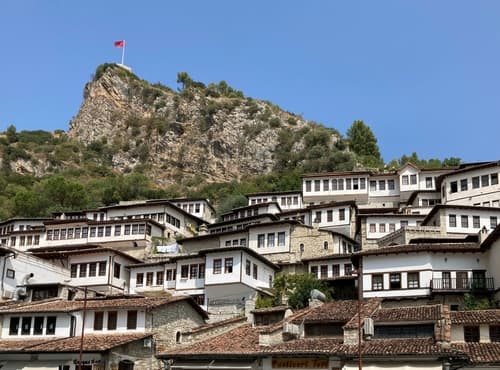
The light here arrives off the Adriatic in thin sheets. It makes the Ottoman houses of Berat glow like a row of lit candles at midday, then vanishes early behind the mountains. Albania spent forty-five years sealed shut under Enver Hoxha, opened badly in 1991, collapsed into pyramid-scheme chaos in 1997, and has spent the two decades since rebuilding in public. It is still deciding what it wants to be. For anyone whose income arrives by wire transfer rather than local paycheck, that unfinished quality is less a warning than an opening.
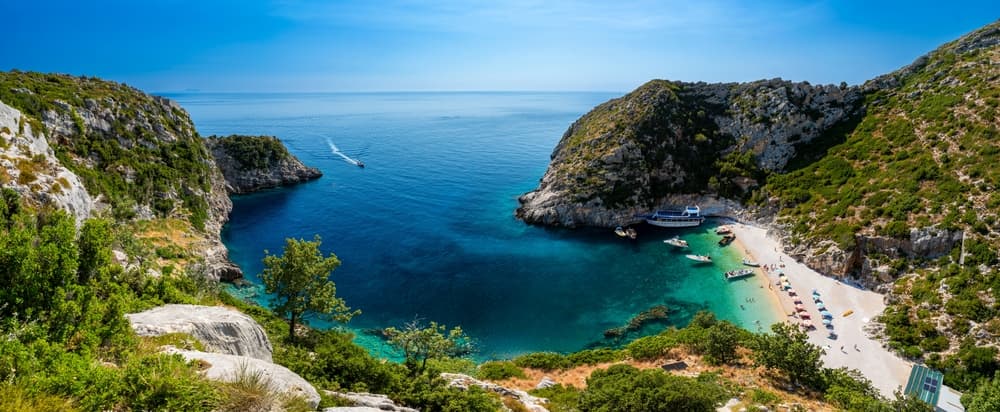
The practical case is easy to state. Fibre reaches the cities, 4G covers nearly everything else, and the mountain valleys where coverage thins out are exactly where you will want your Saturdays. Berat and Gjirokaster are UNESCO towns that cost less to live in than most European cities cost to visit for a weekend. Sarande sits above an Ionian bay of an almost implausible blue, forty minutes by ferry from Corfu. None of this is a secret, but it is not yet crowded either. The Riviera hires each summer as the coast wakes up, and the hostels of Tirana and Sarande have run on work exchange since backpackers first found the place.
What you trade for the price is polish. Bureaucracy moves at its own pace and rarely explains itself, rural roads deserve daylight, and public healthcare is thin enough that private insurance is not a nicety. Set against that, Albanians are among the most genuinely hospitable people in Europe, and besa, the old code obliging a host to protect a guest, is not a tourist-board invention. A foreigner working quietly from a rented flat is either left entirely alone or thoroughly adopted, and which one depends almost entirely on the neighbors.
Widening the search? If you are looking to expand your job hunt across the Western Balkans, take a look at Montenegro →, North Macedonia →, and Greece →.
Cost of living
Albania is the least expensive country in Europe where a remote worker can live comfortably and legally without much compromise. A careful single person covers everything on EUR 650 to EUR 900 a month in Tirana. Around EUR 1,300 buys a considerably softer version of the same life.
Two costs surprise people. Electricity climbs steeply in winter, since older buildings heat badly and run on space heaters. And the Riviera prices itself like a Greek island for eight weeks in July and August, then quietly returns to earth.
- Furnished one-bedroom, central Tirana: EUR 350 to EUR 500, and roughly a third less in Shkoder, Berat, or Vlore.
- Coworking desk: from about EUR 90 a month in Tirana.
- Lunch at a neighbourhood restaurant: EUR 4 to EUR 7 for a full meal.
- Espresso: well under a euro, and it comes with a chair you may keep as long as you like.
Cost-of-living calculator
See how your budget stretches in Albania.
Estimates use approximate exchange rates and typical monthly costs. Your actual costs will vary.
Visas & Entry
Albania is not in the Schengen Area, which is the first thing worth understanding, because days spent here do not count against the 90-in-180 allowance you need for the EU. Entry itself is unusually generous.
Permit decisions are published as taking up to 12 weeks, though many settle in 15 to 30 days. Whichever route applies, register your address with the local police within 30 days of arrival.
- EU, UK, Canada, Australia, New Zealand and most Western passports: 90 days visa-free in any 180-day period, needing only a passport valid three to six months beyond arrival.
- US citizens: up to 12 months with no visa and no residence permit, under a standing bilateral arrangement.
- Everyone staying longer: the Unique Permit system created under Law 79/2021 On Foreigners.
| Visa or permit | What it covers |
|---|---|
| Visa-free entry | Ninety days within any 180-day period for EU, UK, Canadian, Australian, and most Western passports. No application, no fee, no income proof. |
| Visa-free entry (US citizens) | Up to 12 months with no visa or permit under a standing bilateral arrangement. Apply for residence before the twelve months elapse if you intend to stay on. |
| Type C short-stay visa | For nationals not covered by visa-free entry who need up to 90 days for tourism or business. Applied for online. |
| Type D long-stay visa | The entry visa for any stay over 90 days. It gets you into the country; the residence permit is then applied for from inside Albania. |
| Unique Permit, Digital Mobile Worker | Albania's de facto digital nomad permit. One year of residence for remote work performed for employers or clients based outside Albania, renewable toward a five-year track. Local Albanian clients are not permitted. |
| Unique Permit, Employment | Combined work and residence authorization for anyone hired by an Albanian employer. Subject to a labor market test and quota check. |
| Unique Permit, Self-employment | For those registering a business or trading as self-employed inside Albania. Carries local tax and contribution obligations. |
| Family reunification | Spouses, partners, and dependent children joining a permit holder or an Albanian national. Family may be included in a main applicant's filing. |
| Permanent residence | Available after five continuous years of legal residence. Citizenship becomes possible after seven, with reductions for Albanian ancestry or marriage. |
Entry rules and permit categories verified 20 August 2026 against Law 79/2021 and Albanian government portals. Confirm your own case before booking.
EnRoute Jobs AI tool
Route Planner
Map visa routes, timelines, and relocation costs for your next destination.
Work & Legal
Albanian professional life runs on relationships and coffee, in that order. Business here is preceded by real questions about your health and your family, and the half hour over espresso before anyone opens a laptop is the meeting, not the preamble to it. Most Albanian professionals speak English or Italian, messaging apps carry more business than email, and the country largely stops working in late July and August. On the legal side, the line that matters is where your clients sit.
Holding a Digital Mobile Worker permit while quietly billing local clients breaches its terms.
- Foreign employers and foreign clients: entirely lawful, no local entity required. The Digital Mobile Worker permit exists specifically to cover this.
- Your foreign employer's exposure: amendments confirm that hiring a nomad based in Albania creates no tax residency, corporate liability, or permanent establishment risk for them, which is useful ammunition for a nervous HR team.
- Albanian clients or Albanian employment: a different track entirely, requiring the employment or self-employment permit, tax registration, invoicing through the authority's e-invoicing system, and social contributions.
Taxes
Albania combines an unusually generous small-business regime with a hard 183-day residency line, and the gap between those two facts is where most people get into trouble.
| What applies | The rule in 2026 |
|---|---|
| Tax residency | Triggered by 183 days of presence in a calendar year, consecutive or not, or by maintaining a permanent home in Albania. Residents are taxed on worldwide income; non-residents only on Albanian-source income. |
| Personal income tax | Progressive across three bands at 0%, 13%, and 23%. The 23% top rate applies to employment income above ALL 2,040,000 per year, roughly EUR 17,600. |
| Self-employed and small business | The headline benefit. Annual gross turnover up to ALL 14 million, about EUR 120,000, is taxed at 0% under Law 29/2023, guaranteed through 31 December 2029. Registration with the tax authority is required to qualify. |
| Digital nomad exemption | Unique Permit holders working for foreign employers receive a 12-month exemption on foreign income, plus exemption from social contributions in the first year. |
| Social and health contributions | Employees pay 11.2% of gross, employers 16.7%. Self-employed individuals pay a fixed ALL 14,900 per month, roughly EUR 143, regardless of what they earn. |
| VAT | Standard rate 20%, reduced to 6% on accommodation and books. Registration mandatory above ALL 10 million turnover. Services billed to clients with no Albanian presence generally fall outside VAT. |
| Corporate income tax | 15% on taxable profit, reduced to 5% for software development, manufacturing, and other priority sectors. |
| Investment income | Dividends taxed at 8%. Capital gains and cryptocurrency gains at 15%. |
| Treaty position | Albania holds roughly 45 double-taxation treaties. There is no treaty with the United States, so Americans rely on the Foreign Earned Income Exclusion and Foreign Tax Credit and should take specialist advice. |
| Annual filing | The individual declaration (DIVA) is generally required above roughly ALL 1.2 million of annual income and is due by 31 March. |
Rates verified 20 August 2026 against PwC Worldwide Tax Summaries and Albanian tax authority guidance. Thresholds move most years. General information, not tax advice.
Healthcare
Albania runs a universal public system funded through the compulsory health insurance fund, and legal residents who contribute may register for it. Very few foreigners rely on it. The public network is chronically underfunded, waiting times are long, English is inconsistent outside Tirana, and patients are routinely expected to buy their own medicines during a stay. Private care is the practical answer and is genuinely affordable.
One honest caveat: nearly all serious capability sits in Tirana. For major surgery or complex oncology, residents often travel to Italy, Greece, or Kosovo, so any policy you buy should include medical evacuation.
- Private specialist consultation: typically EUR 30 to EUR 60.
- Private health insurance: roughly EUR 30 to EUR 150 a month depending on coverage.
- Unique Permit requirement: insurance valid in Albania with a minimum of EUR 30,000 in coverage.
- Emergency numbers: 127 for ambulance, 129 for police.
| Hospital | What to know |
|---|---|
| American Hospital (Spitali Amerikan), Tirana | Albania's first private hospital, opened 2006, now the largest private group in the country with roughly 400 beds across several facilities. Strong cardiac surgery and oncology, a dedicated international patient department, and records issued in English. |
| Hygeia Hospital Tirana | A 220-bed general, maternity, and pediatric hospital built from a EUR 60 million investment by the Greek Hygeia group. The most comprehensive single private facility in the country, in Kashar near the Durres road. |
| QSUT Nene Tereza, Tirana | Mother Teresa University Hospital Centre, the largest public hospital and the national referral centre. Teaching hospital for the University of Medicine, holding the country's main oncology, nephrology, and transplant services. |
| German Hospital Tirana | Private hospital with a particular reputation in cardiology and cardiovascular surgery, working with European cardiac institutions. Broad specialist coverage beyond that. |
| Salus Hospital, Tirana | Private general hospital known for solid emergency and diagnostic capability, with well-regarded cardiology, orthopedics, and neurology departments. |
| University Hospital of Trauma, Tirana | The national trauma centre and where you would be taken after a serious road accident. Specialises in traumatology, orthopedic surgery, and neurotrauma. |
Facilities verified 20 August 2026. All six sit in Tirana, which reflects where Albanian specialist medicine is actually concentrated.
Safety
Albania is safer than its reputation, and the reputation is mostly thirty years out of date. Violent crime against foreigners is rare, and the organised crime the country is known for operates in a sphere with essentially no contact with visitors. Solo female travellers consistently report Albania as among the more comfortable countries in the region.
- Petty theft: pickpocketing around Skanderbeg Square and the Blloku bars late at night, and along the Riviera at the height of summer.
- Taxi overcharging: agree the fare first or use a local app. Uber does not operate here.
- The roads, which are the real risk: assertive driving, poor rural surfaces, and little street lighting outside towns. Avoid long night drives and consider hiring a driver rather than a car.
- Unexploded ordnance: a narrow but real hazard in remote uncultivated ground near the northeastern border with Kosovo. Stay on marked trails there.
- A current alert: in April 2026 the US Embassy asked American citizens to stay alert in crowded public venues over possible threats from Iran-linked groups. A precaution rather than a specific warning, but it stands.
Official travel advisories
| Government | Current position |
|---|---|
| United States | Level 2, Exercise Increased Caution, carrying a crime indicator. The same level assigned to France, Italy, and Spain.travel.state.gov → |
| United Kingdom | No advisory against travel. Flags petty crime, occasional political demonstrations in central Tirana, and road safety.gov.uk → |
| Canada | Take normal security precautions, the lowest tier. Notes pickpocketing, residential break-ins, and vehicle theft.travel.gc.ca → |
| Australia | Exercise a high degree of caution, chiefly because of limited healthcare options. Also flags protests in central Tirana and seasonal flooding and wildfires.smartraveller.gov.au → |
| Ireland | Normal precautions, its lowest rating. Notes seismic activity and winter flooding in the north.ireland.ie → |
| US Embassy Tirana | Register with the STEP programme for alerts. Consular line +355 4 224 7285.al.usembassy.gov → |
All six advisories checked and wording verified 20 August 2026. These change without notice, so open the source before you travel.
Climate
Albania is Mediterranean on the coast and continental once you move inland, and the two feel like different countries. The Adriatic and Ionian shores get hot dry summers and mild wet winters, with more than 300 days of sun a year in the south. The interior sits higher and colder, and the Albanian Alps in the north hold snow well into spring. Rainfall is heavy by Mediterranean standards and lands mostly between November and March. Tirana averages around 15C annually, which reads mild until you learn that older buildings heat badly and January indoors can be less comfortable than January outdoors.
| Season | What to expect |
|---|---|
| Spring, March to May | Rain tapering through March and April, then the best stretch of the year. Coastal highs climb from 16C to 24C, wildflowers cover the south, and the mountains stay snowbound until late. Fewest tourists, lowest prices. |
| Summer, June to August | Hot, dry, and bright. Coastal highs of 30C to 35C, inland Tirana often hotter. Riviera towns fill from mid-July, prices roughly double, and the country slows down. Air conditioning is worth paying for. |
| Autumn, September to November | The other excellent season. September still gives swimmable sea without the crowds, October settles into 18C to 22C, and November brings the first real rain. Prices drop sharply after the first week of September. |
| Winter, December to February | Mild on the coast at 8C to 14C, cold and wet inland, properly snowy in the northern Alps. The wettest months of the year. Heating is the budget line to watch. |
Culture & Customs
Hospitality here carries the weight of an obligation rather than a courtesy. Besa, roughly a promise kept at any cost, historically bound a host to protect a guest even against their own interests, and its residue shapes ordinary life in ways visitors notice within a week. Coffee is the mechanism. An invitation to coffee is a real invitation, refusing reads as a small rejection, and arguing over who pays is expected theatre in which the visitor is meant to lose gracefully. Albanians tend to be direct, physically closer than northern Europeans find natural, and unbothered by volume. The famous business about nodding for no is real but fading, and mostly survives among older people in rural areas; when in doubt, ask for words rather than reading the gesture.
Religion sits more lightly than the demographics suggest. Albania is majority Muslim with substantial Orthodox and Catholic communities, mixed families are common, and religious identity is rarely the first thing anyone mentions. A few things worth knowing before your first week.
- Greet the oldest person in the room first. Age and family carry real authority, and questions about your parents and marital status are friendliness rather than intrusion.
- Accept a second helping at least once. Meals in a home come with more food than anyone can eat, and refusing outright reads as a slight.
- Avoid casual jokes about the communist period. It is living memory and still painful.
- Do not confuse Albania with its neighbours, or treat Kosovo as a merely foreign country.
- Dress smart casual for company meetings, proper business attire for anything governmental, and modestly inside mosques and churches.
- Round restaurant bills up by 5 to 10 percent. Tipping is not obligatory but is always welcome.