.png)
About Zurich
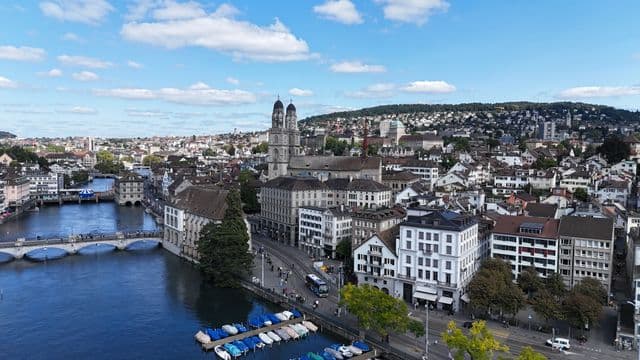
Zurich is the most expensive city in this database and offers the least apology for it. The Swiss franc is a serious currency used by a serious economy, and the city it has built is precise, functional, and designed to a standard that other European capitals study without fully replicating. Everything works. This is not a small thing.
For remote workers who can absorb the costs, the practical case is compelling. Fiber connectivity is among the best in the world. Coworking infrastructure is well-distributed, with Impact Hub Zurich on Sihlquai, Kraftwerk in Wiedikon, and numerous bank-funded innovation spaces serving the professional community. A one-bedroom apartment in Wiedikon or Altstetten, the neighborhoods with the best cost-to-access ratio, runs €2,000 to €2,800 a month. Central neighborhoods like Langstrasse or Kreis 4 approach the same range while offering more street-level culture.
The lake and the Alps are not incidental to the Zurich proposition; they are central to it. The lake is swimmable from June through September at multiple free municipal bathing stations, and the first mountains are forty minutes by train. Swiss transit is the benchmark against which other countries' transit systems are quietly judged.
What Zurich does not offer is the ambient social randomness of cities that charge less. It is orderly and private, and outsiders are welcomed with professional courtesy rather than warmth. Those who prefer to manage their social lives deliberately rather than stumble into them tend to flourish here. Those who need a city to come to them will find it cold.
Best months are April through October. Winter is cold and grey but the city's serious concert and cultural calendar fill it adequately.
Cost of living
Cost-of-living calculator
See how your budget stretches in Zurich.
Estimates use approximate exchange rates and typical monthly costs. Your actual costs will vary.
- Coffee
- $6
- Cheap meal
- $22
- Coworking (day)
- $45
- Mid-range meal for 2
- $100
- Rent (1BR, center)
- $2,500
- Transit (monthly)
- $90
- Internet (monthly)
- $65
- Rent (1BR, outside)
- $1,900
EnRoute Jobs AI tool
Real Value Calculator
See what a salary actually leaves you in the country you want to live in.
Neighborhoods
Wiedikon (Kreis 3)
Remote workers, mid-range residential
The most livable neighborhood for the international professional community by cost-access ratio: tram connections to the center, good supermarket access at the Letzigraben Coop, and a residential character that is settled and functional.
Langstrasse (Kreis 4 / 5)
Nightlife, creatives, younger professionals
Zurich's most socially active neighborhood: the Langstrasse bar and restaurant concentration, the Viadukt market arches, and a community of designers and independent professionals who have made this the most interesting square kilometer in the city.
Seefeld (Kreis 8)
Higher-end residential, lake access
The premium lakeside neighborhood east of the center with the best lake swimming access, excellent cafés on Seefeldstrasse, and a wealthier residential community. Costs are among the highest in the city.
Oerlikon (Kreis 11)
Budget, north side, good transit
The northern development district with significantly lower rents than central Zurich, good S-Bahn connections, and a growing restaurant and commercial infrastructure that has benefited from the MFO Park (vertical garden building) urban renewal projects.
Culture
Zurich is the world's richest city by average wealth and one of its most consistently liveable: a banking and insurance capital on a glacial lake with a quality of life that is genuinely exceptional and a cost of living that reflects it. Swiss culture in Zurich is precise, private, and somewhat reserved. Punctuality is close to a moral virtue, direct neighbour complaints are preferred to official complaints, and Swiss German (Zürichdeutsch) is an entirely different spoken language from Standard German. The city's art museum (Kunsthaus) and opera house are among Europe's best; its club scene (Zurich produced many of the world's best DJs) is underappreciated.
Climate & best time to visit
Temperate continental with Alpine influence: warm summers (July 19–25°C) and cold winters (January −2 to 4°C). Hochnebel (low cloud inversion) can make the city feel grey November–February while the Alps above are sunny. May–September is Zurich at its most active and livable.
Best months: May, June, July, September
Tips & safety
- •The Zurich transport ZVV monthly pass covers all trams, buses, S-Bahn, and lake boats within the city zones; CHF 95/month
- •The Zurich municipal lake swimming pools (Letten, Seebad Utoquai, Seebad Enge) are free or CHF 6-8 entry and are social infrastructure in summer
- •Swiss supermarkets: Aldi and Lidl are significantly cheaper than Migros or Coop; weekly grocery costs at the discount chains are roughly 30% lower
- •Monthly apartment costs in Wiedikon or Altstetten run CHF 1,800-2,500 for a furnished one-bedroom; central Zurich approaches CHF 3,000+
- •The half-fare card (Halbtax, CHF 120/year) cuts all Swiss train tickets in half and pays for itself within a few intercity journeys
- •Swiss German (Züritüütsch) differs significantly from standard German; High German works for formal contexts but learning a few local phrases is noted as unusual and appreciated
- •Emergency: 117 (police), 144 (ambulance), 118 (fire); 112 also works
- •Zurich is among the safest major cities in Europe; violent crime is rare and the primary concern is bicycle theft
- •Swiss law requires health insurance; for stays over 3 months, registration with a Krankenkasse is mandatory and enforceable
- •Tap water in Zurich comes from lake and alpine spring sources and is among the best in Europe
Areas to avoid: The Langstrasse area late at night for those unfamiliar with the environment; the drug and sex work activity on the street is visible and the density of impaired individuals increases after midnight