.png)
About Split
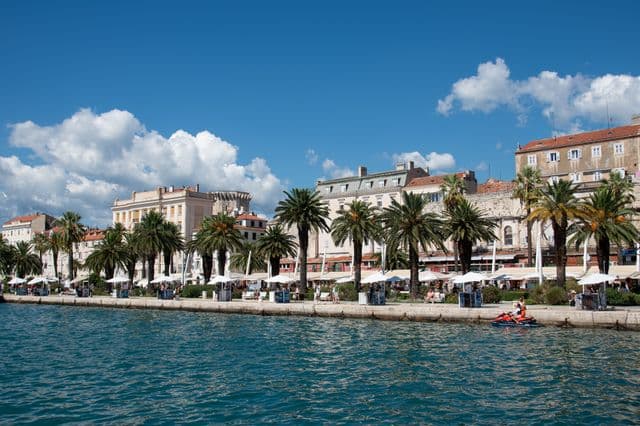
Split is the Dalmatian city that actually functions: a working port, a ferry hub connecting the mainland to the Dalmatian islands, and a 1,700-year-old Roman palace (Diocletian's Palace) whose walls and towers now enclose a living neighborhood of apartments, restaurants, bars, and a cathedral built in the emperor's mausoleum. The palace is not a museum; people live inside it, hang their laundry from the ancient stone windows, and drink coffee in its peristyle square.
For geo-flex professionals, Split offers Croatia's best combination of coastal access, urban infrastructure, and relative affordability within the country. The cost of living in Split is mostly a rent question. Monthly rents in the Meje, Bačvice, and Spinut neighborhoods run $700 to $1,200 from October through May. The coworking scene has developed to serve the significant remote worker population that has chosen Split over more expensive Mediterranean alternatives. Fiber internet is widely available.
The ferry terminal at the harbor serves Brač, Hvar, Vis, and Korčula daily, making Split a practical hub for exploring the Dalmatian islands on extended working trips. The coast north toward Trogir and south toward Omiš provides additional working-day escapes.
High season (June through August) brings significant crowds and price increases. The shoulder seasons, May and September through October, represent Split at its most functional.
The season employs as well as it charges: the charter fleet crews up every spring with skippers and hosts, and the hostels of the old town trade beds for shifts all summer.
Cost of living
Cost-of-living calculator
See how your budget stretches in Split.
Estimates use approximate exchange rates and typical monthly costs. Your actual costs will vary.
- Coffee
- $2
- Cheap meal
- $10
- Coworking (day)
- $18
- Mid-range meal for 2
- $40
- Rent (1BR, center)
- $900
- Transit (monthly)
- $25
- Internet (monthly)
- $20
- Rent (1BR, outside)
- $650
EnRoute Jobs AI tool
Real Value Calculator
See what a salary actually leaves you in the country you want to live in.
Neighborhoods
Diocletian''s Palace Old Town
Tourists, heritage
Living Roman palace where people actually live; the most extraordinary city centre in Croatia.
Meje and Bacvice
Families, beach lifestyle
Quiet residential areas by the beach.
Spinut and Firule
Locals, long-term residents
Authentic local neighbourhoods with lower tourist density.
Getting around
- overview
- Old Town walkable. Buses and ferries connect surroundings. Ferries to islands run regularly.
Culture
Split's cultural identity is organized around the Diocletian's Palace precinct in a way that is not merely historical but genuinely spatial: the oldest continuously inhabited palatial complex in the world has been adapted, rebuilt, and reoccupied so many times that the layers of Roman, medieval, Venetian, and 20th-century use are visible simultaneously in the same walls. The peristyle square at the palace's center is where the city's public life has happened for seventeen centuries. Hajduk Split, the city's football club and one of the most supported in the former Yugoslavia, generates a cultural intensity that the tourist economy does not adequately represent to outside visitors.
Climate & best time to visit
Mediterranean: hot, sunny summers (July 24–31°C) and mild winters (January 7–12°C). The Diocletian's Palace area is walkable year-round. April–June and September–October offer the best working conditions away from the July–August tourist peak.
Best months: May, June, September, October
Tips & safety
- •Old Town walkable. Buses and ferries connect surrounding areas. Ferries to Hvar, Brac, and other islands.
- •Moderate, with tourist inflation in summer. One-bed rent €600–1,000/month outside peak season.
- •Split is very safe; petty theft in tourist crowds is the primary concern.
- •The limestone streets of Diocletian Palace are slippery when wet or in flip-flops; watch your footing.
- •Car break-ins in visible beach parking areas are reported occasionally; do not leave valuables in vehicles.
- •Heatstroke risk is real in July and August; the Palace interior retains heat. Hydrate well and rest during midday.
Areas to avoid: There are no genuinely unsafe areas in Split., The Old Town inside Diocletian Palace gets extremely crowded in July and August — pickpocketing risk rises in dense pedestrian areas; keep bags secured., Žnjan beach area on the outskirts sees occasional rowdy behavior on summer weekend nights.