.png)
About Salzburg
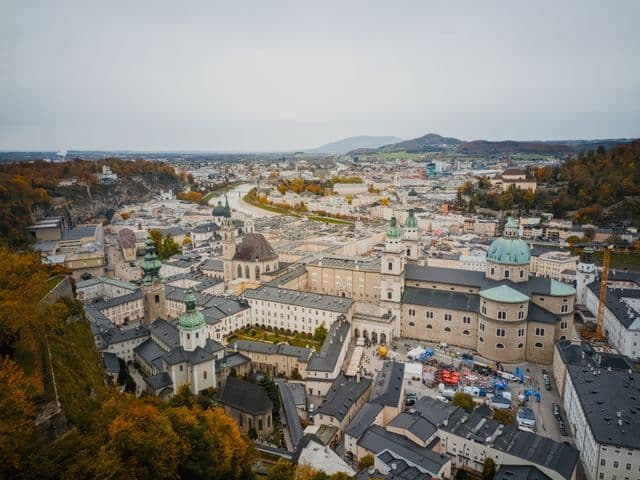
Salzburg is the city that Mozart and the Sound of Music made famous in different centuries for different reasons, and which has spent the intervening time building an identity that earns the attention rather than just inheriting it. The Altstadt on the south bank of the Salzach River, the Hohensalzburg Fortress on the cliff above it, and the Baroque architecture commissioned by the Prince-Archbishops over two centuries have produced a city center that is genuinely among the most beautiful in Central Europe. Not beautiful in the way that ancient ruins are beautiful. Beautiful in the way that an entirely intact, functioning, inhabited city of the seventeenth century is beautiful.
For digital nomads, Salzburg sits at the complex intersection of Austrian costs (not cheap) and Austrian infrastructure (comprehensive). One-bedroom furnished apartments in the Altstadt-adjacent neighborhoods run 1,000 to 1,600 EUR per month. The coworking market is smaller than Vienna''s or Graz''s but includes Impact Hub Salzburg and independent operators in the Andräviertel. The Salzburg Music Festival in July and August brings the highest tourist density and highest prices of the year; the shoulder months either side are materially more workable.
The position 140 kilometers from Munich and 300 kilometers from Vienna makes Salzburg a reasonable point on a Central European rotation rather than a standalone base for most digital nomads.
The festival is also an employer: every summer the Festspiele and the hotels around it staff up, and the ski villages an hour south hire every winter.
Cost of living
Cost-of-living calculator
See how your budget stretches in Salzburg.
Estimates use approximate exchange rates and typical monthly costs. Your actual costs will vary.
- Coffee
- $4
- Cheap meal
- $12
- Coworking (day)
- $22
- Mid-range meal for 2
- $55
- Rent (1BR, center)
- $1,200
- Transit (monthly)
- $48
- Internet (monthly)
- $32
- Rent (1BR, outside)
- $900
EnRoute Jobs AI tool
Real Value Calculator
See what a salary actually leaves you in the country you want to live in.
Neighborhoods
Altstadt
Tourists, culture
UNESCO-listed Baroque heart; Mozart''s birthplace and Dom Cathedral.
Nonntal and Mulln
Students, long-term residents
Quieter areas on Altstadt edges, popular with students.
Schallmoos
Families, commuters
Local neighbourhoods across the river with supermarkets and schools.
Getting around
- overview
- Old town entirely walkable. Buses serve the city. Train to Vienna 2.5 hrs and Munich 1.5 hrs.
Culture
Salzburg''s cultural life is organized substantially around music, and the Salzburg Festival (July-August) is the most concentrated expression: five weeks of opera, concerts, and theater in venues that include the Felsenreitschule, a concert hall carved into the Mönchsberg cliff face. The festival is expensive and internationally attended in ways that transform the city. The rest of the year, the Mozarteum foundation runs a permanent music education and performance program that treats Mozart not as a tourist product but as a living pedagogy.
The Baroque churches, particularly the Kollegienkirche designed by Fischer von Erlach and the Dom (Cathedral) facing the main square, represent the Prince-Archbishop Wolf Dietrich von Raitenau''s systematic reconstruction of medieval Salzburg into an Italian-inflected religious capital in the early seventeenth century. He razed a medieval city to build the one you walk through today. His ambition is now what Salzburg sells.
Climate & best time to visit
Continental Alpine: warm summers (July 18–25°C) and cold, snowy winters (January −4 to 2°C) that are celebrated rather than endured during the Christmas and ski season. Festivals in July–August draw peak crowds. May–June and September–October for the best combination of weather and manageable visitor numbers.
Best months: May, June, September, October
Tips & safety
- •Old town entirely walkable. Train connections to Vienna (2.5 hrs) and Munich (1.5 hrs). Cycling popular.
- •Moderately expensive. Rent €900–1,500/month for one-bed.
- •Salzburg is consistently among the safest cities in Europe; standard precautions apply.
- •Bike lanes are active and well-used throughout the city; pedestrians should stay in walking zones and check before stepping off the pavement.
- •The Salzach River can flood in spring snowmelt; check forecasts if staying in riverside accommodation.
- •Medical care is excellent; the main hospital (LKH Salzburg) handles emergencies well.
Areas to avoid: Salzburg is an extremely safe city — there are no neighborhoods to actively avoid., The main pedestrian zones can see light pickpocketing in peak tourist season (July to August); keep wallets secure around Getreidegasse and the Dom.