.png)
About Podgorica
Podgorica is not a city anyone is writing enthusiastic travel articles about, which is exactly its value proposition. Montenegro's capital is functional, affordable, and sits at the geographic center of a country whose coastline, mountains, and national parks have drawn increasing international attention without yet pricing themselves out of range. Podgorica itself serves as the operational base from which that country becomes accessible.
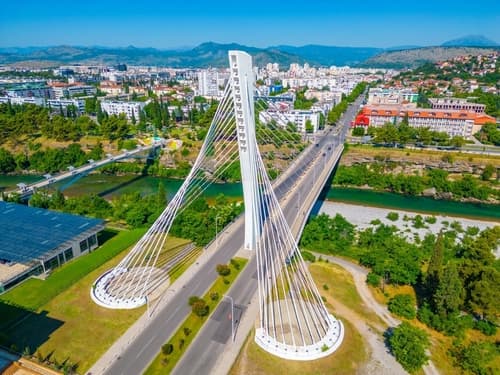
The city was substantially destroyed in the Second World War and rebuilt in the Yugoslav modernist tradition, which gives it a functional rather than photogenic urban aesthetic. The Old Town is small; the river confluences at the city's edge are genuinely beautiful in the way that most cities would make a destination of them. Podgorica does not particularly bother.
For digital nomads, the numbers are among the lowest in Europe. A one-bedroom apartment in the Center or Stari Grad areas runs €350 to €600 a month. Connectivity has improved: fiber coverage has expanded steadily through the urban core, and coworking spaces serve the modest but growing remote-worker community.
Montenegro's status as an EU accession candidate rather than full member means the legal and tax framework requires research for longer stays, but the 90-day arrangement is available to many nationalities without visa requirements.
The honest context: Podgorica rewards those who treat it as a base rather than a destination, who will drive forty minutes to Skadar Lake or two hours to Durmitor and return to low costs and reliable internet. Best months are April through June and September through October.
Cost of living
Cost-of-living calculator
See how your budget stretches in Podgorica.
Estimates use approximate exchange rates and typical monthly costs. Your actual costs will vary.
- Coffee
- $2
- Cheap meal
- $6
- Coworking (day)
- $10
- Mid-range meal for 2
- $28
- Rent (1BR, center)
- $500
- Transit (monthly)
- $18
- Internet (monthly)
- $15
- Rent (1BR, outside)
- $350
EnRoute Jobs AI tool
Real Value Calculator
See what a salary actually leaves you in the country you want to live in.
Neighborhoods
Stara Varoš (Old Town)
Culture, history, traditional dining
The small historic Ottoman-era quarter with the characteristic čaršija (marketplace), a clock tower, and the oldest cafés in the city.
Centar & Bulevar
Professionals, daily life, business
The modern city centre along the main boulevard; government buildings, banks, and the main commercial and restaurant strip.
Zabjelo & Konik
Families, value, long-term residents
The residential satellite suburbs popular with local families and longer-term residents.
Culture
Podgorica is the functional capital of one of Europe's newest EU candidate countries: a small, modern city rebuilt largely from scratch after WWII bombing and focused more on functionality than beauty. It lacks the architectural splendour of Dubrovnik or Kotor (just 90 minutes away), but it has a genuine local warmth, remarkably low costs, a growing café scene on the Ribnica and Morača riverbanks, and serves as the practical base for exploring Montenegro's extraordinary natural landscape.
Climate & best time to visit
Hot continental: very hot summers (July 30–38°C, Podgorica is one of Europe's hottest capitals) and mild, rainy winters (4–12°C). The coast (Budva, 60km away) is much cooler in summer. Best months for Podgorica itself: April–May and September–October.
Best months: April, May, September, October
Tips & safety
- •Podgorica is most useful as a base rather than a destination in itself; the coast (Budva, Kotor) is 1-1.5 hours by car and Ostrog monastery is 1.5 hours away
- •The Stara Varos (old town) area near the Ribnica River junction is the most historically interesting part of the city and has good evening restaurant options
- •Montenegro uses the euro despite not being an EU member; there are no currency exchange complications for European visitors
- •Internet infrastructure in Podgorica is good and accommodation costs are low by Adriatic coast standards; it functions as an underrated work base for those using Montenegro
- •The Moraca Canyon, 10km north of the city, is an extraordinary gorge accessible in under an hour; one of the more dramatic landscapes in the Balkans and almost unknown to visitors
- •Podgorica is safe for visitors; the main concerns are aggressive driving culture and mountain road conditions
- •Heat in July and August can exceed 40 degrees; the city has very little shade infrastructure and midday outdoor activity requires water and planning
- •Medical facilities in Podgorica are functional for basic care; complex or serious situations are typically referred to Serbia; travel insurance matters
- •Emergency number in Montenegro: 112
Areas to avoid: There are no dangerous neighborhoods for visitors in Podgorica; organized crime exists in Montenegro but does not target visitors, Crossing the road is the primary practical safety concern; Montenegrin driving is aggressive and pedestrians do not have effective right of way