.png)
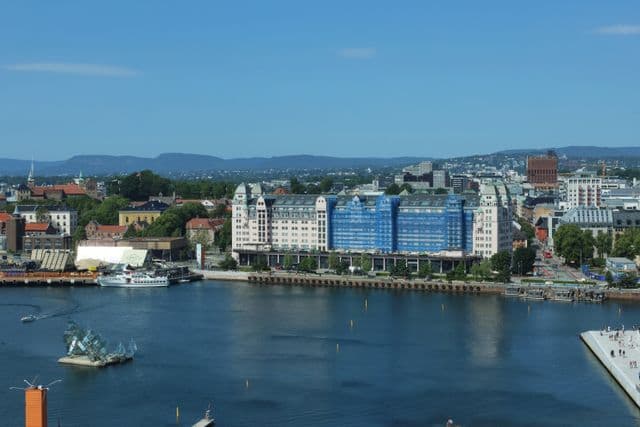
About Oslo
Oslo is expensive and makes no apologies for it. The government revenue that flows from North Sea oil has built a city of exceptional public infrastructure, where the tram arrives on schedule, the trails above the city are free and well-maintained, and the social contract is visibly intact. For geo-flex professionals, the question is not whether Oslo works as a base; it does, efficiently and reliably. The question is whether the cost of that reliability makes sense against what you're earning.
Numbers to know: a one-bedroom apartment in Frogner or Grünerløkka runs €1,400 to €2,000 a month. A sit-down lunch costs €25 to €35. A beer at a bar is €10 to €14. Coworking spaces, including the serious ones at Epicenter Oslo and the independent operators in Tjuvholmen and Majorstuen, are priced accordingly. What is not expensive: the trails, the libraries, the buses within the city, and the fjord views that nobody charges admission for.
The city's character runs quieter than its Scandinavian peers. Stockholm has design culture, Copenhagen has food culture, Oslo has nature culture: weekend hiking from the Nordmarka forest, kayaking on the Oslofjord, skiing at Holmenkollen when winter arrives. Remote workers who find their best focus in clean, calm, aesthetically precise environments tend to function well here.
Best months are May through September, when the long evenings justify the costs. Winter is dark and cold but the city manages it with more equanimity than any place that dark has a right to.
Cost of living
Cost-of-living calculator
See how your budget stretches in Oslo.
Estimates use approximate exchange rates and typical monthly costs. Your actual costs will vary.
- Coffee
- $6
- Cheap meal
- $20
- Coworking (day)
- $40
- Mid-range meal for 2
- $90
- Rent (1BR, center)
- $1,900
- Transit (monthly)
- $85
- Internet (monthly)
- $55
- Rent (1BR, outside)
- $1,400
EnRoute Jobs AI tool
Real Value Calculator
See what a salary actually leaves you in the country you want to live in.
Neighborhoods
Grünerløkka
Creatives, remote workers, independent culture
The most concentrated neighborhood for Oslo's independent café, restaurant, and cultural infrastructure: Thorvald Meyers gate as the main commercial street, Birkelunden park as the social center, and a community of designers, musicians, and younger professionals.
Frogner
Established professionals, higher-end residential
The western residential neighborhood with Vigeland Park, the highest concentration of embassies, and Oslo's most expensive apartments. Calmer and more formal than Grünerløkka; suited to those who want quality without proximity to the nightlife.
Grønland
Budget, diverse community, food culture
The multicultural neighborhood east of the center with Oslo's most affordable food options, a Pakistani and Middle Eastern grocery infrastructure that functions well for daily cooking, and costs below Grünerløkka. The waterfront development is improving connectivity.
St. Hanshaugen / Bislett
Quieter residential, central access
The hillside neighborhoods northwest of the center with good park access (St. Hanshaugen park), a quieter residential character, and good tram connections. Mid-range by Oslo standards and favored by students and young families.
Culture
Oslo is one of the world's most expensive and, by most metrics, most liveable cities: a compact fjord capital of 700,000 people that somehow manages to combine extraordinary natural beauty, outstanding museums, and a social welfare model that genuinely delivers. Norwegian culture values 'janteloven' (the cultural code discouraging showing off) and friluftsliv (outdoor life as philosophy rather than hobby). The combination produces a city where people dress practically rather than fashionably, spend weekends skiing or hiking regardless of status, and take their work-life balance with genuine seriousness.
Climate & best time to visit
Continental with cold winters (January −6 to −2°C, regular snow) and warm sunny summers (July 18–24°C). The fjord landscape at its most dramatic in snow; long evenings in summer are superb. May–August is the high season for a reason.
Best months: May, June, July, August
Tips & safety
- •The Ruter app covers all Oslo transit (T-bane, tram, bus, ferry); a 30-day pass costs NOK 870 (≈€75) and is significantly cheaper than paying per journey
- •The Oslomarka forest begins at the end of several T-bane lines (Frognerseteren, Sognsvann); trail access is free and the skiing infrastructure is public
- •The Maaemo restaurant holds three Michelin stars and is internationally recognized; booking is required months in advance and the tasting menu runs NOK 4,500 per person
- •Supermarket chains (Rema 1000, Kiwi, Coop Prix) are significantly cheaper than Meny or ICA for everyday groceries; alcohol must be purchased at Vinmonopolet stores
- •Monthly apartment costs in Grünerløkka or St. Hanshaugen run NOK 14,000-20,000 (€1,200-1,700); Oslo is expensive but the fjord access is infrastructure-grade
- •The Oslo Public Library (Deichman Bjørvika) is among Europe's finest; it provides free study rooms, 3D printing, recording studios, and roof terrace access
- •Emergency: 112; 110 (fire), 113 (ambulance); English is fully functional at Oslo emergency services
- •Oslo is among the safest capital cities in Europe; violent crime targeting visitors is very rare
- •The fjord swimming areas are cold even in summer (17-19°C maximum) and have varying current conditions; check local signage for designated swimming zones
- •Tap water in Oslo is excellent quality and comes from the Maridalsvannet lake source
Areas to avoid: Accepting drinks from unknown people in nightlife areas; drink spiking incidents targeting foreigners have been reported in Oslo bars, Oslo Sentralstasjon (Oslo S) late at night for lingering; while generally safe the station area has a higher concentration of petty crime than other parts of the city