.png)
About Nuuk
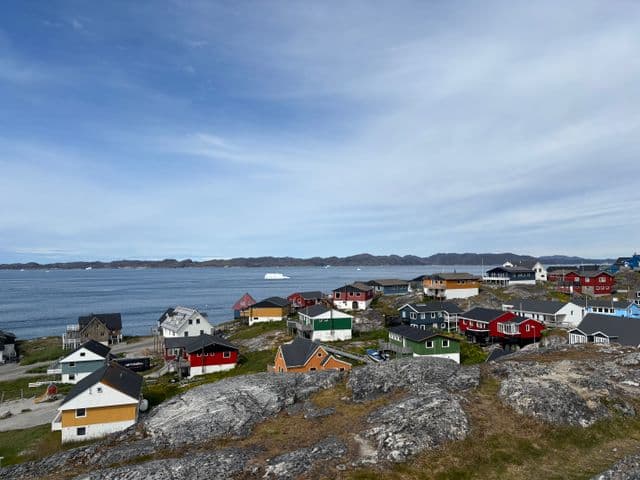
Nuuk is the world''s most remote capital, a distinction that the 18,000 Greenlanders who live here (out of a total national population of 57,000) treat as unremarkable because it is simply their city. The colorful wooden houses ascending the rocky terrain above the fjord, the fishing trawlers at the harbor, and the Greenlandic National Museum holding the mummified Qilakitsoq bodies from the fifteenth century that are the most vivid evidence of pre-colonial Inuit life are all features of a functioning city rather than a curated experience.
For remote workers, Nuuk is a genuine edge-case base: expensive by any standard (everything is flown or shipped in), with limited coworking infrastructure, a small professional community, and connection to the outside world primarily through air link to Copenhagen and occasional transatlantic. What it offers in return is genuinely unlike anything else: the Labrador Sea visible from your kitchen window, northern lights from September through March accessible by walking out the door, and a proximity to one of the world''s last large wildernesses that no other capital on this list can match. One-bedroom furnished apartments run 10,000 to 18,000 DKK per month (approximately 1,440 to 2,600 USD in 2026).
The Naalakkersuisut (Greenlandic government) is actively developing infrastructure as Greenland moves toward a potential independence referendum. The city is in the process of becoming something more than it has been.
Cost of living
Cost-of-living calculator
See how your budget stretches in Nuuk.
Estimates use approximate exchange rates and typical monthly costs. Your actual costs will vary.
- Coffee
- $5
- Cheap meal
- $18
- Coworking (day)
- $30
- Mid-range meal for 2
- $80
- Rent (1BR, center)
- $1,400
- Transit (monthly)
- $50
- Internet (monthly)
- $55
- Rent (1BR, outside)
- $1,100
EnRoute Jobs AI tool
Real Value Calculator
See what a salary actually leaves you in the country you want to live in.
Neighborhoods
City Centre (Kolonien & Nuussuaq)
Daily life, culture, professionals
The compact city centre with government buildings, the Katuaq cultural centre, the Nuuk Art Museum, and the main commercial street.
Nuuk Old Town (Kolonihavn)
History, culture, short-term visits
The oldest part of Nuuk with coloured colonial houses around the harbour; historically significant and increasingly a tourist area.
Qinngorput
Families, long-term residents
The newer residential suburb on the peninsula; modern apartment blocks popular with local families.
Culture
Nuuk is the world's smallest capital by population: a town of 20,000 people at the edge of an Arctic fjord that happens to govern the world's largest island. It is caught between Greenlandic Inuit culture (the language, the traditions, the relationship with the sea) and Danish colonial influence, in a period of rapid change as climate warming transforms the Arctic and Greenlandic political independence becomes an increasingly active debate. The northern lights, the icebergs, and the silence of the surrounding wilderness make it one of the most atmospheric capitals on Earth.
Climate & best time to visit
Subarctic maritime: cold year-round with the warmest month (July) averaging 7–11°C. Winters are extreme (January −12 to −6°C) with limited daylight. Northern lights visible from September through March. Best summer months (June–August) for any outdoor activity or work-life balance.
Best months: June, July, August
Tips & safety
- •Nuuk is the world's most sparsely populated capital; the main sights (National Museum, Katuaq Cultural Centre, old colonial harbor) are all walkable in an afternoon
- •Air Greenland flights from Copenhagen are expensive and book quickly in summer; planning ahead significantly changes the logistics and cost
- •The Greenland National Museum has an exceptional collection including the Qilakitsoq mummies; small but gives the best cultural context for understanding Greenland
- •Food costs are very high given the importation of almost everything; local Greenlandic products (narwhal, musk ox when available) are worth trying regardless of cost
- •Hiking outside the town in summer reveals extraordinary tundra landscape within 30 minutes of the center; boots and waterproof layers are necessary even in July
- •Weather changes quickly and temperatures can drop significantly even in summer; carry waterproof and thermal layers regardless of how the day starts
- •Medical infrastructure is limited; the hospital in Nuuk handles most situations but complex conditions require evacuation to Denmark; travel insurance with medical evacuation is essential
- •Alcohol-related issues are a documented community concern in Greenland; late-night areas warrant awareness though incidents targeting visitors are uncommon
- •The sun in summer never fully sets; blackout curtains or a mask are necessary for normal sleep patterns
Areas to avoid: Nuuk has no dangerous areas in any conventional sense; the city is very small and crime is low by any standard, Venturing onto the ice sheet or into remote wilderness without a qualified guide carries genuine survival risk; this is the only meaningful safety concern beyond basic urban common sense