.png)
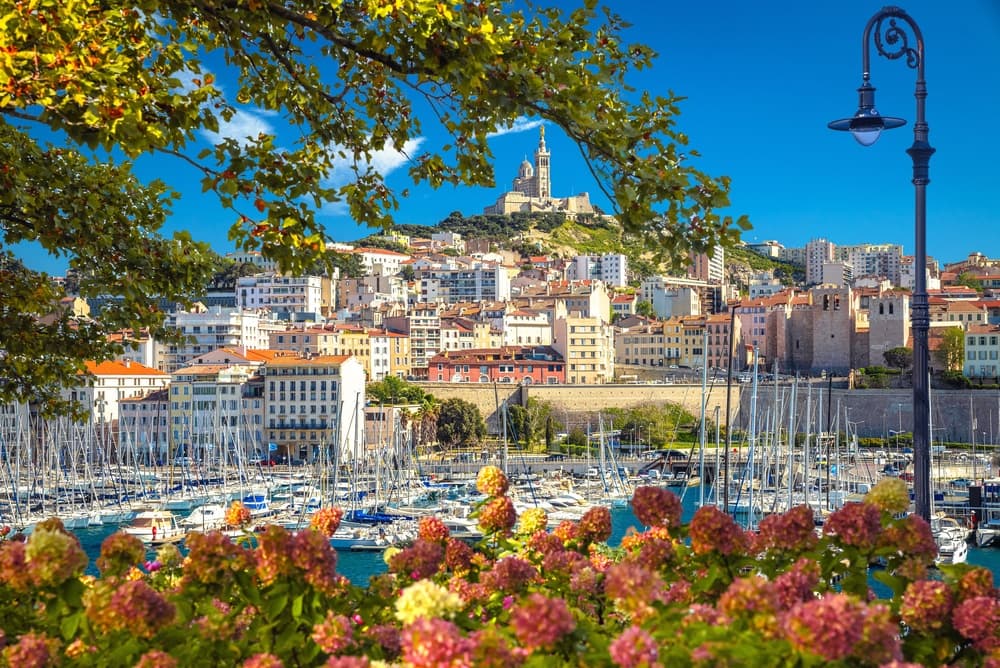
About Marseille
Marseille is the city that France isn't sure what to do with. Paris treats it as a problem to be managed. The rest of France either romanticizes its roughness or avoids it. Marseille itself does not particularly care. It is a Mediterranean port with 2,600 years of history and a talent for absorbing every culture that moves through it, and the energy that produces is unlike anything else in France.
For digital nomads and remote workers, Marseille offers a specific proposition: low costs, serious sun, and a city that rewards the curious and penalizes the unprepared. The Noailles district, just inland from the Vieux-Port, is one of the most genuinely multicultural neighborhoods in Europe: noisy, cheap, and alive. The quieter Cours Julien area and the Estaque coastline offer different registers. A furnished one-bedroom in the 1st or 2nd arrondissement runs €650 to €950 a month; better apartments in the 8th, near the Plages du Prado, run higher.
Connectivity and coworking have improved substantially since 2022. The Euroméditerranée development zone north of the Vieux-Port has pulled in coworking infrastructure, and the SNCF-connected high-speed network links Marseille to Lyon in ninety minutes and Paris in three. Internet quality in newer builds and central districts is reliable; older buildings in the Panier and Belsunce can still be inconsistent.
The honest trade: Marseille requires you to meet it where it is rather than where you'd prefer it to be. For some people that's an exhausting ask. For others, it is precisely the point. Best months are April through June and September through November.
Cost of living
Cost-of-living calculator
See how your budget stretches in Marseille.
Estimates use approximate exchange rates and typical monthly costs. Your actual costs will vary.
- Coffee
- $3
- Cheap meal
- $12
- Coworking (day)
- $20
- Mid-range meal for 2
- $50
- Rent (1BR, center)
- $850
- Transit (monthly)
- $50
- Internet (monthly)
- $28
- Rent (1BR, outside)
- $650
EnRoute Jobs AI tool
Real Value Calculator
See what a salary actually leaves you in the country you want to live in.
Neighborhoods
Le Panier
Artists, history lovers, culture
The oldest neighbourhood in Marseille; a hillside tangle of alleys above the Old Port with street art, studios, and a genuine mix of old Marseillais and new arrivals.
Noailles
Foodies, multicultural living, budget
The vibrant 'belly of Marseille'; the North African and Comorian market area with the best spices, cheap eats, and the most intense street life.
Endoume & Roucas-Blanc
Families, nature lovers, professionals
The southern residential heights with sea views, quieter streets, and proximity to the Calanques National Park.
La Plaine (Cours Julien)
Creatives, young professionals, nightlife
The bohemian arts and nightlife district around the Cours Julien square; street art, live music venues, and independent restaurants.
Culture
Marseille is France's most misunderstood city: wildly different from Paris, famously rough around certain edges, and absolutely alive in ways that its northern rival is not. It is France's oldest city (founded by Greeks in 600 BC), its biggest port, and its most genuinely multicultural; the North African, Comorian, Armenian, and Italian communities that shaped it have created a food culture (bouillabaisse, panisse, socca) and a street energy that is uniquely Marseillais. Its Mediterranean directness can seem brusque to Parisians; to most visitors it reads as refreshing.
Climate & best time to visit
Mediterranean: hot, dry summers (28–33°C, July–August) and mild winters (8–13°C). The Mistral wind can be fierce in winter and spring. April–June and September–October are ideal.
Best months: April, May, June, September, October
Tips & safety
- •The Vieux-Port is the tourist heart but the actual best Marseille experience is in the Noailles and Belsunce markets area, where North African, Asian, and Mediterranean traders create an authentic daily rhythm
- •Bouillabaisse, the city's signature fish stew, is worth having properly once; good versions typically cost 45-60 euros and there is a certification system for the authentic preparation
- •The Calanques national park begins at the edge of the city; boat access from the Vieux-Port or hiking from the Luminy or Cassis ends are both excellent, but the closest calanques require reservation in summer
- •Marseille has a specific, proud local identity; the city rewards those who engage with it on its own terms rather than expecting the tourist smoothness of other French cities
- •The metro and tram system covers the center well; a transport day pass covers all modes including buses to areas not on the tram lines
- •Marseille's crime reputation is partly warranted in specific neighborhoods; in the main visitor and commercial areas, standard European city vigilance covers most situations
- •Pickpocketing and bag snatching are the most common tourist-affecting crimes; keep bags in front and be aware on the metro and in market areas
- •The sea water in the calanques is clean and clear; currents are minimal in the sheltered inlets but the Mediterranean outside the inlets can be stronger than it appears
- •Emergency: 17 police, 15 ambulance
Areas to avoid: Northern neighborhoods including parts of Les Quartiers Nord (around Castellane, Les Flamants, and La Busserine) have some of the highest violent crime rates in France; not tourist areas, The Canebiere and Belsunce area around the central train station have elevated pickpocketing and bag snatching; keep bags secure here, Some areas of Belle de Mai at night warrant standard late-night awareness