.png)
About Ljubljana
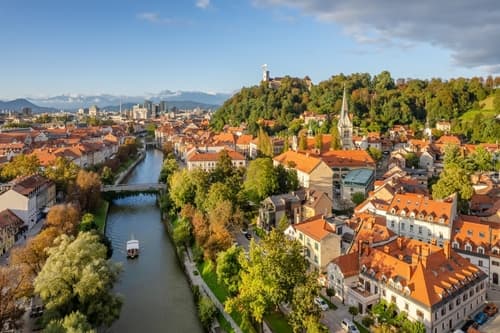
Ljubljana is the capital of Slovenia and is, by any reasonable measure, one of the most pleasant cities in Europe that most people have not yet built an itinerary around. It is small (the population of the city proper sits below 300,000), walkable from one end to the other in under thirty minutes, and organized around a river-threaded center where the car-free Prešernov trg plaza and the castle-topped hill above it create a civic geometry that feels designed for human habitation rather than urban sprawl.
For geo-flex professionals, Ljubljana offers a favorable combination: EU membership, the euro, excellent connectivity, and costs that sit meaningfully below Western European equivalents. A one-bedroom apartment in the Center, Trnovo, or Šiška neighborhoods runs €700 to €1,100 a month. Coworking is present though not abundant: ABC Hub and a handful of independent spaces serve the smaller freelance community. The city's startup scene is modest but genuine, supported by proximity to the Technical University and by EU structural fund investment.
The outdoor proposition is central to the Ljubljana case. From the city center, the Julian Alps are accessible in under an hour. Lake Bled is a fifty-minute drive. The Triglav National Park is one of the most technically accessible mountain environments in Central Europe. Remote workers who want urban infrastructure alongside genuine wilderness access without paying Alpine prices find Ljubljana consistently underrated for this reason.
Best months are May through October. Winters are cold, occasionally very cold, but the city manages them without the grimness that similarly-sized northern European cities can project.
Cost of living
Cost-of-living calculator
See how your budget stretches in Ljubljana.
Estimates use approximate exchange rates and typical monthly costs. Your actual costs will vary.
- Coffee
- $3
- Cheap meal
- $10
- Coworking (day)
- $18
- Mid-range meal for 2
- $40
- Rent (1BR, center)
- $950
- Transit (monthly)
- $28
- Internet (monthly)
- $22
- Rent (1BR, outside)
- $700
EnRoute Jobs AI tool
Real Value Calculator
See what a salary actually leaves you in the country you want to live in.
Neighborhoods
Trnovo
Remote workers, quieter residential, cafés
The neighborhood south of the Old Town along the Gradaščica stream: Ljubljana's best independent café culture on Trnovski Pristan, lower costs than the center, and a genuine residential community.
Tabor / Šiška
Budget, authentic Ljubljana, lower costs
The residential neighborhoods northwest and northeast of the center: the lowest costs in the Ljubljana inner area, good local markets, and a community of Ljubljana's working residential population.
Center (Staro Mestno Jedro)
Short stays, walkability, maximum access
The car-free historical center: the Triple Bridge, the covered market, and the best restaurant density in Slovenia. Higher costs; better for shorter stays than long-term residential.
Culture
Ljubljana is the capital of one of Europe's most underrated countries and possibly the most charming small European capital. It is a city of 300,000 with a Baroque historic centre, a pedestrianised riverfront, an extraordinary café culture, and an arts and food scene that surprises most visitors. Slovenians are deeply proud of their distinct language and identity (neither Serbian, Croatian, nor Austrian, but uniquely Slovenian), and Ljubljana expresses this with a confidence that belies its size.
Climate & best time to visit
Alpine Continental: warm, thundery summers (July 19–28°C) and cold winters (January −4 to 3°C) with reliable snow. Spring (April–May) is beautiful; September–October is excellent. The city is at its best in late spring and early autumn.
Best months: May, June, September, October
Tips & safety
- •The Ljubljana transit (LPP) covers the main routes; cycling is the most practical daily transport in the flat city center - LJ Bike public bikes are available at 36 docking stations
- •The Old Town center is car-free between 6am and midnight; this makes pedestrian and cycling movement genuinely pleasant in a way that most European cities cannot achieve
- •Monthly apartment costs in Trnovo, Tabor, or Bežigrad run €700-1,000; Ljubljana is expensive for a Balkan capital but affordable compared to Western Europe
- •The Ljubljana Castle is free to enter the grounds; the funicular railway costs €5 for the return trip
- •Slovenia's Julian Alps (Triglav, Lake Bled, Soča Valley) are all within 1-2 hours drive; Ljubljana functions as an excellent base for alpine access without alpine costs
- •The Plečnik architecture is a consistent visual thread through the city; the Jože Plečnik Museum provides context for the Triple Bridge, the covered market, and the National Library
- •Emergency: 112; 113 (police), 112 (ambulance)
- •Ljubljana is one of the safest small capitals in Europe; violent crime is extremely rare
- •Cycling safety: the city infrastructure is good but shared paths between cyclists and pedestrians require attention at speed
- •Tap water in Ljubljana is excellent quality, coming from underground aquifers
Areas to avoid: Fužine and parts of Polje at night; outer housing estate neighborhoods with less lighting and infrastructure