.png)
About Limassol
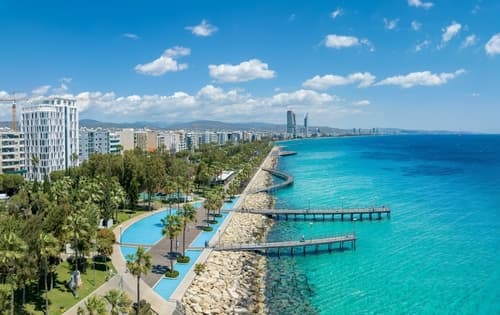
Limassol is Cyprus's fastest-growing city and its most international, shaped in the past decade by the influx of Israeli tech workers, Russian business interests, and the EU passport investment programs that the government has since discontinued but whose consequences for the city's development remain visible. The result is a city that has added gleaming marina developments, high-end restaurant infrastructure, and a coworking ecosystem at a pace that has outrun its historical character.
For remote workers, Limassol's case rests on Cyprus's tax structure (one of the most favorable in the EU for businesses and individuals), the year-round Mediterranean climate, and the English-language environment that makes daily life frictionless in ways that other Eastern Mediterranean cities do not. Rent anchors the cost of living in Limassol. Monthly rents in the Germasogeia and Neapolis neighborhoods run $900 to $1,600 for a furnished apartment: higher than mainland Southern Europe alternatives but reflecting the combination of climate, infrastructure, and tax efficiency.
The old city center (Agora) retains a characterful core of stone buildings, a covered market, and the Limassol medieval castle. The beaches east of the marina are the city's outdoor infrastructure. The Troodos Mountains, an hour's drive north, provide hiking in summer and occasional snow in winter.
Cost of living
Cost-of-living calculator
See how your budget stretches in Limassol.
Estimates use approximate exchange rates and typical monthly costs. Your actual costs will vary.
- Coffee
- $3
- Cheap meal
- $11
- Coworking (day)
- $20
- Mid-range meal for 2
- $45
- Rent (1BR, center)
- $1,000
- Transit (monthly)
- $35
- Internet (monthly)
- $25
- Rent (1BR, outside)
- $750
EnRoute Jobs AI tool
Real Value Calculator
See what a salary actually leaves you in the country you want to live in.
Neighborhoods
Old Town and Limassol Marina
Culture, dining, expats
Historic centre and new marina development with excellent restaurants.
Potamos Germasogeias
Expats, families, beach life
Prime beachside expat area with tourist strip and nightlife.
Agios Tychonas
Wealthy residents, privacy
Upscale hillside area with villas and sea views.
Getting around
- overview
- Car recommended; city spread along coast. Buses available but limited. Taxis and Bolt widely used.
Culture
Limassol's culture is Greek Cypriot at its core, shaped by the specific history of the island's 1974 division and by the subsequent decades of development on the southern side. The displacement of Greek Cypriots from the northern part of the island, many of whom resettled in Limassol and the surrounding villages, gives the city a particular sensitivity to the question of the island's division that occasionally surfaces in unexpected ways. The carnival in February is one of the most colorful in Greece and Cyprus, with a tradition that mixes Venetian and Ottoman influences. The wine culture of the Commandaria region in the Troodos foothills east of Limassol produces one of the world's oldest documented wines, a sweet dessert wine mentioned by the Crusaders.
Climate & best time to visit
Hot Mediterranean: very hot, dry summers (July–August: 30–35°C) and mild winters (December–February: 10–17°C). Cyprus has more annual sunshine than anywhere else in Europe. October–November and March–April are ideal: post-heat, pre-summer, with full infrastructure.
Best months: March, April, October, November
Tips & safety
- •Car recommended; the city is spread along the coast. Buses available but limited. Taxis and apps widely used.
- •Moderate to expensive. One-bed rent €900–1,600/month.
- •Cyprus is very safe by EU standards; petty crime is low and violent crime is rare.
- •Heat from May through October is significant; hydrate well and avoid midday outdoor activity in summer.
- •Driving is on the left (UK system); rental car drivers from mainland Europe should account for this.
- •The main coastal road (Makarios Avenue) has fast-moving traffic; cross only at marked pedestrian signals.
Areas to avoid: The old industrial port area north of the marina is being redeveloped but has stretches that feel isolated at night., The area around Omonia Square in the old town sees some street-level activity very late at night; standard precaution applies.