.png)
About Kraków
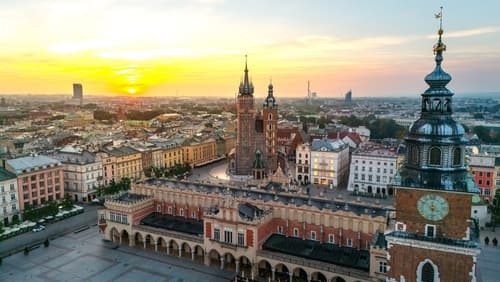
Kraków is Poland's cultural capital in every sense that Warsaw, the political and economic capital, cannot claim. The Wawel Castle above the Vistula, the largest medieval market square in Europe at Rynek Główny, the Jewish quarter of Kazimierz with its history too large and too recent to frame comfortably: these are the things that set Kraków apart not just from other Polish cities but from most European capitals.
For geo-flex professionals, the practical case is strong and well-documented. A one-bedroom apartment in Kazimierz, Podgórze, or the Stare Miasto (Old Town) area runs €500 to €800 a month, in a city with EU membership, excellent fiber connectivity, and a student population of 200,000 that generates the café and coworking infrastructure those numbers imply. Kraków has one of the densest coworking markets in Poland: CoPro, Brain Embassy, and a network of independent spaces in Kazimierz serve a large community of international and domestic remote workers.
The city's history is heavier than most. Auschwitz-Birkenau is forty-five minutes by car or bus; the weight of this is present in the city's cultural life in ways that require acknowledgment rather than management. Those who engage with it rather than bracket it tend to experience Kraków differently, more honestly.
The food and nightlife culture is serious and low-cost: Kazimierz's bars, the milk bars that still serve cheap traditional Polish food, and the restaurant scene emerging in Podgórze over the past several years give the city a social life that costs a fraction of Western European equivalents. Best months are May through September; winters are cold but the Christmas market at Rynek Główny is among the most genuine in Europe.
Cost of living
Cost-of-living calculator
See how your budget stretches in Kraków.
Estimates use approximate exchange rates and typical monthly costs. Your actual costs will vary.
- Coffee
- $2
- Cheap meal
- $8
- Coworking (day)
- $15
- Mid-range meal for 2
- $32
- Rent (1BR, center)
- $750
- Transit (monthly)
- $22
- Internet (monthly)
- $15
- Rent (1BR, outside)
- $520
EnRoute Jobs AI tool
Real Value Calculator
See what a salary actually leaves you in the country you want to live in.
Neighborhoods
Kazimierz
Remote workers, creative culture, coworking
The former Jewish quarter south of the Old Town: the best café and coworking density in Kraków (CoPro, Brain Embassy nearby), independent restaurants and bars, and a mix of international professionals and Polish creative workers.
Podgórze
Creatives, lower costs, emerging
The neighborhood across the Vistula from Kazimierz with industrial conversion culture, the Schindler's Factory museum, and costs below Kazimierz. Plac Bohaterów Getta is the neighborhood's historical center.
Stare Miasto (Old Town)
Short stays, culture, Rynek Główny access
The medieval center with Europe's largest medieval market square: tourist-priced, beautiful, and impractical as a long-term residential base.
Dębniki / Salwator
Families, university proximity, quieter base
The residential neighborhoods across the river from the Old Town: quieter, good park access to Skałki Twardowskiego, and lower costs than Kazimierz.
Culture
Kraków is Poland's most beautiful city and its cultural capital: a royal city that was spared the WWII destruction that levelled Warsaw, and as a result has an intact medieval centre of astonishing quality. The Wawel Castle, the vast Rynek Główny square, the Jewish quarter of Kazimierz, and the memory of Auschwitz (90 minutes away) all coexist in a city that is simultaneously a living destination for young Poles, a major tourist city, and a site of profound historical weight.
Climate & best time to visit
Continental, slightly milder than Warsaw. Warm summers (July 18–26°C) and cold winters (January −4 to 1°C) with Tatra Mountain context. May and September–October are the best months: pleasant weather and manageable tourist volumes relative to peak July–August.
Best months: May, September, October
Tips & safety
- •Kraków public transport (MPK) monthly pass costs around PLN 110 (€25); the Old Town center is compact enough to walk but trams reach outlying neighborhoods efficiently
- •The Kazimierz district's Jewish heritage is most accessible through the Galicia Jewish Museum and the guided walking tours run by the local community organizations
- •Monthly apartment costs in Kazimierz or Podgórze run PLN 1,800-3,200 (€420-730); excellent value by EU capital comparison
- •The Wieliczka Salt Mine (30 minutes by bus or train) is genuinely extraordinary underground; book tickets in advance as queue times are significant
- •Milk bars (bar mleczny) in Kraków are cheaper than in Warsaw and the quality varies significantly; Bar Mleczny "Pod Temidą" on Grodzka is among the better ones
- •Auschwitz-Birkenau is 70km west by bus or organized transport; the site requires 3-4 hours minimum and advance tickets for the guided sections
- •Emergency: 112; 997 (police), 999 (ambulance)
- •Kraków is generally safe; the primary concern is overcharging in tourist-facing restaurants near the Rynek and occasional pickpocketing during festival events
- •The Vistula flood plain can affect the Kazimierz and Podgórze areas during extreme spring rainfall; check flood level indicators on the river bank
- •Tap water is safe throughout Kraków
Areas to avoid: The Nowa Huta district alone at night without local knowledge; the Soviet-planned industrial suburb is genuinely interesting architecturally but is at some remove from the city's main infrastructure