.png)
About Hamburg
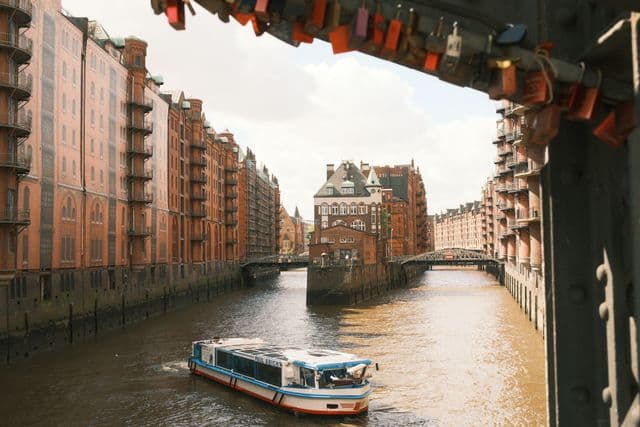
Hamburg is the city that Germany builds its commercial relationship with the world through, which means it is different from Munich''s Bavarian confidence and from Berlin''s creative disruption. The port, the second-largest in Europe after Rotterdam, is still functional and still defines the city''s character: the Speicherstadt warehouse district (UNESCO listed, now converted to museums, offices, and the Miniatur Wunderland), the fish market on Sunday mornings, and the Reeperbahn''s entertainment district that has been serving seafarers since the eighteenth century all descend from the same commercial logic.
For remote workers, Hamburg is the German city with the best balance between Berlin''s creative energy and Munich''s infrastructure, at costs that fall between the two. One-bedroom furnished apartments in the Altona or Eimsbüttel neighborhoods run 1,000 to 1,600 EUR per month. The coworking market (Mindspace, Spaces, Betahaus Hamburg, and the dense independent scene in the Schanzenviertel) serves a tech and media community that is the largest in Germany outside Berlin. The Alster lake system and the extensive park network make Hamburg one of the greener large German cities, and the harbor promenade has been the city''s public living room in all weather since the Jungfernstieg was laid in 1663.
The music culture, from the Beatles'' early Hamburg years at the Kaiserkeller to the contemporary electronic and indie scenes in the Schanzenviertel, is the creative legacy of a port that always received more than goods.
Cost of living
Cost-of-living calculator
See how your budget stretches in Hamburg.
Estimates use approximate exchange rates and typical monthly costs. Your actual costs will vary.
- Coffee
- $3
- Cheap meal
- $13
- Coworking (day)
- $25
- Mid-range meal for 2
- $55
- Rent (1BR, center)
- $1,400
- Transit (monthly)
- $95
- Internet (monthly)
- $40
- Rent (1BR, outside)
- $1,000
EnRoute Jobs AI tool
Real Value Calculator
See what a salary actually leaves you in the country you want to live in.
Neighborhoods
Eimsbüttel
Remote workers, families, mid-range residential
The residential neighborhood northwest of the Alster lakes: Eimsbüttel Markt on Saturdays, the Osterstrasse café corridor, and a settled professional and family community. Consistent with what Hamburg's international professional community generally recommends.
Altona / Ottensen
Creatives, younger professionals, independent culture
The western neighborhood with the Altona fish market (Sunday 5am-10am), the Ottensen pedestrian zone with independent shops, and a community that has made this Hamburg's most internationally recognized residential area.
Eppendorf
Higher-end residential, families, park access
The northern bourgeois neighborhood: Eppendorfer Baum as the commercial center, the Alster lake access, and a wealthier settled community in high-quality apartment stock.
Culture
Hamburg is Germany's great port city: a wealthy, cosmopolitan Hanseatic city that made its money from trade and still wears that mercantile confidence proudly. It has Europe's largest red-light district (the Reeperbahn), one of the world's great opera houses, the Beatles' origins story, and the newly developed HafenCity (Europe's largest inner-city urban development project) all competing for attention. Hamburg people are businesslike, independent, and slightly amused by any suggestion that their city is second to Munich.
Climate & best time to visit
Temperate maritime, windier and cooler than Munich. Summers mild (17–22°C); winters cold and grey (0–4°C). June–August offers long evenings and the city's vibrant Alster waterfront culture at peak. Expect rain year-round.
Best months: June, July, August
Tips & safety
- •The HVV monthly pass covers all U-Bahn, S-Bahn, bus, and harbor ferry within the Hamburg zones; around €95/month
- •The Hamburg harbor ferry (routes 62 and 73) functions as public transit and crosses the Elbe to the Elbphilharmonie side; standard HVV tickets apply
- •Monthly apartment costs in Eimsbüttel, Altona, or Eppendorf run €1,100-1,600 furnished; Hamburg is expensive but the harbor city infrastructure and quality of life justify it for longer stays
- •The Speicherstadt warehouse district and HafenCity development are free to walk through and provide the best architectural urban transformation in Germany over the past 20 years
- •The Reeperbahn (St. Pauli) is Hamburg's famous entertainment district; visit during the day for the Beatles connection (Indra Club, Kaiserkeller), understand it operates differently after midnight
- •Hamburg's port is the third largest in Europe; the harbor boat tours (Barkassen) on the inner harbor run year-round and provide a useful perspective on the industrial scale
- •Emergency: 110 (police), 112 (fire/ambulance)
- •Hamburg is generally safe; the primary concern for visitors is petty theft in the central station and around the Reeperbahn
- •The Elbe flood events (Sturmflut) are a real infrastructure risk; Hamburg's flood protection is sophisticated but coastal residents follow the alerts seriously
- •Tap water is safe and excellent quality throughout Hamburg
Areas to avoid: The Reeperbahn and Herbertstrasse area (men only) after midnight; the concentrated sex industry infrastructure and the associated late-night street economy make the environment unpredictable after 2am