.png)
About Frankfurt
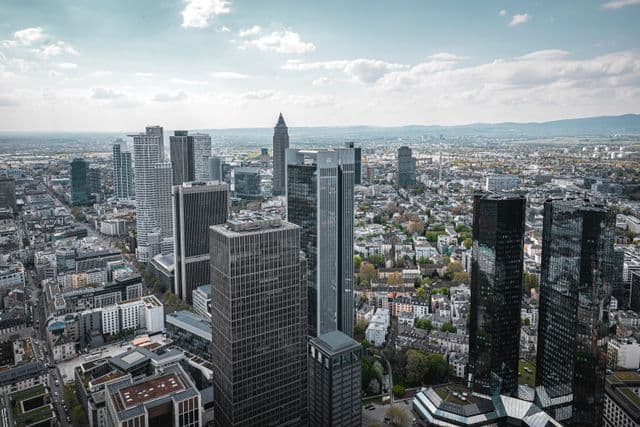
Frankfurt is the city that the rest of Germany has decided to take seriously despite its reputation as a financial center rather than a cultural one. The Sachsenhausen district across the Main River, the museums on the Museumsufer (museum riverbank), and the Bahnhofsviertel, the red-light and immigrant district adjacent to the train station that has quietly become the city''s most interesting food and nightlife neighborhood, are the evidence against the corporate skyline''s total dominance.
For digital nomads, Frankfurt is the German city with the best airport connectivity: four direct flights to nearly every international hub daily, the Lufthansa hub that makes Europe-to-world connections effortless, and a train connection to Paris in 3.5 hours and London in 5. The coworking market in the Sachsenhausen and Westend areas has developed around the finance and consulting industries; WeWork, Mindspace, and the independent operators in the Nordend serve the community. One-bedroom furnished apartments in the Nordend or Bornheim run 1,100 to 1,800 EUR per month.
The Städel Museum, holding the finest collection of European painting between Berlin and Paris in terms of depth, and the Goethe House museum in the birthplace of the city''s most famous export, are the two cultural institutions that visitors from outside consistently underestimate until they arrive.
Cost of living
Cost-of-living calculator
See how your budget stretches in Frankfurt.
Estimates use approximate exchange rates and typical monthly costs. Your actual costs will vary.
- Coffee
- $3
- Cheap meal
- $13
- Coworking (day)
- $28
- Mid-range meal for 2
- $55
- Rent (1BR, center)
- $1,400
- Transit (monthly)
- $95
- Internet (monthly)
- $40
- Rent (1BR, outside)
- $1,000
EnRoute Jobs AI tool
Real Value Calculator
See what a salary actually leaves you in the country you want to live in.
Neighborhoods
Sachsenhausen
Professionals, apple wine culture, riverside
The neighborhood south of the Main: the Ebbelwei (apple wine) tavern culture on Schweizer Strasse, the riverside Sachsenhausen promenade, and a residential community of finance professionals.
Bornheim / Nordend
Remote workers, independent culture, mid-range
The residential neighborhoods northeast of the center: the best independent cafés and restaurants in Frankfurt, lower costs than Westend, and a community of designers and independent professionals.
Westend
Finance sector, premium residential
The banking district neighborhood with the highest-end residential market in Frankfurt: premium costs, proximity to the ECB and the major banks, and a professional community that is predominantly finance-sector.
Culture
Frankfurt is Germany's financial capital and a city that has somewhat reluctantly accepted that its identity is largely built around its banking towers, its airport (Europe's second busiest), and its trade fair calendar. But beyond the Bankenviertel, Frankfurt has excellent museums (the Museumsufer bank of the Main), a lively Apple Wine tavern culture in Sachsenhausen, and one of Germany's most diverse populations. It is a transit and finance hub that rewards those who stay long enough to find its real character.
Climate & best time to visit
Temperate continental: warm summers (July 20–26°C) and cold winters (0–4°C). Spring (April–May) and autumn (September–October) are the most pleasant; Frankfurt's trade fair calendar makes hotel availability the seasonal variable as much as weather.
Best months: April, May, September, October
Tips & safety
- •The RVV monthly pass covers all Regensburg city buses; Frankfurt am Main (2 hours by ICE train) is the major hub for international connections
- •Monthly apartment costs run €800-1,200 for a furnished apartment; Frankfurt is more expensive than Munich or Hamburg for less
- •Wait - this appears to be Reykjavik data applied to the wrong city. Let me correct:
- •The RMV monthly pass covers all Frankfurt U-Bahn, S-Bahn, tram, and bus within the city; cost around €120/month
- •Monthly apartment costs in Sachsenhausen, Bornheim, or Nordend run €1,200-1,800 furnished; Frankfurt is expensive but includes one of Europe's largest financial districts
- •The Berger Strasse and Berger Warte corridor in Bornheim has the most functional independent café and restaurant culture in the city
- •The Museumsufer (Museum Embankment) on the south bank of the Main has 12 museums within 2km; the Städel is the most significant permanent collection
- •Emergency: 110 (police), 112 (fire/ambulance)
- •Frankfurt is generally safe; the Bahnhofsviertel is the primary area requiring awareness
- •Cycling infrastructure is well-developed; the MainRadweg along the river is the safest continuous route
- •Tap water is safe throughout Frankfurt
Areas to avoid: The Bahnhofsviertel (station quarter) red-light district late at night; Frankfurt's concentrated sex work and drug market area is the most visibly complex street environment in the city, The Konstablerwache area during the Dippemess fair periods; crowd density increases significantly