.png)
About Dublin
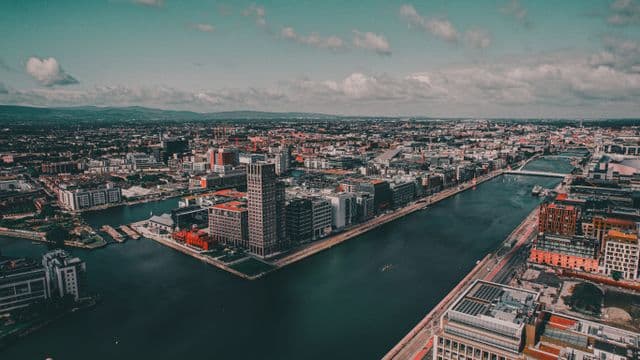
Dublin grew faster in the past thirty years than its infrastructure was designed to accommodate, which is the honest version of the technology capital story. The corporate headquarters of Google, Meta, LinkedIn, Twitter, Airbnb, and most of the major US tech platforms in Europe are here because of the 12.5% corporate tax rate, the English language, and the EU market access. What followed them was a housing crisis and a cost of living that has made Dublin one of the more expensive European capitals for younger workers.
The city''s bones are good. The Georgian squares of the southside (Merrion, Fitzwilliam), the Victorian markets of Moore Street, the literary pubs of the cultural quarter around Temple Bar, and the two canals that mark the inner city''s limits give Dublin a scale and a character that the tech concentration has not entirely homogenized. The Liberties on the southside, the historic textile and distillery district, and the Stoneybatter and Phibsborough areas on the north have absorbed the professional migration with more of their original character intact.
For digital nomads on European income, the number that matters is accommodation: one-bedroom furnished apartments in the Ranelagh or the South Circular Road neighborhoods run 1,600 to 2,400 EUR per month. Coworking (Dogpatch Labs, Huckletree, and a dense market in the Grand Canal Dock area, the local ''Silicon Docks'') is well-provisioned. The Luas tram and Dublin Bikes reduce dependence on an unreliable bus network.
Cost of living
Cost-of-living calculator
See how your budget stretches in Dublin.
Estimates use approximate exchange rates and typical monthly costs. Your actual costs will vary.
- Coffee
- $5
- Cheap meal
- $17
- Coworking (day)
- $30
- Mid-range meal for 2
- $75
- Rent (1BR, center)
- $2,200
- Transit (monthly)
- $120
- Internet (monthly)
- $45
- Rent (1BR, outside)
- $1,700
EnRoute Jobs AI tool
Real Value Calculator
See what a salary actually leaves you in the country you want to live in.
Neighborhoods
Stoneybatter / Smithfield
Remote workers, independent culture
The neighborhood north of the Liffey that has the best independent café culture in Dublin: the North Circular Road, Manor Street, and the Smithfield plaza area. Good value relative to the Southside and a genuinely local community.
Rathmines / Rathgar
Longer stays, families, established residential
The south Dublin suburban neighborhoods with good supermarket access on Rathmines Road, Victorian residential streets, and a large student population from the nearby UCD and TU campuses.
Portobello / Ranelagh
Professionals, mid-range, canal side
The canal-side neighborhoods south of the center: Portobello for the independent restaurants along the canal, Ranelagh for the village high street character and slightly higher costs.
Liberties / Kilmainham
History, lower costs, creative
The oldest part of Dublin: Guinness Storehouse proximity, the Irish Museum of Modern Art at Kilmainham Gaol, and lower costs than the Southside. The most historically layered of Dublin's neighborhoods.
Culture
Dublin is a city that has transformed from a parochial capital into one of Europe's most dynamic and diverse cities in a single generation. The tech hub status (Google, Meta, Salesforce, LinkedIn all have European HQs here) has brought tens of thousands of international workers and driven rents to London levels. But the essential Dublin (the pub culture, the literary heritage, the wit, and the capacity for craic) remains genuinely intact. The Irish pub is not a tourist construct here; it is the living room of the city.
Climate & best time to visit
Cool maritime, green, and reliably damp. Temperatures range from 5–8°C in winter to 16–20°C in summer; frost is rare. June and July offer the best combination of long daylight and reasonable warmth.
Best months: May, June, July, August
Tips & safety
- •The Luas tram and Dublin Bus cover most of the city; the Leap Card works on both and across Dart rail; a monthly adult cap is around €140
- •Forty Foot at Sandycove (15 min Dart from central Dublin) is a sea swimming spot that operates year-round with a dedicated community; water temperature averages 10-14°C
- •Monthly apartment costs in Stoneybatter, Rathmines, or Phibsborough run €1,400-2,000; Dublin is expensive by European standards
- •The Liberties and the Iveagh Markets on Francis Street provide the best affordable vintage and antique hunting in the city
- •Grocery costs at Lidl and Aldi are meaningfully lower than Tesco or SuperValu; most neighborhoods have one within walking distance
- •Ireland operates on the Irish Business Inbox system for formal communications; many services still require in-person attendance with physical documents
- •Emergency: 999 or 112; Garda (police) and ambulance dispatch through both
- •Dublin is generally safe; the main concerns are pickpocketing on the Luas red line in the city center and occasional late-night incidents near Temple Bar
- •Cycling in Dublin is improving but infrastructure is inconsistent; the Grand Canal cycle path and the Phoenix Park are the safest routes
- •Tap water is safe throughout Dublin
Areas to avoid: O'Connell Street late at night; the main northside thoroughfare sees the most late-night antisocial behavior in Dublin, Tallaght and parts of the north inner city (Sheriff Street, Ballymun) without local knowledge; these areas have higher crime rates than the tourist center