.png)
About Cork
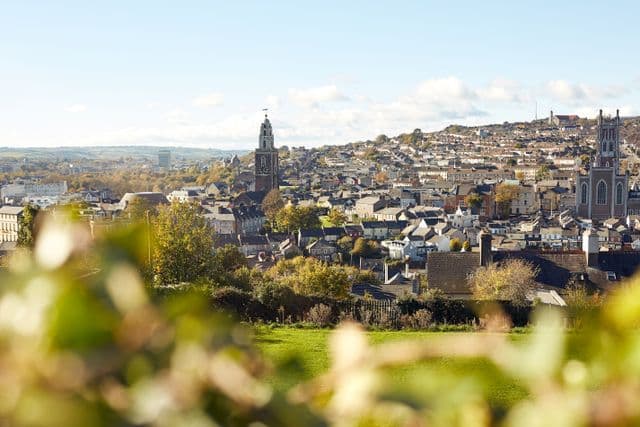
Cork is Ireland's second city and the first to mention that it's the real capital, a civic self-regard the city maintains with enough humor to make it charming rather than insufferable. It is smaller than Dublin by every measure but also less expensive, less clogged with tourism infrastructure, and arranged on an island in the River Lee in a way that gives it a distinctive waterway geography and a center that is entirely walkable.
For remote workers, the practical case is specific. A one-bedroom apartment on the island center or in the Shandon or Douglas areas runs €1,000 to €1,400 a month, lower than Dublin but still meaningful by European standards. Coworking has improved substantially in the past four years; The Rubicon Centre at MTU, IGNITE in the city center, and a network of independent spaces near the English Market serve the growing remote-worker community. Connectivity is generally good, though older building stock in some neighborhoods can still be inconsistent.
Cork's food culture runs deeper than its size suggests. The English Market, one of the oldest covered food markets in Europe, is the literal center of what Cork takes most seriously about itself. The city's proximity to some of Ireland's most dramatic coastal scenery, including the Sheep's Head and Mizen Head peninsulas within an hour's drive, gives weekends a particular quality.
The honest note: Cork's tech and startup ecosystem has grown around the presence of Apple's European headquarters in nearby Hollyhill, which has pulled secondary companies into the area. For tech workers specifically, the professional network here is deeper than the city's scale implies. Best months are May through September.
Cost of living
Cost-of-living calculator
See how your budget stretches in Cork.
Estimates use approximate exchange rates and typical monthly costs. Your actual costs will vary.
- Coffee
- $4
- Cheap meal
- $15
- Coworking (day)
- $25
- Mid-range meal for 2
- $65
- Rent (1BR, center)
- $1,600
- Transit (monthly)
- $90
- Internet (monthly)
- $40
- Rent (1BR, outside)
- $1,200
EnRoute Jobs AI tool
Real Value Calculator
See what a salary actually leaves you in the country you want to live in.
Neighborhoods
Shandon / Northside
Authentic Cork, lower costs
The traditional northside working-class neighborhood: the Shandon Bells church, the Cork Butter Museum, and a community that has always been more Cork than the tourist-facing south and east.
Douglas / Ballintemple
Families, quieter residential, south side
The leafy south Cork neighborhoods with the Douglas Village commercial strip, good schools, and the suburban residential infrastructure preferred by Cork's professional families.
City Center / Leeside
Maximum convenience, short stays
The island center with the English Market, the main shopping streets, and the highest café and restaurant density in the city.
Culture
Cork is Ireland's second city but proudly considers itself the 'real capital', a distinction locals maintain with amused conviction. The city has a strong independent identity shaped by its history as a major port, its role in the Irish War of Independence (Michael Collins was from Cork), and a food culture centred on the famous English Market that has made it one of Ireland's culinary capitals. It has a smaller, warmer, more manageable character than Dublin without sacrificing ambition.
Climate & best time to visit
Mild and wet with Atlantic influence. Slightly warmer and wetter than Dublin; summers rarely top 22°C, winters stay above freezing. May–September is the working sweet spot.
Best months: May, June, July, August
Tips & safety
- •Cork city is walkable; Bus Éireann covers the suburbs and the Cork commuter rail connects Cobh and Midleton
- •The English Market (Monday-Saturday, 8am-6pm) is one of the finest covered food markets in Ireland and functions as real daily infrastructure rather than a tourist product
- •Monthly apartment costs in Douglas, Ballintemple, or the city center run €1,200-1,700; Cork has become Ireland's second most expensive city as Dublin overspill has arrived
- •The Lee Valley Walk and the Cork Harbour area provide excellent cycling infrastructure without requiring a car
- •Kinsale (30 minutes south) is the best food destination within reach of Cork and worth a full day trip
- •Cork has a strong independent music and arts scene concentrated around the Triskel Arts Centre and the Granary Theatre
- •Emergency: 999 or 112
- •Cork is generally safe; the main concerns are occasional late-night incidents on the main nightlife streets around Washington Street
- •The River Lee flooding during extreme rain events can affect low-lying areas near the quays; the Cork City Flood Warning System provides advance notice
- •Tap water is safe throughout Cork
Areas to avoid: Parts of the northside (Knocknaheeny, Farranree) late at night; higher crime rates than the south side residential areas