.png)
About Bergen
Bergen is Norway's second city in population and its first in rain. The seven mountains that ring the city catch weather systems rolling off the North Atlantic with an efficiency that keeps everything green and everything slightly damp. Locals call it raining when the sky does anything other than shine, which means they acknowledge it often. This does not stop them from being outside continuously.
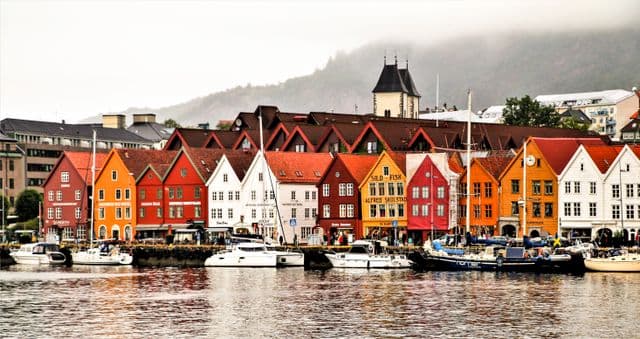
For remote workers, Bergen offers something Oslo doesn't: a smaller city with a genuine historic center, a tight community of creative and technical freelancers, and costs that are still high by most European standards but meaningfully lower than the capital. A one-bedroom apartment in Sandviken or Nordnes runs €1,000 to €1,500 a month. The Bryggen wharf on the inner harbor, one of the most photographed places in Norway, is surrounded by cafés and coworking spaces that have learned to capitalize on the remote-worker influx without entirely losing the character that made the area interesting.
Bergen's connectivity to the rest of Norway is good: the Bergen Railway to Oslo takes about seven hours and is widely considered one of the most beautiful train journeys in Europe, which is not a coincidence given the terrain. Flesland airport connects the city to European hubs directly. The university area around Nygårdsparken provides the best coworking concentration outside the city center.
The honest note: Bergen works exceptionally well for people who want a contained, walkable, culturally rich base that does not demand constant engagement with urban scale. If you need a large city's energy and anonymity to do your best work, Oslo is the answer. Bergen is for the opposite instinct. Best months are June through September; the rest is green and wet and genuinely beautiful.
Cost of living
Cost-of-living calculator
See how your budget stretches in Bergen.
Estimates use approximate exchange rates and typical monthly costs. Your actual costs will vary.
- Coffee
- $5
- Cheap meal
- $16
- Coworking (day)
- $30
- Mid-range meal for 2
- $75
- Rent (1BR, center)
- $1,600
- Transit (monthly)
- $80
- Internet (monthly)
- $50
- Rent (1BR, outside)
- $1,200
EnRoute Jobs AI tool
Real Value Calculator
See what a salary actually leaves you in the country you want to live in.
Neighborhoods
Bryggen & Vagen
Tourists, culture, seafood dining
The famous UNESCO-listed Hanseatic wharf district around the harbour; the face of Bergen to the world.
Sandviken
Residential, quiet, local character
The neighbourhood north of Bryggen with beautiful traditional wooden houses climbing the hillside.
Nordnes
Families, expats, outdoor lovers
The peninsula neighbourhood west of the harbour; family-friendly, walkable, with an aquarium and sea views.
Culture
Bergen is the gateway to the Norwegian fjords and a city of extraordinary natural drama: seven mountains surround it, the Bryggen Wharf (a UNESCO Hanseatic trading post) frames its harbour, and rain falls on approximately 240 days a year. Bergensers are famously proud of their city and refreshingly unsentimental about its climate. The city has a strong arts scene (Edvard Grieg was born here), a busy fish market, and an identity quite distinct from Oslo; the rivalry between Norway's two largest cities is genuine and affectionate.
Climate & best time to visit
One of Europe's wettest cities; over 2,200mm of rain annually. Mild year-round (1–20°C range) but reliably overcast and damp. The surrounding fjords are beautiful in any weather. June–August offers the best odds of clear skies.
Best months: June, July, August
Tips & safety
- •Bergen receives approximately 239 days of rain per year on average; this is not an exaggeration, and a quality waterproof jacket and waterproof footwear are the most important items to pack
- •The Flobanen funicular to Mount Floyen takes 8 minutes from the city center and provides a comprehensive view of Bergen and the surrounding fjords
- •Bryggen Wharf restaurants charge significantly more than those one block behind the tourist-facing frontage; the same food quality costs considerably less on the back streets
- •Bergen Airport is 20 minutes by light rail (Bybanen) from the city center; the light rail is the most practical airport connection and runs directly to most central areas
- •The covered Kjottbasaren market is where to buy actual fresh fish at actual prices; the outdoor fish market on the quay is priced for tourists
- •Rain is the primary practical challenge; inadequate waterproofing makes most outdoor activity genuinely unpleasant regardless of season
- •The wooden Bryggen boardwalks are slippery when wet, which is often; footwear with grip matters
- •Weekend nightlife in the harbor area can be rowdy after midnight but serious incidents are rare and emergency response is strong
- •Emergency number: 112
Areas to avoid: Bergen has no dangerous neighborhoods; Norway has very low violent crime rates and this applies to Bergen as fully as any other Norwegian city, The area behind the main bus terminal at night has occasional minor issues by Norwegian standards, which remain very mild compared to most European capitals