.png)
About Liechtenstein
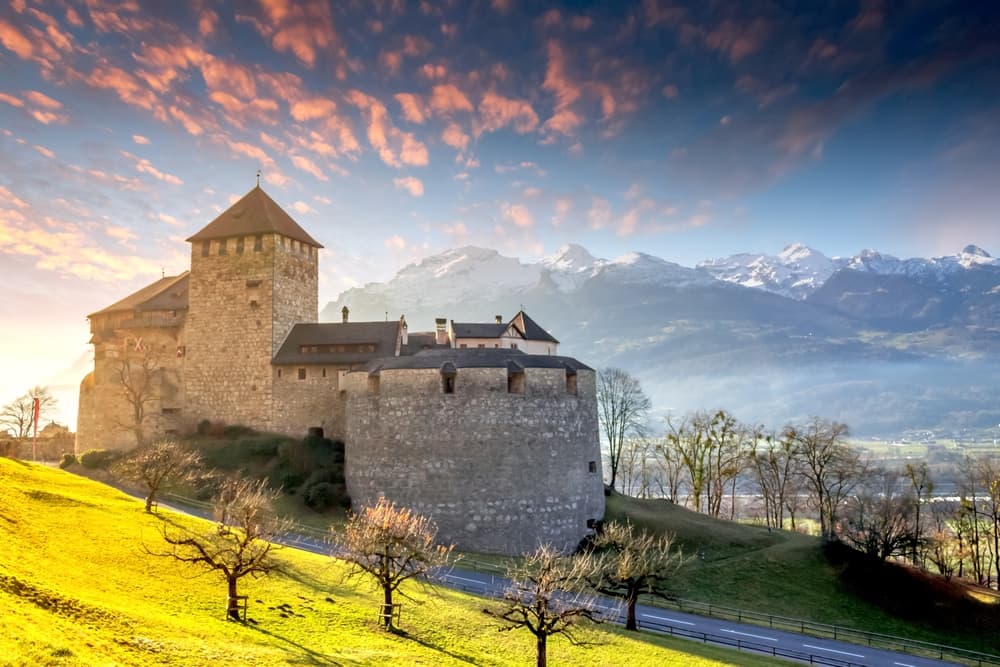
Liechtenstein is 25 kilometers long and 12 wide, the sixth-smallest country on earth, a constitutional monarchy whose prince genuinely governs from the castle above Vaduz, and a principality that solved its own popularity by rationing itself: there are more jobs in Liechtenstein than residents, more registered companies than people by the old joke, and fewer new residence permits each year than most towns issue parking spaces. The Rhine valley floor is industrial in the polite Liechtenstein way, Hilti and Ivoclar and a banking sector reformed into respectability, while Malbun's small ski bowl and the Fürstensteig ridge trail hang above it, and the entire arrangement runs on the Swiss franc inside a customs union with Switzerland, EEA membership for market access, and Schengen since 2011.
The residence story is the strictest in this index and the page states it plainly. EEA citizens, despite nominal free movement, face a quota carved into the EEA agreement itself: 72 permits a year, 56 for gainful employment and 16 for the economically inactive, with half allocated by a genuine lottery drawn twice a year, spring and autumn, application by form and a CHF 100 advance-draw fee, and the other half granted by government decision where public interest weighs. Swiss citizens receive 17 a year by allocation. Third-country nationals, Americans and Britons alike, have no quota and no right: only discretionary, exceptional-case permits for senior specialists, the economically important, or the wealthy of particular interest, sometimes paired with the lump-sum tax regime. Property purchase confers nothing; even real estate is restricted. The B permit runs five years for EEA and Swiss nationals, one year renewable for third-country holders, permanent residence follows five years of the residence almost nobody gets, and ordinary naturalization sits at thirty years, the longest wait in Europe. And yet the principality works, because residence and work were decoupled long ago: the Grenzgänger cross-border permit sits outside the residence quota entirely, most of the workforce commutes in daily from the Swiss and Austrian valley towns, Buchs and Sargans and Feldkirch minutes away, and the honest EnRoute answer for nearly everyone is exactly that geometry, work in Liechtenstein, live beside it.
What the scarcity protects: effective income tax in the low twenties even at height, wealth taxed gently through a notional-yield mechanism rather than seized, no capital gains tax on private securities, dividends at zero, corporate tax at 12.5 percent, and the Swiss-grade texture of the safest full entry in this index, a country with homicide-free years, whose real hazards are the föhn wind and the ridge trail, and whose national day, August 15, ends with the prince pouring drinks in his own garden for whoever walks up the hill.
Widening the search? If you are looking to expand your job hunt across Western Europe, take a look at Switzerland →, Austria →, and Germany →.
Cost of living
Liechtenstein prices at the Swiss tier because it is, economically, the Swiss tier: Vaduz and Schaan one-bedrooms run 1,500 to 2,200 francs when they surface at all in a rental market sized for 40,000 people and rationed by the residence quota itself, utilities and insurance follow the Swiss schedule, and the Grenzgänger arbitrage is the entire practical answer, the Swiss and Austrian valley towns minutes away offering more housing at Buchs-and-Feldkirch prices with the principality's salaries intact.
Daily life runs Swiss-adjacent: the Migros and Coop tier across the Rhine, local Denner and Sutterlüty options, the 20-to-28-franc lunch menu in the working economy, and the duty-free-adjacent quirk that fuel and some goods price gently against Austria. The compensations are the small country's: everything is fifteen minutes away, the bus network is excellent and cheap, the mountain tier, Malbun's lifts, the Fürstensteig, the Rhine dam cycling, is effectively free, and Zurich airport sits ninety minutes by road or rail via Sargans. The comfortable single life assembles at 4,000 to 5,000 dollars inside the principality, the budget floor sits near 2,900 mostly by living across a border, and the honest addition is the housing hunt itself: the market is the quota made visible, and the cross-border address is not a compromise but the design.
- One-bedroom rent: 1,500 to 2,200 francs in Vaduz and Schaan when supply surfaces at all; the Swiss and Austrian valley towns minutes away are the designed relief valve, not the fallback.
- Budget on the Swiss schedule: groceries, insurance and services price at the Swiss tier with gentle Austrian arbitrage at the margins, and the 20-to-28-franc lunch menu is the working meal.
- Use the free mountain tier: Malbun's compact ski bowl, the Fürstensteig ridge and the Rhine-dam cycling network are the compensation the prices fund, all fifteen minutes from any desk.
- Count the geometry as infrastructure: Zurich airport at ninety minutes via Sargans, Feldkirch and Buchs as the commuter towns, and the excellent valley bus network stitching all of it together.
Cost-of-living calculator
See how your budget stretches in Liechtenstein.
Estimates use approximate exchange rates and typical monthly costs. Your actual costs will vary.
Visas & Entry
Liechtenstein is Schengen and EEA but emphatically not open: short stays ride the standard 90-in-180 Schengen window with no border formalities from Switzerland or Austria, and long-term residence is the most rationed in Europe, administered by the Migration and Passport Office under quotas written into the EEA agreement itself.
The numbers are the story. EEA citizens receive 72 new permits a year: 56 for gainful employment and 16 for residence without work, with half of each allocated by a genuine lottery, drawn twice yearly in spring and autumn, entered by form and fee, CHF 100 for the advance draw and CHF 500 for the final, and the other half granted by government decision on public-interest grounds. The non-gainful lottery tier amounts to roughly eight permits a year for the financially independent, who must show substantial means, local housing and full insurance. Swiss citizens receive 17 permits annually by allocation without a lottery. Third-country nationals, including post-Brexit Britons, face no quota and no entitlement: permits arrive only in exceptional cases, senior managers and specialists whose employment is economically important, or persons of particular interest to the principality, occasionally paired with the lump-sum taxation regime; property purchase is itself restricted and confers nothing. The B permit runs five years for EEA and Swiss holders, one year renewable for third-country nationals, permanent residence follows five years, and ordinary naturalization requires thirty years of residence, community vote or parliamentary route included, with dual citizenship excluded in the ordinary process. The decoupled alternative is the working answer: the Grenzgänger cross-border permit for those living in Switzerland or Austria sits outside the residence quota, EEA citizens register through their employer, third-country nationals need the permit with annual renewal, and the majority of Liechtenstein's workforce commutes exactly this way.
- Enter the lottery like the raffle it is: the twice-yearly draws take a form and a fee, the odds are long and public, and the government-allocation half rewards genuine economic cases; treat winning as the exception and plan around not.
- Build the cross-border life deliberately: the Grenzgänger permit is the system's designed answer, the Swiss and Austrian valley towns are minutes away, and the principality's salaries pair with the neighbors' housing by intention.
- Third-country professionals, aim through the employer: the exceptional-case permit follows economic importance demonstrated by a Liechtenstein company, not personal applications, and the specialist-and-manager framing is the entire doctrine.
- Do not buy property expecting status: real-estate acquisition is itself restricted and confers no residence right, the inverse of every golden-visa reflex this index covers.
- Respect the thirty-year horizon: naturalization here is a generational project with renunciation on the ordinary path; residence, not citizenship, is what the principality actually offers.
- Count Schengen days as usual: the visitor window spans the zone, EES logs it, and the no-border geometry with Switzerland and Austria changes nothing about the arithmetic.
| Visa or permit | What it covers |
|---|---|
| Schengen entry | Ninety days in any 180 with no internal border from Switzerland or Austria; the visitor tier is ordinary in a country where nothing above it is. |
| The EEA quota and lottery | 72 permits a year, 56 gainful and 16 non-gainful, half drawn by lottery each spring and autumn with CHF 100 and 500 fees, half granted by government decision; an EEA carve-out unique in Europe, and the reason free movement stops at the Rhine. |
| The non-gainful tier | Roughly eight lottery permits a year for financially independent EEA nationals showing substantial means, housing and insurance; among the most exclusive residence documents on earth by pure arithmetic. |
| Swiss citizens | Seventeen permits a year, twelve for employment and five without, allocated by government decision rather than lottery under the two countries' special relationship. |
| Third-country nationals | No quota and no right: exceptional-case permits only, for senior specialists and the economically significant, or persons of particular interest sometimes paired with lump-sum taxation; Britons now sit here too, and property purchase confers nothing. |
| The Grenzgänger answer | The cross-border work permit sits outside the residence quota entirely: live in Buchs, Sargans or Feldkirch, work in the principality, with EEA citizens registering via the employer and third-country nationals renewing annually; the arrangement most of the workforce actually uses. |
| The long game | B permits at five years for EEA and Swiss, one renewable year for third-country; permanent residence after five; and ordinary naturalization at thirty years, Europe's longest wait, with dual citizenship excluded on the standard path. |
Good to know: No DNV; THE most restricted system in Europe: EEA quota 72/yr (56 gainful + 16 non-gainful), HALF by twice-yearly lottery (CHF 100/500 fees), half by government allocation; non-gainful lottery ≈ 8/yr; Swiss 17/yr allocated; third-country = NO quota, exceptional cases only (specialists/particular interest, sometimes + lump-sum tax); property confers nothing; B = 5 yrs EEA/CH, 1 yr third-country; PR 5 yrs; citizenship 30 yrs; Grenzgänger cross-border permit = quota-exempt and THE real answer (live Buchs/Feldkirch, work LI).
EnRoute Jobs AI tool
Route Planner
Map visa routes, timelines, and relocation costs for your next destination.
Work & Legal
Liechtenstein's professional culture is Alemannic-Swiss in rhythm: punctual, precise, consensus-minded and quietly first-name-averse until invited otherwise, with High German the formal register, the Alemannic dialect the social one, and English fluent across the financial center, the industrial exporters and the university. The economy is improbably deep for 160 square kilometers, Hilti's global toolworks, Ivoclar's dental empire, a fund-and-fiduciary sector rebuilt into post-reform respectability, and a blockchain-law niche the principality legislated early, all of it staffed by the daily Grenzgänger tide that more than doubles the country each morning.
The legal lines follow the quota logic: visitors work for no one locally and the foreign-client laptop sits in the standard tolerated gray zone; local employment requires the permit architecture, residence-based or cross-border; and self-employment inside the principality runs through the Office of Economic Affairs with trade-license discipline, realistic mainly for the few who hold residence or the cross-border self-employed niche. The texture is microstate-Swiss: reputation is the working currency, the fiduciary and legal tier is world-class and priced accordingly, banking compliance is thorough in the post-cleanup style, and the calendar keeps Swiss-adjacent rhythms, the August 15 national day as the year's civic summit, the Fasnacht season, and a working year that treats the mountain as lunchtime infrastructure.
- Work the Grenzgänger physics: the commuter permit is the labor market's actual operating system, the valley towns are the residential tier, and the arrangement is respected rather than second-class; build it deliberately.
- Match the Alemannic register: High German formally, dialect socially, punctuality as ethics and titles until invited; the Swiss professional codes apply with a princely accent.
- Formalize through the Office of Economic Affairs when local: trade licensing is orderly and thorough, the fiduciary tier smooths what cold filings cannot, and banking compliance rewards early, documented approaches.
- Use the depth behind the size: world-class industrial employers, a rebuilt financial center and an early blockchain framework make the job market far larger than the map suggests; the employer, not the lottery, is the realistic door.
Good to know: Grenzgänger tide = the labor market's operating system (workforce more than doubles daily); Alemannic-Swiss codes; self-employment via Office of Economic Affairs (realistic mainly with residence or cross-border niche); blockchain-law niche legislated early; visiting laptop = standard gray zone; banking compliance thorough.
Taxes
Liechtenstein tax is Swiss-adjacent arithmetic with its own elegant machinery: income rates topping out in the low twenties after communal multipliers, wealth taxed through a notional-yield conversion rather than confiscation, no capital gains tax on securities, dividends at zero, and a lump-sum regime for the wealthy few the quota admits.
| What applies | The rule in 2026 |
|---|---|
| The residency tests | Tax residence follows domicile or habitual abode in the principality; the Schengen visitor stays clear, the Grenzgänger is taxed on Liechtenstein workdays under the neighbor treaties, and the resident joins the communal system by design. |
| Residents and the schedule | A national base schedule multiplied by communal surcharges lands effective income rates for most professionals in the teens and tops out around the low twenties even at height; among Europe's gentlest full-service tax states. |
| The Sollertrag wealth mechanism | Net wealth is not taxed directly but converted to a notional standard yield folded into taxable income, an elegant integration that taxes capital lightly and predictably while abolishing separate wealth-tax filing drama. |
| The investor's package | No capital gains tax on private securities and crypto dispositions, dividends taxed at zero, and the private-wealth architecture, foundations and establishments, that made the fiduciary sector famous, now operating in the post-reform, treaty-compliant era. |
| The lump-sum regime | Expenditure-based taxation available to foreign nationals admitted without gainful local activity, negotiated with the tax administration; the instrument that pairs with the exceptional-case residence tier for the wealthy of particular interest. |
| Corporate and the daily layer | A flat 12.5 percent corporate rate with a notional interest deduction, VAT at the Swiss 8.1 percent under the currency-and-customs union, and social contributions in the Swiss three-pillar pattern. |
| Americans specifically | No comprehensive US income-tax treaty and no totalization agreement, only information-exchange and FATCA machinery: citizenship-based taxation applies undiluted, the zero local rates on gains and dividends do not silence US taxation of either, and self-employment tax runs unshielded; the low ceilings help less than they read. |
| The home-country half | The quota means most readers engage this system as Grenzgänger taxed partly at home: the Swiss and Austrian treaties split the salary by workdays, telework day counts matter, and the residence-side planning decides more than the principality's gentle schedule does. |
Verified 21 August 2026: the domicile-and-abode tests, the communal-multiplier schedule with low-twenties effective ceilings, the notional-yield wealth integration, the absent securities CGT and zero dividend taxation, the lump-sum regime for admitted non-working foreigners, corporate 12.5 percent with VAT at the Swiss 8.1, and the absence of any comprehensive US treaty or totalization agreement. General information, not tax advice.
Good to know: Effective income low-20s ceiling (national base × communal multipliers); wealth via Sollertrag notional-yield integration; NO securities/crypto CGT; dividends 0%; lump-sum regime for admitted non-working wealthy; corporate 12.5% flat + notional interest deduction; VAT = Swiss 8.1%; NO US treaty/totalization (TIEA/FATCA only); Grenzgänger taxed by workday split under CH/AT treaties.
Healthcare
Liechtenstein healthcare runs the Swiss model at principality scale: mandatory basic insurance for residents from approved insurers in the KVG-style architecture, premiums and deductible tiers in the Swiss pattern, and quality equivalent to the Swiss standard because much of the serious care literally is Swiss, the system built around the Landesspital in Vaduz for everyday and planned care with organized cross-border referral as the design rather than the exception, Grabs hospital across the Rhine handling much of the acute and maternity tier, Feldkirch in Austria minutes away, and the university hospitals of Chur, St. Gallen and Zurich as the tertiary ladder. Visitors carry travel insurance against Swiss-tier billing, EU cards function in the EEA pattern, and English-speaking medicine is easy across an international professional system.
The texture is Alpine-orderly: primary care is quick and personal at village scale, pharmacies run the Swiss professional standard, dental sits outside basic cover at Swiss-adjacent prices with the Austrian border option as the honest arbitrage, and the health file's real content is the mountain tier, ski-season orthopedics from Malbun, the Fürstensteig's no-mistakes exposure in summer, föhn-day migraines as the local folklore admits, and winter driving on the valley's brief but real ice. Emergencies answer at 112 with the Swiss and Austrian rescue networks integrated across the borders, and the summary is the Swiss one at smaller scale: superb, insured, and priced accordingly.
- Insure on the Swiss pattern: mandatory basic cover from approved insurers with the deductible as the premium lever, supplements for the private tier, and the annual comparison ritual imported intact.
- Trust the lattice, not just the building: the Landesspital plus Grabs, Feldkirch and the St. Gallen-Chur-Zurich ladder is the system; ask your insurer how it routes across borders before you need it.
- Visitors, carry cover for Swiss billing: the care is excellent and priced like its franc; EU cards serve union citizens in the EEA pattern and travel insurance serves everyone else.
- Respect the mountain syllabus: Malbun's slopes write the orthopedic statistics, the Fürstensteig's exposure forgives nothing, and the föhn and winter ice are the valley's honest small hazards.
| Hospital | What to know |
|---|---|
| Liechtensteinisches Landesspital, Vaduz | The national hospital: everyday, planned and stabilization care at principality scale, with the referral bridge as its designed second half. |
| Spital Grabs (St. Gallen, CH) | The Rhine-valley partner across the border carrying much of the acute and maternity tier for Liechtenstein patients by standing arrangement. |
| LKH Feldkirch (AT) | The Austrian regional hospital minutes away, the eastern half of the cross-border lattice. |
| Kantonsspital St. Gallen and Chur | The Swiss cantonal tier for serious specialty care, organized and insurer-covered in the referral pattern. |
| University hospitals, Zurich | The tertiary ceiling ninety minutes away for the rarities, reached through the same organized ladder. |
| The access architecture | Mandatory Swiss-style basic insurance for residents with deductible tiers, EU cards in the EEA pattern for visitors from the union, and travel insurance against Swiss-tier billing for everyone else. |
Hospital list compiled 21 August 2026 and not yet confirmed against each facility directly. Treat as indicative and verify before relying on it.
Good to know: Swiss-model mandatory insurance (deductible tiers); Landesspital Vaduz + designed cross-border lattice (Grabs acute/maternity, Feldkirch, St. Gallen/Chur/Zurich ladder; insurer-covered); Swiss-tier billing for visitors; dental via Austrian arbitrage; mountain file = the real content; 112 w/ integrated CH/AT rescue.
Safety
Liechtenstein sits at the very top of this index and the file is nearly empty by nature. The official half: the US advisory holds Level 1, Exercise Normal Precautions, covered from the embassy in Bern, and the principality's crime statistics are the kind that make rankings look broken, entire years without a homicide, violent crime as national news, and a police force whose annual report reads like a parish newsletter. The street half barely exists: petty theft is possible where tour buses concentrate on Vaduz's Städtle in high summer, unlocked bicycles occasionally migrate, and that is genuinely the register; solo travelers of every description report the kind of safety that makes the question feel theoretical, and the evening walk anywhere in the principality is as benign as Europe offers.
The genuine hazards are Alpine and specific: the Fürstensteig and Drei-Schwestern ridge routes are spectacular and genuinely exposed, no-mistakes terrain that the marked-trail grading states honestly; Malbun's slopes write the winter orthopedic statistics at family scale; the föhn wind arrives violently enough to close lifts and rattle nerves; winter valley ice asks real tires for the brief season it visits; and summer storms build over the ridge with mountain speed. Emergencies answer at 112 with Swiss and Austrian rescue networks integrated across the borders, the police non-emergency line handles what little else arises, and the honest summary is the one the score now states: the safest full entry in this index, a country whose advisory file is shorter than its hiking-trail waiver.
- Read the file as the statistical event it is: homicide-free years, violent crime as news, and an advisory whose practical content approaches zero; the principality is the index's ceiling and earns it.
- Mind the Städtle in tour season: the summer bus crowds on Vaduz's pedestrian core carry the country's entire petty-theft register, and the bicycle lock covers the remainder.
- Take the ridge routes seriously: the Fürstensteig and Drei Schwestern are genuinely exposed no-mistakes terrain, the gradings mean what they say, and the föhn closes what it touches.
- Drive the brief winter honestly: valley ice visits shortly but really, the Malbun road climbs in earnest, and real tires are the answer the police expect.
- Watch the mountain sky: summer storms build over the ridge with Alpine speed, and the lift-and-trail closures on föhn days are instructions rather than suggestions.
- Know 112 and the Bern coverage: the universal number reaches integrated Swiss-Austrian rescue, the US file runs through Embassy Bern, and STEP takes five minutes for a country that will never call.
Official travel advisories
| Government | Current position |
|---|---|
| United States | Level 1, Exercise Normal Precautions, administered from Embassy Bern: the floor tier, with the file's practical content approaching zero.travel.state.gov → |
| Canada | Normal security precautions: the summer tour-crowd petty-theft note and the Alpine-conditions register are the entire practical text.travel.gc.ca → |
| United Kingdom | No overall advisory against travel; mountain-weather and winter-driving notes carry what substance exists.gov.uk → |
| Australia | Normal safety precautions with the honest Alpine syllabus: exposure on the ridge routes, föhn-day conditions and storm speed.smartraveller.gov.au → |
| US Embassy Bern | Liechtenstein is covered from Bern alongside Switzerland; enroll in STEP for the rare notices. Sulgeneckstrasse 19, Bern; +41 31 357 70 11.ch.usembassy.gov → |
Advisory positions verified 21 August 2026: the US Level 1 administered from Bern, the near-empty crime register with its tour-season petty-theft note, and the Alpine file, ridge exposure, föhn, winter ice and storm speed, as the genuine syllabus. Open the sources before travelling.
Good to know: US L1 (via Embassy Bern); homicide-free years; index ceiling (93, above CH 92); register = Städtle tour-season petty theft + bike locks, full stop; real hazards = Fürstensteig/Drei-Schwestern exposure, Malbun orthopedics, föhn closures, brief valley ice; 112 w/ integrated CH/AT rescue.
Climate
Liechtenstein runs an Alpine continental climate compressed into one valley and one mountain wall: the Rhine floor at 460 meters keeps moderate seasons, winters at 0 to 5 with real but manageable snow, summers at 20 to 28 with the valley light that makes the evening Rhine-dam walk a local liturgy, while the mountain tier above 1,000 meters, Malbun at 1,600, runs a genuine snow season November through March and a brilliant hiking summer. The signature is the föhn: the warm, dry downslope wind that can lift winter days twenty degrees in hours, scour the sky to surreal clarity, close the lifts, and, the locals will tell you with medical seriousness, deliver headaches on schedule; it is the valley's weather personality and the reason forecasts here read like character studies. The working year: May through September is the prize, the Fürstensteig season, terrace evenings, and the mountain fifteen minutes from any desk; December through March runs the compact ski season with the valley grey-to-bright below; and the shoulders are quiet, quick and honest. The kit is Swiss-Alpine, layers and real winter tires in season, and the practical fact is the compression itself: the entire climate range of the Alps, reachable inside a lunch break.
| Season | What to expect |
|---|---|
| Summer, May to September | The prize: 20-to-28 valley days, the ridge-trail season at full run, terrace evenings on the Städtle, and the Rhine-dam cycling light the locals schedule around. |
| Winter, December to March | Valley 0-to-5 with manageable snow, Malbun's compact family ski season above, and the brief real ice that asks winter tires; grey below, bright above, föhn rewriting both. |
| The shoulders, April and October-November | Quick melts and first snows, quiet trails and closures between seasons; the principality at its most private. |
| The föhn constant | The warm downslope wind that lifts temperatures in hours, polishes the sky, closes lifts and delivers folkloric headaches; the valley's weather personality year-round. |
Good to know: May-September is the prize; the föhn is the valley's personality (closures + folkloric headaches); the entire Alpine range compresses into a lunch break; winter tires for the brief real ice.
Culture & Customs
Liechtenstein culture is Alemannic-Alpine with a princely accent and a functional sense of humor about its own improbability: a 1719 principality that kept its sovereignty by being useful, careful and small, whose prince genuinely governs under the 2003 constitution and whose citizens voted him the powers, and whose national self-image blends Swiss-grade diligence with the intimacy of a place where the head of state's garden party is the year's main event. The eleven communes are the real social units, the dialect is the belonging language above the High German of paperwork, and village life, clubs, brass bands, fire brigades, the Verein tissue of the Alemannic world, is where integration actually happens for the few the quota admits and the many who commute in.
The codes are Swiss-adjacent: punctuality as respect, greetings kept, quiet hours real, recycling serious, reserve genuine but warmer at valley scale than the Zurich version, and discretion a professional virtue in a country built partly on it. The calendar peaks on August 15, Staatsfeiertag, when the prince opens Vaduz castle's gardens, the country walks up the hill for drinks and fireworks, and the entire national arrangement is briefly, literally visible; Fasnacht carries the pre-Lent anarchy, the Alpabtrieb brings the cows down flowered in autumn, and the wine village of Vaduz keeps the princely cellars as the local pride. The table is Alemannic-hearty, Käsknöpfle as the national comfort, Ribel as the old-valley dish, and the professional who learns Hoi as the dialect greeting, respects the commune rhythm and walks up the castle hill on August 15 has met the principality on its own terms: small on purpose, rich by design, and quietly certain both were the right call.
- Greet with Hoi and keep the codes: the dialect hello opens the valley, High German carries the paperwork, and the Swiss-adjacent punctuality-and-quiet-hours package applies with a warmer, smaller accent.
- Attend the Staatsfeiertag: August 15 is the national day when the prince opens the castle gardens to everyone; walking up the hill for the drinks and fireworks is the single fastest cultural immersion the country offers.
- Join the Verein tissue: brass bands, sport clubs and fire brigades are where Alemannic belonging happens, and one membership outperforms years of polite adjacency at valley scale.
- Practice microstate discretion: in a country of 40,000 where the fiduciary sector runs on confidence, reputation travels instantly and quiet competence is the entire professional brand.
- Eat the valley table: Käsknöpfle as the national comfort, Ribel with the old-timers, the princely Vaduz wines as the local pride, and the mountain restaurant tier as the weekend liturgy.
- Respect the princely arrangement: the 2003 constitution gave the prince real powers by referendum and the citizens meant it; the monarchy is functional, popular and not a costume.