.png)
About Latvia
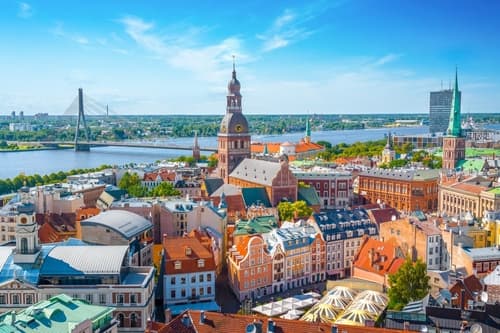
Latvia is the Baltic country the other Baltic countries would prefer you not discover first. Riga, home to a third of the nation, holds the finest concentration of Art Nouveau architecture on earth, an entire district of extravagant facades built in one optimistic decade, wrapped around a medieval core and stitched to a Central Market housed in old Zeppelin hangars where half the city still shops. It is a real capital at a modest scale: serious opera, a genuine tech scene, fiber everywhere, and twenty minutes from anywhere to pine forest or the long white sand of Jūrmala.
The nomad machinery is quietly excellent and structurally odd. Latvia moved early, in mid-2022, and built its visa around a filter no one else uses: what matters is not your citizenship but where your employer or your own business is registered, which must be an OECD state. For the standard American, British, Canadian or Australian remote employee this is a distinction without a difference; for the freelancer running income through a non-OECD structure it is the entire ballgame, and worth understanding before anything else. Behind the visa sits a country priced a notch below Estonia with infrastructure a notch behind and character entirely its own. Riga's hostels run a quiet exchange scene, and Jūrmala staffs its short bright summer, mostly on EU passports.
That character runs deep and quiet. Latvians are reserved in the northern register, sincere rather than performative, bonded to nature with an intensity that organizes the calendar: the Jāņi midsummer, all bonfires and oak crowns and no sleep, is the true national holiday, and the Song and Dance Festival, tens of thousands of voices in one choir every five years, is how a small nation kept itself intact through a brutal century. Roughly a quarter of the population is Russian-speaking, an ordinary fact of Latvian society best met as neighbors rather than as a topic. Warmth here is earned slowly and holds; so does the winter, which is long, dark and honest about it.
Widening the search? If you are looking to expand your job hunt across Northern Europe, take a look at Estonia →, Lithuania →, and Germany →.
Cost of living
Riga is the value play of the Baltic capitals. A one-bedroom in the center or the Art Nouveau quiet of the embassy district runs roughly 450 to 750 euros a month, with renovated stock at the top of that band and Soviet-era buildings well below it; Jūrmala, the beach town twenty minutes out, becomes a plausible base the moment summer ends. The line item that ambushes newcomers is winter heat: older buildings with district heating can add 150 to 250 euros to cold-month bills, and the annual budget should be built on January.
Daily life runs gentle on the wallet. Lunch specials at 8 to 12 euros, excellent coffee under 4, the Central Market selling produce, smoked fish and rye bread at prices that make supermarkets feel optional, and public transport on the e-Talons card costing a rounding error. Cards work everywhere, the euro removes any exchange arithmetic, and the practical splurges, the opera at prices Vienna would laugh at, the ferry to Stockholm, a Jūrmala sauna day, are all priced like the small pleasures they should be.
- One-bedroom rent: roughly 450 to 750 euros central Riga, renovated stock at the top of the band; winter heating in older buildings adds 150 to 250 euros in the cold months.
- Coworking desk: 120 to 250 euros a month across a compact but real Riga scene, with the startup community concentrated enough that one membership buys the entire network.
- Eating well: lunch specials 8 to 12 euros, the Central Market for produce and smoked fish at pre-inflation prices, and a serious dinner for two under 60.
- Transit: the e-Talons card makes trams and trolleybuses nearly free by Western standards, and Bolt, Baltic-born, covers the rest for a few euros a ride.
Cost-of-living calculator
See how your budget stretches in Latvia.
Estimates use approximate exchange rates and typical monthly costs. Your actual costs will vary.
Visas & Entry
Latvia is a full Schengen member: 90 days in any 180 for visa-free Western passports under EES biometric logging, with ETIAS expected late in 2026. The nomad route is the long-stay visa for remote work, in force since June 2022 and administered by the Office of Citizenship and Migration Affairs, the PMLP.
The design filters on employment structure rather than passport. Applicants must be employed by an employer registered in an OECD member state, or be self-employed persons registered in one, and able to perform their duties remotely from Latvia; the OECD's 38 members cover the US, UK, Canada, Australia, Japan and most of Europe, so ordinary remote employees pass without noticing, while freelancers running income through non-OECD structures fail at the gate regardless of citizenship. The proof requirements are stricter than the usual nomad file: the employment or self-employment must be certified by the tax administration or social insurance institution of the OECD state, not merely by an employer letter, alongside six months' tenure and pay evidence. The income bar is a formula, 2.5 times Latvia's previous-year average gross monthly salary as published by the statistics office, which stood at 4,213 euros in the official notice early in 2026 and moved to roughly 4,538 as new wage data was incorporated mid-year; the current figure on the PMLP page is the one that binds. The visa runs up to one year, renews once for a maximum of two, can be filed at an embassy or, during a legal stay, in Latvia itself with decisions in about 30 days, and comes with the office's own bolded warning: it grants no right to employment in Latvia.
- The OECD gate is structural, not national: any citizenship qualifies if the employer or self-employment is registered in an OECD state, and none qualifies if it is not; nomads invoicing through non-OECD entities should restructure before applying, not argue after.
- The income figure is a formula that moves every year: 2.5 times the prior-year average gross salary, 4,213 euros in the early-2026 notice and roughly 4,538 after mid-year revision; read the PMLP page the week you file and treat every article's number, including this one, as history.
- Official certification beats private paperwork: the tax administration or social insurance institution of the OECD state must certify the employment or self-employment income; employer letters and bank statements support the file but cannot replace that document.
- Six months' tenure is the floor, with the employer certifying the relationship, the pay and the remote capability; job-switchers should let the new role season before filing.
- Two years is the ceiling and none of it counts: one renewal, no family attachment, and visa time builds no residency clock; staying longer means converting to a residence permit whose clock starts from zero.
- Fees are almost quaint: around 60 euros standard, roughly double for expedited in-country filing, with 30-day decisions, among the cheapest serious nomad visas in the world.
| Visa or permit | What it covers |
|---|---|
| Schengen visa-free entry | Ninety days in any 180 for most Western passports under EES; ETIAS pre-authorization expected from late 2026. Remote work within it is the standard quiet European gray zone. |
| Long-stay remote work visa (nomad visa) | One year, renewable once to a two-year ceiling, for employees of OECD-registered employers or OECD-registered self-employed, at 2.5 times the previous year's average gross salary. A visa rather than a residence permit: no Latvian work rights, no family attachment, no residency clock. |
| Start-up visa | Latvia's founder route for building a scalable business locally, with modest financial bars and actual residence-permit status; the correct door for anyone whose plan involves a Latvian company rather than a foreign one. |
| Temporary residence permit for employment | The sponsored route for jobs with Latvian companies, and the category the PMLP points remote-visa holders toward the moment they want local work. |
| EU Blue Card | High-skill employment at a salary threshold around 1.5 times the average wage, with the EU-wide mobility and family advantages national permits lack. |
| Investment residence | Latvia's once-famous property-based residence has narrowed substantially; capital routes remain for business investment, at bars that make the nomad visa the sensible first chapter. |
| EU and EEA citizens | Freedom of movement: no visa, registration for stays past 90 days, and none of the OECD machinery applies. |
Good to know: Nomad visa since Jun 2022: OECD-registered employer or self-employment required, 2.5x prior-year avg salary (€4,213→~€4,538 during 2026), tax-authority certification, 1+1 years, no Latvian work rights, no PR clock.
EnRoute Jobs AI tool
Route Planner
Map visa routes, timelines, and relocation costs for your next destination.
Work & Legal
Latvian professional culture is northern in the quiet way: punctual, direct without volume, sparing with praise and allergic to overstatement. First meetings are reserved and second ones warmer, silence is comfortable, and commitments are treated as literal, which makes the country an easy place to do serious work and a hard place to bluff. English is standard in Riga's professional and tech circles, with Russian widely spoken as a fact of demography and Latvian appreciated everywhere as a gesture that lands.
For remote workers the legal lines are unusually clearly drawn. The remote-work visa authorizes exactly what its name says, work performed remotely for the OECD-registered employer or business, and the PMLP's own page carries the rest in bold: no right to employment in Latvia. Local clients, local jobs and local company-building each route through their own categories, the employment permit, the Blue Card or the start-up visa, and the office treats the boundaries as real. The freelance infrastructure for those who do go local, the individuālais komersants and micro-enterprise regimes, is workable but built for residents; the nomad visa population is meant to keep its economics offshore, and the design works best taken at its word.
- The visa authorizes foreign-source remote work explicitly and prohibits Latvian employment in bold on the official page; the gray zone other countries tolerate is simply legislated away here in both directions.
- Local ambitions have their own doors: a Latvian job means the employment permit, a Latvian startup means the start-up visa, and the conversion is a new application rather than an upgrade.
- The OECD structure follows you through renewal: the same certifications are re-evidenced for year two, so keeping the employer relationship and its paperwork clean is the renewal strategy.
- Riga's tech scene is small and permeable: a couple of coworking memberships and the meetup circuit put you inside the entire ecosystem within a season, which is the practical compensation for the compact market.
Good to know: Visa explicitly authorizes foreign-source remote work and prohibits Latvian employment; local work routes through employment permits or the start-up visa.
Taxes
Latvian tax was reformed at the start of 2025, which quietly obsoleted most nomad-guide numbers: the old 20-23-31 ladder is gone, replaced by two rates, and the 15 percent nomad flat tax that circulates in listicles is a floated proposal that has not become law.
| What applies | The rule in 2026 |
|---|---|
| The 2025-reformed rates | Residents pay 25.5 percent on annual income up to roughly 105,300 euros and 33 percent above it, with the old three-band ladder abolished; guides still quoting 20, 23 and 31 percent are describing the pre-2025 system. |
| Residency at 183 days | Presence of 183 days in any twelve-month period, or a registered place of residence in Latvia, makes you tax resident on worldwide income. A sub-half-year stay on the nomad visa leaves foreign income entirely outside Latvian tax. |
| No special nomad regime | The remote-work visa carries no tax privilege, and the 15 percent flat rate for nomads discussed in Latvian policy circles remains a legislative proposal at verification; plan on the general rules and treat any enactment as good news rather than an assumption. |
| Non-residents | Taxed on Latvian-source income only, which a compliant nomad-visa holder has none of; the visa and the tax code agree on this cleanly. |
| Social contributions | Latvian social insurance attaches to Latvian employment and local self-employment rather than to foreign remote contracts; residents on foreign employment should confirm their home-system coverage continues, since falling between systems is the real risk. |
| VAT | Twenty-one percent standard with reduced bands, folded into prices; freelancer registration thresholds sit far above nomad-scale turnover. |
| Americans specifically | The US-Latvia treaty and standard mechanisms apply: FEIE or foreign tax credits on the income side, self-employment tax surviving both, and no totalization agreement, so US self-employment tax continues regardless of Latvian status. |
| Filing, if resident | Latvian returns run through the EDS electronic system with pre-filled data for standard cases; residents with foreign income should expect to declare it and to want one hour of local advice the first spring. |
Verified 20 August 2026. The 25.5 and 33 percent rates reflect the 2025 reform; the 15 percent nomad rate is a proposal, not law; residency at 183 days or registered residence. General information, not tax advice.
Good to know: 2025 reform: 25.5% to ~€105k, 33% above; old 20/23/31 ladder abolished; no nomad tax regime (15% flat is only a proposal); under 183 days foreign income untouched.
Healthcare
Latvian healthcare pairs a strained public system with a private tier in Riga that serves foreign professionals well at prices Western Europe forgot. The public network's university hospitals handle serious medicine competently, but staffing emigration has left queues and unevenness the private clinics exist to solve: a consultation at ARS or Veselības Centrs 4 runs 30 to 60 euros, English is workable at the main facilities, and specialists follow within days rather than months. EU visitors carry EHIC rights; everyone else, the nomad visa's insurance requirement included, lives in the private tier by design.
The regional pattern applies with Baltic specifics: capability concentrates in Riga, with Stradiņš and Riga East as the serious-care anchors; dentistry is a genuine bargain drawing Scandinavian patients south; pharmacies are professional and strict; and the emergency number 112 answers in English. For the most complex elective care, some residents still fly to Helsinki or Berlin, a candor worth keeping in the plan.
- Private consultation: 30 to 60 euros, typically same week, English workable at the main clinics; the private tier is where the foreign community simply operates.
- The visa requires comprehensive insurance, commonly evidenced at around 42,600 euros of coverage for the stay, and the requirement doubles as accurate advice about the public queues.
- Emergency number 112, answered in English, with Riga response solid and capability thinning outside the capital; plan elective care for the city.
- Dentistry is the quiet bargain, high-quality and priced for the Scandinavian patients who fly in for it; residents inherit the infrastructure at local rates.
| Hospital | What to know |
|---|---|
| Pauls Stradiņš Clinical University Hospital, Riga | The country's flagship university hospital, the referral center for complex cardiac and specialist medicine and the serious-care default. |
| Riga East University Hospital | The largest hospital complex in the country across several campuses, anchoring oncology, trauma and acute care for the capital region. |
| Children's Clinical University Hospital, Riga | The national pediatric center, the answer to every serious child-health question in Latvia. |
| ARS Clinic, Riga | The established private outpatient clinic in the center, English-capable and long the expatriate first call for GP and specialist care. |
| Veselības Centrs 4, Riga | The large private clinic network with diagnostics, specialists and same-week access across multiple Riga sites. |
| ORTO Clinic, Riga | The private orthopedics and sports-medicine hospital, a regional draw for joint surgery at Baltic prices. |
Hospital list compiled 20 August 2026 and not yet confirmed against each facility directly. Treat as indicative and verify before relying on it.
Good to know: Public system strained, private Riga tier at €30-60 solves access; insurance required for the visa; dentistry draws Scandinavian patients south.
Safety
Latvia is one of Europe's safer countries by street-level measures, and every government this site tracks holds it at the lowest advisory tier. Riga's crime list is short and geographically tiny: pickpocketing in Old Town and the Central Market in season, the occasional nightlife overcharge in the stag-party corners of Vecrīga, and drink awareness in the same blocks; residential Riga and the rest of the country see essentially none of it. Winter ice is the honest daily hazard, and reflector tags on coats after dark are required by law and worn without irony.
The eastern question deserves the same straight answer Estonia's page gives. Latvia borders Russia and Belarus, is a NATO and EU frontline state, and lives with the era's hybrid weather: stray drones and military debris from the war in Ukraine have crossed into Latvian airspace and fallen on Latvian soil, smuggling balloons from Belarus have drifted over the border, and airspace or crossing arrangements shift with little notice. None of it has touched daily civilian life, which proceeds with practiced Baltic calm. The border itself carries literal rules: access within two kilometers of the Belarus frontier requires a Border Guard licence, one crossing to Belarus remains open with an electronic queue system mandatory since October 2025, Russian and Belarusian-plated vehicles are banned, and every Western government pairs its green rating for Latvia with do-not-travel language for both neighbors. Treat the eastern border as scenery, cross nothing, and Latvia is simply a safe northern country with superb bread.
- Winter ice outranks crime as the daily hazard: boots with grip, gritted-path discipline and the legally required reflector tags after dark are the actual safety equipment of a Latvian year.
- Old Town pickpocketing is seasonal and mapped: the summer cruise-and-stag crowds bring the light fingers to Vecrīga and the Central Market; ordinary bag sense retires the category.
- Choose bars with printed prices in the stag corners of Old Town, where the overcharge-and-intimidate genre survives at low volume; one street's distance solves it entirely.
- Never approach the Belarus border zone: the two-kilometer strip requires a Border Guard licence, the far side is criminally serious, and hikers in Latgale should track their maps.
- Crossing east is its own project, if it is anything: one Belarus crossing open, electronic queue registration mandatory, Russian-plated vehicles banned, and every Western government at do-not-travel for both neighbors; for a nomad the correct amount of eastern border in your life is zero.
- Expect the era's background noise without alarm: stray drones, debris and balloon incidents make headlines and not casualties, the state communicates clearly when anything matters, and the population's calm is well earned. Emergency number 112, answered in English.
Official travel advisories
| Government | Current position |
|---|---|
| United States | Level 1, Exercise Normal Precautions, reissued 1 April 2026 with no changes to level or indicators; the country pages add only standard crowd awareness and demonstration monitoring.travel.state.gov → |
| United Kingdom | No advisory against travel, with standard guidance on petty crime, winter conditions and the closed-border realities to the east.gov.uk → |
| Canada | Take normal security precautions, with unusually candid notes: conflict drones and military debris have entered Latvian airspace and fallen in places, smuggling balloons from Belarus have landed on Latvian soil, and vehicle bans reflecting EU sanctions apply at the borders.travel.gc.ca → |
| Australia | Exercise normal safety precautions, with detailed border mechanics: selected crossings open except to Russian and Belarusian-plated vehicles, third-country vehicles requiring advance declaration, no passenger rail east, and conditions changing at short notice.smartraveller.gov.au → |
| US Embassy Riga | Enroll in STEP for alerts. Samnera Velsa iela 1, Riga; switchboard +371 6710 7000.lv.usembassy.gov → |
Advisory positions verified 20 August 2026, including Smartraveller directly. All four governments hold Latvia at their lowest tier; the border rules are specific, literal and easy to follow. Open the sources before travelling.
Good to know: Lowest tier from all four governments; winter ice is the real daily hazard; hard rules at the eastern borders (2km Belarus zone licence, vehicle bans, one crossing open).
Climate
Latvia's climate is Estonia's with a half-degree of mercy: winters run December into March around minus three to one with real cold snaps toward minus twenty, snow that transforms Riga's Art Nouveau into a film set, and darkness that must be actively managed; summers answer at 17 to 25 degrees under white nights that peak at Jāņi, when the country decamps to bonfires and nobody sleeps on principle. The shoulders, May to June and late August through September, are the arrival windows, and the honest working pattern is the Baltic standard: winter for deep, undistracted production with a light-therapy lamp as ordinary equipment, summer for the glorious opposite.
| Season | What to expect |
|---|---|
| Winter, December to March | Minus three to one with snaps to minus twenty, snow-quiet and dark around the solstice; interiors warm, saunas essential, and ice underfoot the season's real hazard. |
| Spring, April to May | Fast and emphatic: ice out on the Daugava, light returning at minutes per day, terraces open by mid-May and the city visibly exhaling. |
| Summer, June to August | Seventeen to twenty-five under white nights, Jāņi as the national all-nighter, and Jūrmala's white-sand beach twenty minutes from the office; the payoff season. |
| Autumn, September to October | Golden, mushroom-mad and brief; September is the year's most reliable working month before the light begins the long withdrawal. |
Good to know: Light is the variable to manage; shoulder seasons are the arrival windows; Jāņi midsummer is the national holiday that explains the country.
Culture & Customs
Latvian culture is quiet on the surface and choral underneath. This is the nation that sang its way out of an empire, the Singing Revolution shared with its Baltic neighbors, and that gathers tens of thousands of voices every five years for a Song and Dance Festival UNESCO lists and locals plan lives around; the reserve visitors meet on the street coexists with a capacity for collective feeling that has to be witnessed at the festival grounds or a Jāņi bonfire to be believed. Nature is the other religion: mushrooming and berry-picking are national sports with etiquette, the bog walk is a legitimate weekend plan, and midsummer outranks every other date on the calendar.
Social codes run northern and sincere. Small talk is minimal and unmissed, punctuality is respect, shoes come off at the door, and flowers are brought in odd numbers to any home, a rule taken seriously enough to correct. Roughly a quarter of the country is Russian-speaking, concentrated in Riga and the east; daily life mixes languages without drama, and the visitor's wisest position on Baltic history and politics is interested listening. Warmth is earned across repeated meetings and, once granted, is quietly permanent; the sauna, the market and the regular café are where the earning happens.
- Respect the reserve and outlast it: minimal small talk, comfortable silence and literal commitments are the operating system, and the friendliness underneath is unlocked by showing up repeatedly, not by performing.
- Flowers in odd numbers, always, for any visit or occasion; even numbers are for funerals, and this is one custom Latvians will actually correct you on.
- Shoes off at the door of every home without being asked, and a small gift, flowers, chocolate, something from your country, marks the first visit.
- Treat Jāņi as sacred: the midsummer weekend empties cities and closes plans, and an invitation to a countryside celebration is the highest social honor available; accept it and expect no sleep.
- Meet the Russian-speaking quarter as neighbors, not a topic: languages mix in daily life, history is contested ground locals navigate with care, and visitor geopolitics is welcome nowhere.
- Tip around ten percent in restaurants for good service, rounding up elsewhere; it is appreciated rather than assumed, and no one will chase you over it.