.png)
About Czech Republic
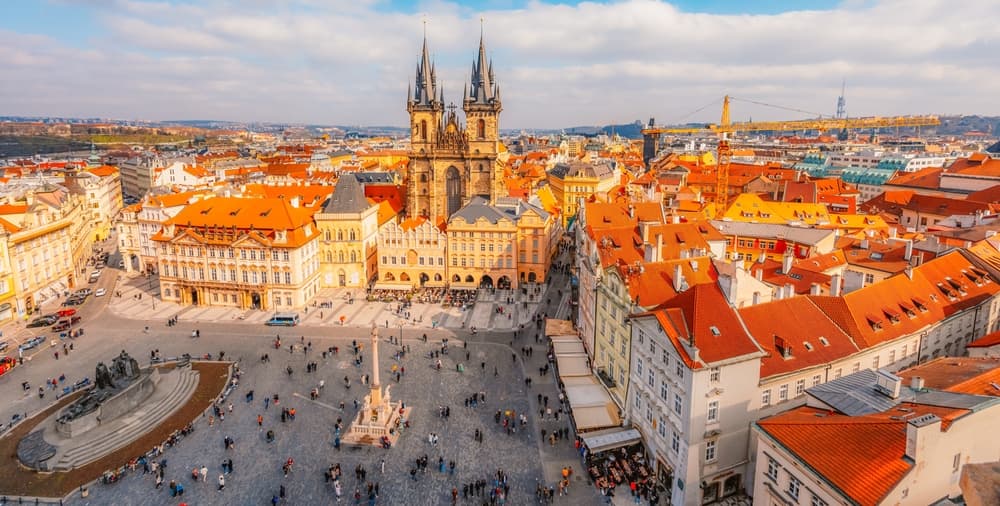
Prague is the argument Europe makes for itself most persuasively: an impossible skyline of Gothic, Baroque and Art Nouveau compressed onto a bend in the Vltava, a city the twentieth century somehow failed to flatten, and beneath the postcard, one of the continent's most livable working capitals. The tourist crush is real and severely local, a few square kilometers of Old Town; step one district out into Vinohrady, Karlín or Letná and you find the actual city, leafy, caffeinated, superbly connected by tram, and priced like Western Europe circa fifteen years ago. Brno, two hours southeast, is the tech-university second city that many long-stayers quietly prefer.
The country's remote-work offer has two layers that outsiders routinely confuse. The famous one now is the Digital Nomad Program, a selective 2023 fast-track for IT and marketing professionals from thirteen approved countries. The durable one is older: the živnostenské oprávnění, the Czech trade licence, which has made Prague a freelancer capital for two decades because it pairs a workable long-stay route with a tax treatment, the 60/40 flat expense rate, that leaves independents keeping more of their income than almost anywhere else in the EU. The nomad program is the express lane into that same system for those who qualify; the system itself is the point. Prague is also one of Europe's TEFL capitals: the language schools hire year-round, and taking the certification course in the city has been the classic soft landing for two decades.
Czech culture will not perform for you, and that is its charm. Reserve is the default, dry humor the national dialect, and warmth something earned across a shared table at the hospoda rather than offered to strangers. The beer is the best in the world at roughly the price of water, the public transport embarrasses richer countries, and the professional class speaks English while appreciating every mangled děkuji. People who need effusiveness find it cold. People who value competence, irony and being left alone to work tend to stay years.
Widening the search? If you are looking to expand your job hunt across Central Europe, take a look at Germany →, Austria →, and Poland →.
Cost of living
Prague costs like a Western European capital that got distracted before finishing the price rises. A one-bedroom in the neighborhoods worth living in, Vinohrady, Karlín, Letná, Smíchov, runs roughly CZK 22,000 to 32,000 a month, call it 950 to 1,400 dollars, with the Old Town premium above and Brno a solid quarter to a third below. Rents have climbed hard since 2021, and the honest advice is that the bargain era is over while the value era continues: what you get per koruna in transport, food and beer still humiliates the continent's west.
Daily life is where Czechia overdelivers. The lunch menu, polední menu, is a national institution at CZK 150 to 220 for soup and a main, world-class beer runs CZK 55 to 75 a half-liter in a normal hospoda, and the monthly transit pass for Prague's superb tram-metro network costs about CZK 550, roughly one American ride-share. The koruna, not the euro, is the currency, cards work everywhere, and the only financial trap worth naming is the tourist-core exchange offices, whose rates are a famous local scandal: use bank ATMs, decline dynamic currency conversion, and never change cash on the street.
- One-bedroom rent: roughly CZK 22,000 to 32,000 in Prague's good residential districts, 25 to 35 percent less in Brno; two months' deposit standard and lease registration matters for visas.
- Lunch and beer: polední menu at CZK 150 to 220, hospoda beer at CZK 55 to 75, and a proper dinner for two under CZK 1,000 outside the tourist core.
- Transport: Prague's monthly pass around CZK 550 via the Lítačka app for one of Europe's best tram-metro systems; Bolt and Liftago replace taxis entirely.
- Coworking desk: CZK 3,500 to 6,500 a month across a deep Prague market, with Brno's scene anchored by the tech faculties.
Cost-of-living calculator
See how your budget stretches in Czech Republic.
Estimates use approximate exchange rates and typical monthly costs. Your actual costs will vary.
Visas & Entry
Czechia is a full Schengen member: 90 days in any 180 for visa-free Western passports, biometrically logged under EES, with ETIAS pre-authorization expected in late 2026 though the date is not yet fixed. Above that sit two distinct long-stay machines that the internet constantly blurs together.
The Digital Nomad Program, launched 1 July 2023 and run by the Ministry of Industry and Trade, is a selective fast-track rather than an open visa. It admits citizens of thirteen countries, the original eight, Australia, Canada, Japan, New Zealand, South Korea, Taiwan, the UK and the US, plus Brazil, India, Israel, Mexico and Singapore added in an expansion most guides have not caught, and only for IT and marketing professionals holding a STEM university degree or three years' field experience. Income must reach 1.5 times the Czech average gross salary, CZK 69,836 monthly in the May 2025 to April 2026 window, recalculated every May. Employees need a foreign employer of at least fifty staff worldwide with remote work written into the contract; freelancers commit to the Czech trade licence and show one substantial client contracted for the entire stay, which is why the program suits the single-anchor-client professional and frustrates the many-small-clients one. Admission runs by email to the ministry, the visa is then filed at an embassy, and the interior ministry decides within 45 days, startlingly fast by Czech standards. Applicants must not have held a Czech long-term visa in the preceding twelve months, and insurance must be genuine long-term cover of at least 60,000 euros, not a travel policy.
The older machine is the živno route: a long-stay business visa built on the trade licence, open to any nationality, slower and more scrutinized, and still the standard path for freelancers the program excludes.
- Thirteen nationalities, not eight: the 2023 launch list has been expanded with Brazil, India, Israel, Mexico and Singapore, a change the majority of guides still miss. Everyone else routes through the ordinary živno visa.
- The income bar resets every May: 1.5 times average gross salary, CZK 69,836 monthly for May 2025 through April 2026; check the ministry's current figure the month you file rather than any article's.
- The freelance track wants one big client, contracted and affidavit-backed for the entire stay; portfolios of small clients, courses and ad revenue fit the culture of nomadism and fail the paperwork of this program.
- A twelve-month cooling rule applies: holders of any Czech long-term visa in the preceding year are ineligible, so the program is an entry door, not a status switch.
- Insurance must be long-term comprehensive cover of at least 60,000 euros valid in Czechia; travel policies are the standard rejection, and the requirement bites again at every extension.
- From January 2026 every Czech freelancer needs a data box: the datová schránka with electronic filing is mandatory for OSVČ, so the trade licence now arrives with a digital mailbox and no paper option.
| Visa or permit | What it covers |
|---|---|
| Schengen visa-free entry | Ninety days in any 180 for most Western passports under EES biometric logging; ETIAS pre-authorization expected from late 2026, date unconfirmed. Registration with the Foreigners' Police within three working days applies to stays in private accommodation. |
| Digital Nomad Program, employee track | For IT and marketing employees of foreign companies with 50-plus staff worldwide and a remote-work clause, from the thirteen eligible countries, at 1.5 times the average salary. Fast-tracked long-term visa decided within 45 days. |
| Digital Nomad Program, freelancer track | Same nationality and qualification gates, built around taking the Czech trade licence and evidencing one main foreign client contracted for the entire stay. The express lane into the OSVČ system for those who fit its single-client shape. |
| Živno long-stay business visa | The general freelancer route for any nationality: trade licence plus a long-term visa for business, heavily documented and more slowly scrutinized, but the door the nomad program leaves open to everyone else. |
| Employee Card | The standard sponsored route for jobs with Czech companies, combining work and residence in one permit and covering the ordinary employment market. |
| EU Blue Card | For high-salary skilled employment with Czech employers, the EU-wide alternative for those above the wage threshold, with faster family and mobility rights. |
| EU and EEA citizens | Freedom of movement: no visa, registration after 90 days, and the trade licence available on essentially local terms. |
Verified 20 August 2026 against the ministry's program documents, including the expanded thirteen-country eligibility list and the CZK 69,836 threshold for the May 2025 to April 2026 window; the figure resets each May.
Good to know: DNP since Jul 2023: 13 eligible nationalities (expanded), IT+marketing, STEM degree or 3 yrs experience, 1.5x avg salary (CZK 69,836 to Apr 2026, resets each May), 45-day decisions; živno route for everyone else.
EnRoute Jobs AI tool
Route Planner
Map visa routes, timelines, and relocation costs for your next destination.
Work & Legal
Czech professional culture is punctual, unpretentious and allergic to performance. Meetings start on time and end early, first names arrive slowly behind the formal vy, credentials matter less than demonstrated competence, and enthusiasm is trusted roughly in inverse proportion to its volume. The real networking venue is the hospoda table after work, where hierarchy dissolves over excellent beer and the dry, dark Czech humor does its filtering.
For independents, the legal architecture is unusually generous once entered. The trade licence, živnostenské oprávnění, is the universal key: it legalizes freelancing including for Czech clients, plugs into public health insurance, and unlocks the tax treatments that make the country a freelancer haven, the 60/40 flat expense rate and the paušální daň lump-sum regime. The nomad program's freelance track is precisely a fast pass into this system. The boundaries are the usual ones: employment by a Czech company needs an Employee Card, the švarcsystém, disguised employment through a trade licence, is genuinely policed, and since January 2026 the entire freelance apparatus runs through mandatory electronic filing and the data box, the e-state arriving with Czech thoroughness.
- The trade licence is the entire game: one registration legalizes freelance work for foreign and Czech clients alike, connects you to public health insurance, and opens the flat-rate tax regimes.
- The 60/40 rule is the quiet superpower: service freelancers deduct a flat 60 percent of revenue as deemed expenses with no receipts, paying income tax on the remaining 40, which produces effective rates the rest of the EU does not believe until shown.
- Disguised employment is enforced: one client, fixed hours and their equipment looks like a job to the labor inspectorate, and the švarcsystém fines land on both sides of the arrangement.
- From 2026, the freelance life is digital by law: data box, electronic tax filing and e-communication with authorities are mandatory for OSVČ, which in practice makes a local accountant's few thousand koruna a year the best subscription in the country.
Good to know: Trade licence legalizes freelancing incl. Czech clients; 60/40 flat expenses; švarcsystém (disguised employment) policed; data box mandatory from 2026.
Taxes
Czech tax is flat-ish, freelancer-friendly to a degree that reads like a typo, and paid in koruna. The headline rates are 15 and 23 percent, but for independents the number that matters is what the flat-expense and lump-sum regimes do to the base before those rates ever touch it.
| What applies | The rule in 2026 |
|---|---|
| The rates | Fifteen percent on income up to roughly three times the average salary on an annualized basis, 23 percent above that line; the threshold moves with the average wage each year. No municipal income taxes, no surtaxes. |
| Residency at 183 days or a home | Presence of 183 days in a calendar year, or a permanent home with intent to stay, makes you Czech tax resident on worldwide income. Sub-183-day visitors on foreign income owe Czechia nothing. |
| The 60/40 flat expense rate | Service freelancers on the trade licence may deduct 60 percent of revenue as deemed expenses without a single receipt, paying tax on 40 percent. On a middle freelance income the all-in effective burden lands in the low teens, the arithmetic that built Prague's freelance colony. |
| Paušální daň, the lump-sum regime | Lower-revenue OSVČ can instead pay one flat monthly amount covering income tax, health and social insurance together, with no return to file at all in the basic case. The trade of maximum simplicity for modest cost, and for many nomad-scale incomes the correct choice. |
| Social and health insurance | The real second tax for freelancers: mandatory monthly minimum advances to both systems, which buy genuine public health coverage and accrue pension rights; budget them alongside income tax rather than discovering them in month three. |
| Non-residents | Taxed on Czech-source income only. The nomad program makes most holders residents in practice, since it exists precisely for stays past 183 days. |
| VAT | Twenty-one percent standard with a twelve percent reduced band since the 2024 consolidation; registration for freelancers is triggered by turnover of CZK 2 million, far above nomad scale. |
| Americans specifically | The US-Czech treaty and a totalization agreement both exist, the latter mattering: with a Czech certificate of coverage, freelancers paying Czech social insurance can escape US self-employment tax, one of the few European setups where that combination works cleanly. FEIE or credits handle the income side. |
Verified 20 August 2026. The 60/40 and lump-sum regimes are the substance behind every low-tax claim about Czech freelancing; the mandatory electronics of 2026 make a local accountant near-essential. General information, not tax advice.
Good to know: 15/23% rates; 183-day or home-based residency; 60/40 flat expenses and lump-sum regime make freelance burdens among the EU's lowest; US totalization agreement exists.
Healthcare
Czech healthcare is the good kind of unglamorous: a universal public insurance system delivering solid European medicine at Czech prices, anchored by Prague hospitals with real international weight, Motol above all, one of Europe's largest hospital campuses. EU visitors use EHIC on local terms; trade-licence freelancers join the public system through their mandatory contributions, which is one of the quiet privileges of the OSVČ route; and everyone else lives in a private tier where an English-speaking consultation runs 50 to 100 euros at the international clinics serving the expat districts.
The texture is Central European: excellent specialists, brisk bedside manner, modest queues by Western standards, and dentistry good enough and cheap enough to schedule visits around. English is reliable at the international clinics and the big Prague hospitals, thinner in the regions, and the practical expat setup is a private clinic membership for daily medicine with the public system behind it for anything serious.
- Private consultation: 50 to 100 euros English-first at the international clinics, typically same or next day; public-system care is excellent and near-free for the insured.
- The trade licence buys you in: OSVČ health contributions enroll freelancers in the public insurance system, one of the strongest practical arguments for the formal route over gray-zone status.
- Emergency number: 112 works nationally in English alongside the local 155 for ambulance; Prague emergency care is strong.
- Dentistry is a genuine bargain by Western standards at high quality, though English-speaking dentists in Prague book out; ask the international clinics for referrals.
| Hospital | What to know |
|---|---|
| University Hospital Motol, Prague | The country's flagship and one of the largest hospital complexes in Europe, the default answer for complex and pediatric care, with dedicated foreigner services. |
| General University Hospital (VFN), Prague | The historic central teaching hospital of Charles University, deep in specialist departments and central to the city's serious medicine. |
| Královské Vinohrady University Hospital, Prague | Major eastern-Prague teaching hospital with the national burn center and broad acute coverage for the districts foreigners favor. |
| University Hospital Brno | Moravia's heavyweight and the second city's tertiary anchor, covering the tech-student-expat population alongside the region. |
| Canadian Medical, Prague | The established international private clinic group, English-first, multi-site, and the standard first call of the expat and diplomatic community. |
| EUC Clinics, Prague and nationwide | The large private clinic network offering direct-pay and membership primary care with English-speaking physicians across the main cities. |
Hospital list compiled 20 August 2026 and not yet confirmed against each facility directly. Treat as indicative and verify before relying on it.
Good to know: Solid universal system; Motol is the flagship; OSVČ contributions enroll freelancers in public insurance; private English-first tier at €50-100.
Safety
Czechia is one of the safest countries in the world by measured crime, sitting near the top of the Global Peace Index, and every Western government holds it at the lowest advisory tier. The threats that actually exist are economic and concentrated in a few tourist blocks of Prague: pickpocketing on the crowded trams and in Old Town Square, the notorious currency-exchange storefronts whose rates approach performance art, taxi overcharging solved entirely by Bolt and Liftago, and the drink-pricing games of the stag-party strips. None of it follows you into the residential districts where life actually happens.
The oddities worth knowing are administrative rather than dangerous. Stays in private accommodation trigger a legal duty to register with the Foreigners' Police within three working days, a rule hotels handle automatically and Airbnb guests technically inherit. Satellite phones are illegal to use. Demonstrations around the political calendar can fill Wenceslas Square with little notice and are best watched from a café. And winter brings the region's standard ice-and-darkness package, worth respecting on Prague's cobbles.
- Guard pockets on the 22 tram and in Old Town Square: Prague pickpocketing is professional, concentrated and entirely predictable in location; residential districts see essentially none of it.
- Never use the tourist exchange offices. The Old Town storefronts' rates are a standing national embarrassment; bank ATMs with dynamic currency conversion declined beat them every time.
- Transport is an app: Bolt and Liftago end the taxi-overcharge genre entirely, and the tram network makes both mostly unnecessary anyway.
- Register if you're in an Airbnb: private stays over three working days legally require Foreigners' Police registration, a duty hotels absorb but private guests technically carry.
- Leave the satellite phone at home, literally: their use is illegal in Czechia, one of the stranger true lines in any European advisory.
- Watch the stag-party economics: the nightlife strips' inflated menus, pushy promoters and occasional drink games are the closest Prague comes to a hustle, and one street's distance solves it.
Official travel advisories
| Government | Current position |
|---|---|
| United States | Level 1, Exercise Normal Precautions, reissued 8 January 2026, flagging only tourist-area petty crime and the possibility of short-notice demonstrations.travel.state.gov → |
| United Kingdom | No advisory against travel, with standard guidance on pickpocketing, exchange scams and nightlife-district drink pricing.gov.uk → |
| Canada | Take normal security precautions, with Schengen entry mechanics and tourist-core petty-crime notes.travel.gc.ca → |
| Australia | Exercise normal safety precautions, with the useful specifics that private-accommodation stays over three days require Foreigners' Police registration and that ETIAS has no confirmed start date yet.smartraveller.gov.au → |
| US Embassy Prague | Enroll in STEP for alerts. Tržiště 15, Malá Strana; switchboard +420 257 022 000.cz.usembassy.gov → |
Advisory positions verified 20 August 2026, including Smartraveller directly. All four governments sit at their lowest tier; the risks are wallet-sized and geographically tiny. Open the sources before travelling.
Good to know: Lowest tier from all four governments; tourist-core pickpockets and exchange-office scams are the real list; register with Foreigners' Police for private stays over 3 days.
Climate
Czechia runs four real seasons in the Central European register. Winter is cold, gray and long, Prague in January hanging around freezing under low skies with occasional snow that makes the castle look like propaganda for itself; summer is warm at 22 to 27 degrees with heat-wave spikes; and the shoulders are the prize, a chestnut-blossom spring and a golden September that rank among the best urban weather in Europe. For a remote worker the calendar is friendly both ways: the beautiful months are obvious, and the gray ones empty the tourist core, cut short-term rents and suit deep work, provided the light deficit is managed the Central European way, with lamps, saunas and no shame about either.
| Season | What to expect |
|---|---|
| Winter, December to February | Around freezing, gray and atmospheric, with the Christmas markets as the season's opening argument and January-February as the cheap, quiet, productive stretch. |
| Spring, April to May | Fast and photogenic: terraces open, Petřín blossoms, and May is arguably the single best month to be in Prague. |
| Summer, June to August | Warm to hot with occasional 30-plus spikes, peak tourist density in the Old Town, and the season the entire country decamps to cottages, rivers and beer gardens. |
| Autumn, September to October | Golden, stable and slightly emptier; September is the connoisseur's month, and late October's fog on the Vltava is its own genre of morning. |
Good to know: Shoulder seasons are the prize; winter is gray but cheap, quiet and productive; summer brings the tourist crush to a few square kilometers only.
Culture & Customs
Czech culture is reserved, dry-humored and fundamentally decent in ways that take a season to read. The first layer is distance: no small talk with strangers, no performed enthusiasm, a formal vy until invited otherwise, and a national suspicion of anyone selling anything too cheerfully, a temperament forged by a century that gave Czechs excellent reasons to distrust grand claims. The second layer, unlocked slowly, is loyal, funny and low-maintenance, friendships that outlast the effusive kind by decades. The national institution is the hospoda, the neighborhood pub, where the same table hosts the same people every week over the world's best and cheapest beer, and where a foreigner who keeps showing up quietly becomes a regular, which is the entire Czech social ladder in one move.
The etiquette is simple and sincerely meant. Shoes come off at the door of every home, greetings are exchanged entering small shops and doctor's waiting rooms, quiet is kept on trams, and punctuality is assumed. Beer arrives without ordering more being questioned, tipping is a rounded-up ten percent told to the server rather than left on the table, and the fastest cultural credit available is pronouncing děkuji recognizably and knowing that the country is Czechia, the currency is the koruna, and neither is interchangeable with anything Soviet.
- Become a regular somewhere. The hospoda is the social institution, loyalty is the currency, and the same corner table on the same weeknight will do more for your Czech life than any networking event.
- Shoes off at the door, always, in every home and many small studios; hosts hand out pantofle, slippers, and the ritual is non-negotiable.
- Keep the volume down in public: loud phone calls on trams and performative enthusiasm in restaurants mark the tourist; Czech public space runs quiet.
- Tip by rounding up and saying the total to the server when paying, ten percent at most; leaving coins on the table reads oddly here.
- Use vy until offered ty, and surnames with pan or paní in formal settings; the informality ladder is climbed by invitation, usually over beer.
- Skip the Eastern Europe framing. Czechs place themselves firmly in Central Europe, the history is raised by them and not by visitors, and dry self-deprecation is safe ground where grand geopolitics is not.

