.png)
About Costa Rica
Costa Rica abolished its army in 1948 and spent the money on schools and hospitals instead, which is most of the explanation for why it looks so different from its neighbours. It is stable, democratic, and has been receiving foreigners long enough to have thoroughly professionalised the business of doing so. Pura vida is a real phrase used constantly, and it means something closer to a shrug at urgency than to happiness.
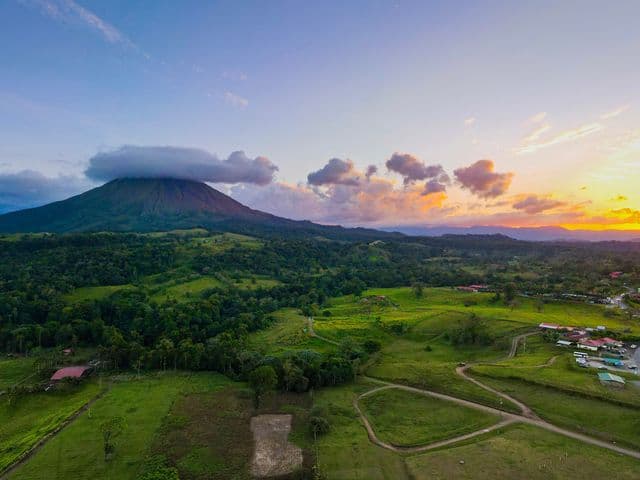
The appeal is a particular combination: genuine nature at the doorstep rather than a weekend flight away, a US-adjacent time zone, decent healthcare, and a legal remote-work route that has been running since 2021 rather than being announced last month. The country is small enough that a Pacific surf town and a cloud forest and the capital are all a few hours apart. The exchange economy thrives in that geography: surf camps in Santa Teresa and Tamarindo, eco-lodges on both coasts, and wildlife projects in the interior all trade room and board for working hands, and for many travelers that swap is the entire budget.
What it is not is cheap. Costa Rica is the most expensive country in Central America by a wide margin, and imported goods carry duties that make a supermarket shop feel European rather than Latin American. Set against that, it is also the one where the infrastructure reliably works, and most people who come to compare it against Nicaragua or Guatemala on price end up paying the premium anyway.
Widening the search? If you are looking to expand your job hunt across Central America, take a look at Panama →, Mexico →, and Colombia →.
Cost of living
Costa Rica costs meaningfully more than its neighbours and roughly what a mid-tier US city costs once you account for imports. The Central Valley around San Jose and Escazu is where the value sits; the Pacific beach towns price for tourists year round.
Two things surprise people. Anything imported, and that includes most electronics, cars and packaged groceries, carries heavy duty and can cost more than in the US. And the beach towns run on generators and wells more often than visitors expect, so ask specific questions about power and water before signing a lease.
- Furnished one-bedroom: roughly 600 to 1,000 USD a month in the Central Valley, and 900 to 1,600 in Tamarindo, Santa Teresa or Nosara.
- Coworking desk: 150 to 250 USD a month, with the beach-town spaces at the top of that range.
- Casado lunch: 4,000 to 6,000 colones, around 8 to 12 USD, at a local soda.
- Private doctor visit: 50 to 80 USD, and considerably less at a pharmacy clinic.
Cost-of-living calculator
See how your budget stretches in Costa Rica.
Estimates use approximate exchange rates and typical monthly costs. Your actual costs will vary.
Visas & Entry
Costa Rica grants 90 days visa-free on arrival to citizens of the US, Canada, UK, EU, Australia and most Western countries, with proof of onward travel required at the gate as well as at the border. For anything longer, the country has run a dedicated remote-work route since 2021, one of the earliest in the Americas and by now one of the better-established.
The Estancia para Trabajadores Remotos is applied for online through the government's Tramite Ya platform, and can be filed either from abroad or from inside Costa Rica during a tourist stay, which is unusual and convenient. It grants one year, renewable once, and then it ends. There is no path from it to permanent residency.
- Income threshold: 3,000 USD a month from foreign sources for a single applicant, rising to 4,000 if dependents are included. Both figures are set in law rather than indexed annually.
- Renewal requires 80 days of physical presence in Costa Rica during the first year. This is the condition most people miss, and it rules out treating the visa as a flexible base you rarely occupy.
- Two years is the ceiling. After the renewal you either leave or transition to Rentista, Pensionado or Investor residency, which have their own thresholds.
- No Costa Rican clients or employers. The visa covers income earned entirely outside the country, and taking local work breaches it.
- Health insurance is mandatory and must be a genuine policy covering the full stay. Travel insurance is routinely rejected.
| Visa or permit | What it covers |
|---|---|
| Visa-free entry | Ninety days for US, Canadian, UK, EU, Australian and most Western passports. Proof of onward travel is genuinely checked. Extensions are not routinely granted, and the old border-run habit now draws scrutiny. |
| Estancia para Trabajadores Remotos | The digital nomad visa under Law 9996. One year, renewable once to a two-year maximum. Requires 3,000 USD monthly foreign income, or 4,000 with dependents, plus qualifying health insurance. Exempts holders from Costa Rican income tax on foreign earnings. |
| Rentista | Temporary residency for those with stable unearned or foreign income, typically evidenced by a bank guarantee. Two-year permit, renewable, and it does lead toward permanent residency. |
| Pensionado | For retirees with a qualifying lifetime pension, at a much lower monthly threshold than the nomad visa. Two years, renewable, and a route to permanent residency after three. |
| Inversionista | Investor residency, requiring a qualifying investment in Costa Rican business or property. Two-year renewable temporary residency. |
| Work permit | Employer-sponsored and requiring prior authorisation from the Ministry of Labour. The only route that permits working for Costa Rican companies. |
Verified 20 August 2026 against Costa Rican government guidance. The 80-day presence requirement for renewal is the condition most often overlooked. Confirm current thresholds before filing.
Good to know: Digital Nomad Visa requires $3,000/month foreign income proof, health insurance, and clean background check.
EnRoute Jobs AI tool
Route Planner
Map visa routes, timelines, and relocation costs for your next destination.
Work & Legal
Costa Rican working culture is polite, indirect and unhurried, and the pura vida reputation is accurate in ways that are pleasant socially and occasionally maddening professionally. Deadlines are treated as aspirations, confrontation is avoided, and a direct no is rare enough that you learn to read around it. Relationships precede transactions.
- Remote work for foreign employers and clients: exactly what the nomad visa authorises, and formally recognised rather than tolerated.
- Costa Rican clients or employers are off limits on the nomad visa. Local employment requires a work permit sponsored by the employer and cleared by the Ministry of Labour.
- Labour law is strongly employee-protective if you ever hire locally, with a mandatory thirteenth-month aguinaldo and accrued severance.
- Spanish matters more than in Panama. English is common in tourism and the Central Valley business community, and much less so elsewhere.
Good to know: Law 9996 explicitly permits remote work for foreign-source income; one of the clearest legal frameworks in Latin America.
Taxes
Costa Rica runs a territorial tax system, which is the single most important fact for anyone earning abroad, and the nomad visa makes that exemption explicit rather than merely implied.
| What applies | The rule in 2026 |
|---|---|
| Territorial taxation | Costa Rica taxes income sourced inside the country only. Money earned from clients and employers abroad falls outside the Costa Rican net regardless of how long you stay, which is a genuine structural advantage over most European bases. |
| Nomad visa exemption | Law 9996 states the exemption directly for remote worker visa holders, removing the ambiguity that territorial systems sometimes leave. Holders pay no Costa Rican income tax on foreign earnings. |
| Import duty exemption | A practical benefit that is easy to miss: visa holders can bring in work equipment free of import duty, which matters in a country where electronics are otherwise heavily taxed. |
| Domestic income tax | Progressive up to 25% on Costa Rican-source income, which the nomad visa does not permit you to earn in any case. |
| VAT (IVA) | 13% standard, applied broadly to goods and services including many that are zero-rated elsewhere. |
| CCSS social security | Costa Rica's public health system is funded by employer contributions running around 26.8% of gross. Nomad visa holders do not contribute and correspondingly do not get public health access, which is why insurance is mandatory. |
| Americans specifically | Because Costa Rica levies no tax on your foreign income, there is no foreign tax credit to claim against a US return. The Foreign Earned Income Exclusion is the practical tool, and it does not cover self-employment tax. |
| Home-country obligations | The exemption is Costa Rican. Your own country's rules on residency and worldwide income continue to apply and are frequently the binding constraint. |
Verified 20 August 2026. Costa Rica's exemption does not remove home-country obligations, which is the most common misunderstanding here. Take advice in both jurisdictions. General information, not tax advice.
Good to know: Territorial tax system; foreign-sourced income is not taxed in Costa Rica regardless of residency status.
Healthcare
Costa Rica's healthcare is the reason a lot of people choose it over its neighbours. The public system, the Caja Costarricense de Seguro Social, is genuinely good and gives the country life expectancy above the United States. Nomad visa holders do not contribute to it and so cannot use it, which is precisely why the visa makes private insurance mandatory.
Private care is concentrated in the Central Valley and is inexpensive by US standards, which has made Costa Rica a long-standing medical tourism destination, particularly for dentistry and elective surgery. Outside San Jose the picture thins quickly, and the Pacific beach towns rely on small clinics with transfer to the capital for anything serious.
- Private consultation: 50 to 80 USD, typically same week.
- Private insurance: roughly 60 to 200 USD a month. The visa requires a policy covering the full period, and travel insurance is rejected.
- Nomad visa holders cannot join the Caja, unlike Rentista and Pensionado residents, who must.
- Emergency number: 911.
| Hospital | What to know |
|---|---|
| Hospital CIMA San Jose, Escazu | The private hospital most used by the foreign community, internationally accredited and English-speaking, in the Escazu suburb west of the capital. |
| Hospital Clinica Biblica, San Jose | Long-established private hospital with a substantial medical tourism practice and an international patient department. |
| Hospital La Catolica, San Jose | Private general hospital in Guadalupe, well regarded for diagnostics and specialist care. |
| Hospital Mexico, San Jose | One of the largest public hospitals in the Caja system and a national referral centre for complex cases. |
| Hospital Cima Guanacaste, Liberia | The main private facility serving the northern Pacific coast and the Guanacaste beach towns. |
| Hospital Monsenor Sanabria, Puntarenas | The principal public hospital for the central Pacific region, covering the Jaco and Manuel Antonio areas. |
Hospital list compiled 20 August 2026 and not yet confirmed against each facility directly. Treat as indicative and verify before relying on it.
Good to know: Private insurance required for Digital Nomad Visa; Hospital CIMA in Escazú serves international professionals to US standards.
Safety
Costa Rica is among the safer countries in Latin America and the safest in Central America by a comfortable margin, but its reputation runs slightly ahead of the reality. Violent crime against foreigners is rare. Opportunistic theft is common enough that it is the defining safety story here, and it is concentrated exactly where visitors congregate.
The other risk is environmental rather than criminal, and it kills more foreigners than crime does. Costa Rica's Pacific beaches have powerful rip currents, drowning is the leading cause of accidental death among visitors, and most beaches have no lifeguard at all.
- Theft from vehicles and beaches is the single most common incident. Never leave anything in a parked car, including the boot, and do not leave belongings on the sand while you swim.
- Rip currents are the real danger. Most beaches are unpatrolled. If caught, swim parallel to shore rather than against the pull.
- San Jose after dark warrants ordinary city caution, particularly around the Coca-Cola bus terminal and the downtown core.
- Driving is demanding. Unlit roads, sudden potholes, aggressive overtaking and river crossings in the wet season. A 4x4 is not an upsell in much of the country.
- Dengue is present and cases have risen. Mosquito precautions matter more here than most visitors expect.
Official travel advisories
| Government | Current position |
|---|---|
| United States | Exercise increased caution due to crime. The advisory focuses on petty theft and armed robbery rather than any threat specific to foreigners.travel.state.gov → |
| United Kingdom | No advisory against travel. Guidance emphasises petty crime, vehicle break-ins and beach safety.gov.uk → |
| Canada | Advises a high degree of caution due to petty and violent crime, with particular reference to San Jose.travel.gc.ca → |
| Australia | Advises a high degree of caution, flagging crime, rip currents and seasonal flooding.smartraveller.gov.au → |
| US Embassy San Jose | Register with STEP for alerts. Consular line +506 2519 2000.cr.usembassy.gov → |
Advisory wording verified 20 August 2026. Drowning, not crime, is the leading cause of accidental death among foreign visitors here. Open the source before travelling.
Good to know: Safest country in Central America; standard urban awareness in San José, beach town judgment for remote coastal areas.
Climate
Costa Rica has two seasons rather than four, and altitude matters as much as the calendar. The Central Valley around San Jose sits at about 1,150 metres and stays in the low twenties year round, which is why the capital has no heating and no air conditioning. The coasts are hot and humid throughout. The Caribbean side runs on a different rhythm from the Pacific, with its own short dry window in September and October when the Pacific is at its wettest, so there is usually somewhere dry.
| Season | What to expect |
|---|---|
| Dry season, December to April | Locally called verano, summer. Sunny and dry on the Pacific side, hot on the coasts, mild in the Central Valley. Peak season, peak prices, and beach accommodation books months ahead over Christmas and Easter. |
| Green season, May to August | Afternoon rain rather than all-day rain, mornings usually clear, and the country at its greenest. Prices drop substantially and it is the best value stretch of the year for anyone working through the week. |
| Peak rains, September and October | The wettest months on the Pacific and the quietest of the year. Roads wash out, some coastal businesses close. The Caribbean side, unusually, has its driest and best spell now. |
| Caribbean coast, year round | Puerto Viejo and the Limon province run on their own pattern, wetter overall, with short dry windows around September and October and again in February and March. |
Good to know: Dry season (December-April) is optimal for reliability; Pacific coast becomes very wet May-November.
Culture & Customs
Ticos are welcoming, conflict-averse and unhurried, and the national temperament genuinely differs from the rest of the isthmus. Pura vida functions as greeting, farewell, thanks and philosophy, and its underlying meaning is that urgency is slightly undignified. Directness reads as rudeness, and a request phrased as a demand will get a polite yes and no action.
Costa Rica is also proud of things visitors sometimes overlook: abolishing the army in 1948, running the electricity grid almost entirely on renewables, and protecting more than a quarter of its land. Environmental carelessness lands worse here than almost anywhere.
- Do not call Costa Ricans anything but Ticos unless you use Costa Rican. The term is theirs and used with pride.
- Greet before transacting. Buenos dias before the question, every time, in shops and offices alike.
- Take conservation seriously. Feeding wildlife, touching sloths and straying off marked trails are all genuinely offensive here, not just discouraged.
- Expect Tico time socially and rather more punctuality professionally. Assuming everything runs late is a cliche that will occasionally embarrass you.
- Tipping is not expected. A 10% service charge is already added to restaurant bills by law, and anything further is optional.
- Do not compare Costa Rica to its neighbours. The distinction from Nicaragua in particular is felt strongly and the comparison rarely lands well.