.png)
About Naples
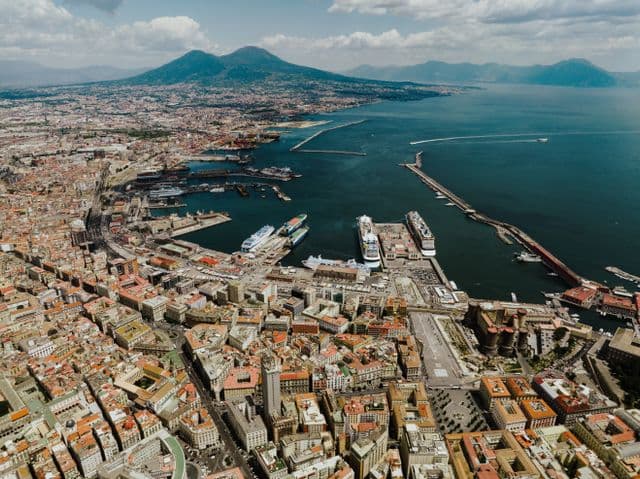
Naples does not try to be approachable. It does not try to be anything, actually; it simply is, indifferent to opinion in a way that most cities spend considerable effort pretending to achieve. The historic center, a UNESCO-listed labyrinth of narrow streets piled over Greek and Roman foundations, operates on a logic that only becomes legible after the first week. Before that it is noise, heat, scooters, and magnificence.
For digital nomads and remote workers who can tolerate ambiguity and move comfortably through organized chaos, Naples is one of the most cost-effective cities in Western Europe. A furnished one-bedroom in the Quartieri Spagnoli or Spaccanapoli area runs €600 to €900 a month. Grocery costs are low, coffee costs almost nothing, and street food is a legitimate meal strategy. The internet infrastructure has genuinely improved over the past several years, though it rewards apartment selection; older buildings in the dense historic center can be unreliable, while newer builds and co-living spaces near Chiaia and Mergellina offer solid fiber connections.
The coworking scene is small but real: a handful of spaces in the Chiaia and Vomero neighborhoods serve the local freelance and startup community. The city's creative and tech energy tends to be underground, informal, and worth finding once you are embedded enough to recognize it.
What Naples offers that nothing else does: one of the most concentrated deposits of art, history, and food culture in Europe, priced like it hasn't been discovered. That window may be closing. Best months run April through June and October through November. July and August are hot enough to reduce the appeal of the outdoor life the city otherwise provides.
Cost of living
Cost-of-living calculator
See how your budget stretches in Naples.
Estimates use approximate exchange rates and typical monthly costs. Your actual costs will vary.
- Coffee
- $1
- Cheap meal
- $9
- Coworking (day)
- $15
- Mid-range meal for 2
- $40
- Rent (1BR, center)
- $700
- Transit (monthly)
- $38
- Internet (monthly)
- $25
- Rent (1BR, outside)
- $550
EnRoute Jobs AI tool
Real Value Calculator
See what a salary actually leaves you in the country you want to live in.
Neighborhoods
Chiaia
Professionals, higher-end residential, waterfront
The elegant western neighborhood along the Gulf waterfront: the Lungomare promenade, Piazza dei Martiri as the commercial center, and a wealthier residential community. The most conventionally comfortable neighborhood for extended stays.
Vomero
Families, quieter residential, hilltop
The hilltop neighborhood above Chiaia: residential streets, the Castel Sant'Elmo for views, and a calmer environment than the chaotic centro storico. Connected to the center by funicular.
Centro Storico (Spaccanapoli)
Short stays, authentic Naples, maximum culture
The UNESCO historic center: the busiest, noisiest, most intensely Neapolitan environment in the city. Essential to visit; challenging for extended focused work. The street food and the churches are both extraordinary.
Culture
Naples is chaos, opera, and genius in equal measure: Italy's most misunderstood city and, for many Italians, its most human. It invented pizza (specifically pizza margherita, here in 1889). Its historic centre is UNESCO-listed. It produced Giambattista Vico, Enrico Caruso, and Elena Ferrante's four-novel masterpiece. Neapolitans live their lives at operatic volume on the street, and the city's rough edges (the traffic, the motorcycle scooters, the concrete housing blocks of the periphery) coexist with a depth of culture and food that can make everywhere else feel thin.
Climate & best time to visit
Hot Mediterranean: very warm summers (July 26–32°C) and mild, occasionally rainy winters (8–14°C). May and October are the optimal months for combining pleasant weather, accessible hiking (Vesuvius, Amalfi coast), and a city at full operational pace.
Best months: May, June, October
Tips & safety
- •The Naples Metro (Line 1 and 2), circumvesuviana railway, and funiculars work together; the Unico Napoli day pass covers all of them
- •Neapolitan pizza is a separate category from all other pizza; Pizzeria Sorbillo on Via dei Tribunali and Michele on Via Cesare Sersale (cash only, no reservations) are the two historical reference points
- •Monthly apartment costs in Posillipo, Chiaia, or Vomero run €700-1,200; the Quartieri Spagnoli and Piazza Garibaldi areas run lower
- •The historic center (Centro Storico) is a UNESCO site and has the best street food walking in Italy: fried pizza at Antica Friggitoria Masardona, sfogliatelle pastries, and coffee at any bar for €1
- •The Circumvesuviana train to Pompei runs every 30 minutes from Napoli Centrale; the UNESCO ruins are 40 minutes away and manageable as a half-day
- •Neapolitans eat late even by Italian standards; dinner before 8:30pm at a non-tourist-facing restaurant is unusual
- •Emergency: 112; 113 (Carabinieri), 118 (ambulance)
- •Naples has a more complex street-level security environment than Rome or Florence; heightened awareness in the historic center and near the central station is appropriate
- •Mount Vesuvius is active and monitored; current eruption risk is assessed by the Vesuvius Observatory which maintains public alerts
- •Tap water is safe throughout Naples
Areas to avoid: The Scampia neighborhood and the area around Secondigliano; these outer neighborhoods have historically been connected to organized crime activity and present a different security environment than the historic center, Handbags on the outer shoulder of the body in narrow streets; motorbike bag-snatching (scippatori) has a historical association with Naples that has reduced but not disappeared