.png)
About Luxembourg City
Luxembourg City is the capital of a country so small that its neighbors sometimes forget it exists, which is fine with Luxembourg. The Grand Duchy has built one of the world''s highest GDP per capita by becoming the banking center for European private wealth, the headquarters of the European Court of Justice, the European Investment Bank, and a third of the European Commission''s administration, and the base for steel, satellite technology, and fintech in a configuration that the country''s founders in 1815 could not have predicted.
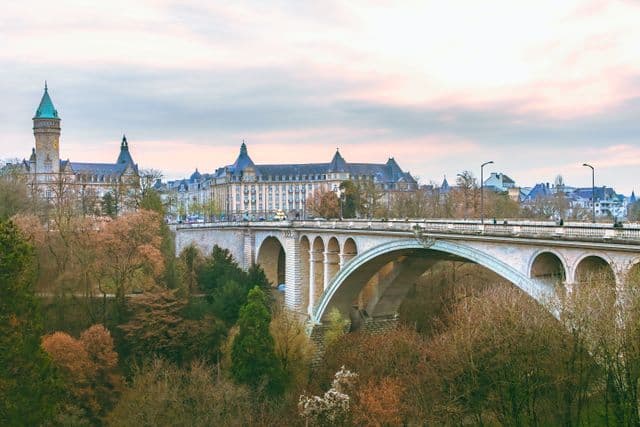
The old town, the Ville Haute on the plateau and the Grund below it in the valley carved by the Alzette and Pétrusse rivers, is UNESCO World Heritage-listed for the fortifications and the valley morphology that created a natural citadel position. The fortresses that made Luxembourg the ''Gibraltar of the North'' were partially demolished by treaty in 1867; what remains is a dramatic canyon of green valleys running beneath the city center.
For remote workers, Luxembourg offers EU access and Schengen positioning at costs that are high but not as extreme as the GDP would suggest for daily living. One-bedroom furnished apartments in the Bonnevoie or Limpertsberg neighborhoods run 1,300 to 2,000 EUR per month. The coworking market (Lux Future Lab, Nyuko, and the Luxembourg House of Financial Technology for fintech-focused operators) is growing with the country''s innovation agenda. Three borders within a 20-minute drive and direct trains to Paris, Brussels, and Cologne make Luxembourg an unusually mobile base.
Cost of living
Cost-of-living calculator
See how your budget stretches in Luxembourg City.
Estimates use approximate exchange rates and typical monthly costs. Your actual costs will vary.
- Coffee
- $5
- Cheap meal
- $18
- Coworking (day)
- $35
- Mid-range meal for 2
- $80
- Rent (1BR, center)
- $2,000
- Transit (monthly)
- $0
- Internet (monthly)
- $45
- Rent (1BR, outside)
- $1,500
EnRoute Jobs AI tool
Real Value Calculator
See what a salary actually leaves you in the country you want to live in.
Neighborhoods
Limpertsberg
Professionals, families, established residential
The residential neighborhood north of the city center: established residential streets, good supermarket access, and a quieter environment than the city center or Kirchberg.
Bonnevoie / Hollerich
Budget, diverse community, lower costs
The most affordable neighborhoods in Luxembourg City: more multicultural than Limpertsberg, lower rents, and still within cycling or bus distance of the center.
Kirchberg
EU institutions, finance sector, professional access
The European Quarter on the plateau northeast of the center: the EU institutions, major banks, and the Philharmonie concert hall. More professional than residential in character.
Culture
Luxembourg City is the capital of Europe's wealthiest country per capita: a three-valley fortified city that was one of Europe's most important military strongholds for centuries and is now one of its most important financial centres. The city's culture is shaped by extraordinary multilingualism (Luxembourgish, French, German, and English are all everyday languages) and a cosmopolitan character driven by the 47% of the population that is foreign-born, most of whom work in finance or EU institutions.
Climate & best time to visit
Temperate oceanic, similar to Belgium: mild, wet, and grey in winter (2–6°C), pleasantly warm in summer (18–24°C). May–September is the working sweet spot; the forest-and-gorge setting of the city is dramatic in autumn (October) leaf color.
Best months: May, June, July, September, October
Tips & safety
- •The Val bus network covers the city; the Eurobus to Luxembourg station from Kirchberg and the free city-center zone tram are the most useful routes
- •Luxembourg City is officially trilingual (French, German, Luxembourgish); French is the primary working language, German works in shops, English is widely understood
- •Monthly apartment costs in Limpertsberg or Bonnevoie run €1,600-2,400; Luxembourg is among the most expensive rental markets in Europe
- •The BCEE and BGL BNP Paribas banks are the two most straightforward for account setup; the documentation requirements are typical European KYC
- •Cross-border commuting is built into the city's structure; Belgium, France, and Germany are all within 30-45 minutes and many professionals base in those countries at lower cost
- •The European Court of Justice, Court of Auditors, and European Investment Bank are all headquartered here; the EU institution professional community is a significant part of the city's social fabric
- •Emergency: 112; 113 (police), 112 (ambulance)
- •Luxembourg City is one of the safest capitals in Europe; violent crime targeting visitors is very rare
- •Driving is straightforward but parking in the center is expensive; the Park+Ride system on the city outskirts is well-organized
- •Tap water is safe throughout Luxembourg
Areas to avoid: The Gare (train station) area late at night; Luxembourg City is generally safe but the station precinct has a higher concentration of late-night street activity than the rest of the small city