.png)
About Chicago
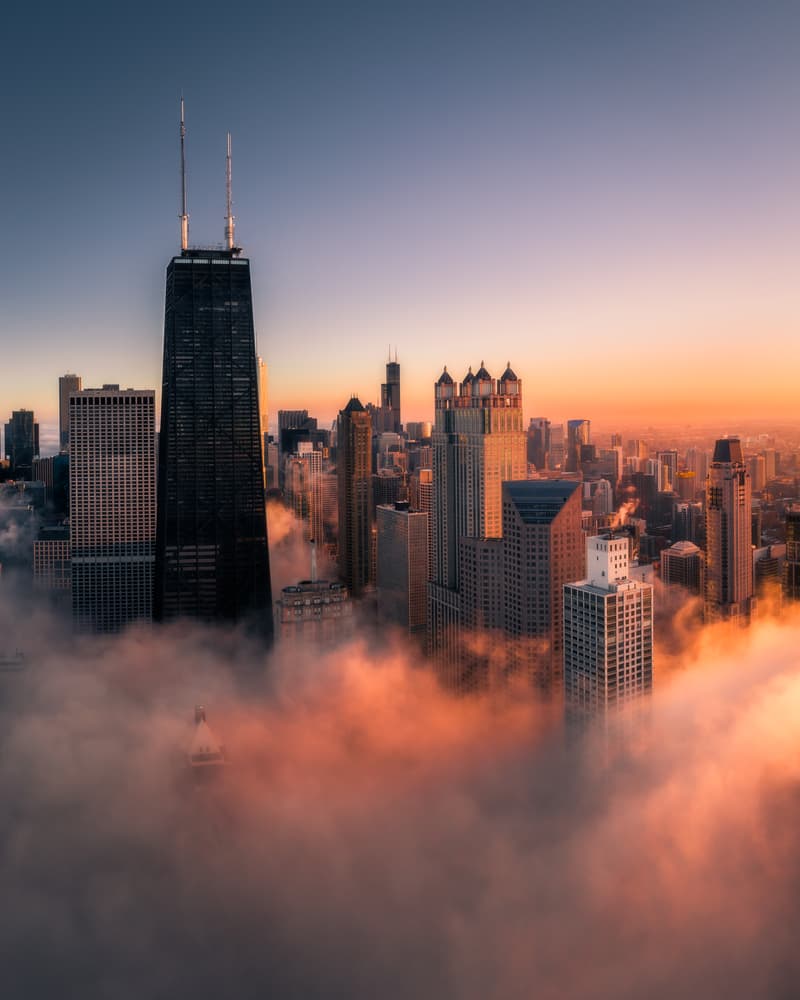
Chicago is the American city that tends to be underestimated by people who have spent more time in New York or Los Angeles, which is their loss. It is organized on the lake with a formal clarity that New York's organic growth never managed, the downtown grid anchored by the Chicago River on one end and Lake Michigan on the other, neighborhoods running outward in patterns that are navigable within weeks. The architecture, from the 1890s steel frame pioneers to the later Mies van der Rohe buildings to the current generation, is the best concentrated urban building collection in North America.
For geo-flex professionals, the numbers are competitive by US city standards. A one-bedroom apartment in Logan Square, Wicker Park, or Pilsen runs $1,600 to $2,400 a month. Coworking is well-distributed: 1871 in the Merchandise Mart, WeWork across multiple locations, and a network of independent spaces in the River North and West Loop areas serve the professional community. Connectivity is excellent throughout.
Chicago's professional culture spans finance, manufacturing, healthcare, and a genuine tech sector that has grown significantly since 2015 without migrating entirely to either coast. For remote workers in those fields with reason to maintain US professional networks, the city offers access at a lower cost than its two more famous peers.
The practical note: Chicago winters are genuinely severe. November through March requires preparation and the psychological acceptance that the temperature will occasionally make outdoor movement unpleasant. The city has spent 150 years building an interior culture for exactly these months; it largely works. Best months are May through October, when the lake effect produces the summer Chicago residents spend November through April waiting for.
Cost of living
Cost-of-living calculator
See how your budget stretches in Chicago.
Estimates use approximate exchange rates and typical monthly costs. Your actual costs will vary.
- Coffee
- $5
- Cheap meal
- $17
- Coworking (day)
- $30
- Mid-range meal for 2
- $80
- Rent (1BR, center)
- $2,200
- Transit (monthly)
- $105
- Internet (monthly)
- $55
- Rent (1BR, outside)
- $1,600
EnRoute Jobs AI tool
Real Value Calculator
See what a salary actually leaves you in the country you want to live in.
Neighborhoods
Logan Square
Remote workers, creatives, mid-range
The most active neighborhood for Chicago's independent café, restaurant, and music culture: the Milwaukee Avenue corridor, the Logan Square Farmers Market (Sunday), and a community of younger professionals and families. Blue Line access to the Loop takes 20 minutes.
Wicker Park / Bucktown
Professionals, design, nightlife
The neighborhood that established Chicago's independent creative economy in the 1990s: concentrated restaurant and bar culture on Damen and Milwaukee, boutique retail, and a professional community with a design-adjacent character. Higher costs than Logan Square.
Pilsen / Little Village
Artists, budget, Mexican culture
The Mexican cultural center of Chicago with the best tacos in the city (on 18th Street), affordable studio and live-work space, and a thriving artist community that moved in as rents were lower and has partially settled. Little Village (26th Street) is the most commercially active Mexican commercial strip in the US.
Hyde Park
Academics, families, cultural access
The University of Chicago neighborhood on the South Side: the best bookshops in the city (Seminary Co-op), the Museum of Science and Industry, and a quieter residential environment at significantly lower costs than North Side neighborhoods.
Culture
Chicago is the American city that does everything seriously: architecture (birthplace of the skyscraper and home to the world's greatest concentration of 20th-century architecture), food (deep dish pizza is genuinely a different dish from pizza, not a marketing exercise), jazz and blues heritage, and a civic culture shaped by machine politics, Saul Alinsky community organising, and Barack Obama. Chicagoans have a chip on their shoulder about New York and Los Angeles, but it is a chip worn with great pride.
Climate & best time to visit
Humid continental with extreme seasonal variation: brutal winters (January −10 to −4°C with wind chill) and hot summers (July 23–30°C). Spring (May) and autumn (September–October) are brief but glorious. The "Windy City" moniker is well-earned October–March.
Best months: May, September, October
Tips & safety
- •The Ventra card covers all CTA rail and bus; a monthly pass costs $105 and is the most efficient option for regular commuters
- •Deep dish pizza is a tourist dish in Chicago; locals eat thin-crust or tavern-style from neighborhood spots like Pequod's or Marie's Riptide
- •The Chicago Pedway is a 40-block underground pedestrian network connecting downtown buildings; useful in winter for moving between the Loop buildings without going outside
- •The Chicago Public Library (Harold Washington Library Center) provides free study rooms and meeting spaces; the Newberry Library has an exceptional map and genealogy collection free to all
- •Monthly apartment costs in Logan Square, Wicker Park, or Pilsen run $1,600-2,400; the Lakeview and Lincoln Park neighborhoods are higher
- •The Chicago Architecture Center river tour ($47) is the most educational 90 minutes you can spend understanding why the city looks the way it does
- •Winter preparedness is not optional: -15°C wind chill is common in January and February; appropriate footwear and face coverage are functional requirements
- •Emergency: 911
- •Chicago's high-profile crime statistics are almost entirely concentrated in specific South and West Side neighborhoods; the North Side neighborhoods popular with remote workers have crime rates comparable to other major US cities
- •Cold weather safety: frostbite and hypothermia are real risks in January and February; skin exposure in -15°C wind chill should be minimized and wet clothes changed immediately
- •Tap water in Chicago comes from Lake Michigan and is safe; it is one of the most reliably good municipal water systems in the US
Areas to avoid: Certain South and West Side neighborhoods (Englewood, Austin, North Lawndale) after dark; Chicago's gun violence is geographically concentrated in specific neighborhoods and visitors are rarely targeted but situational awareness matters, The Magnificent Mile during peak tourist season for regular café working; the tourist infrastructure pricing and density are impractical for productive use